
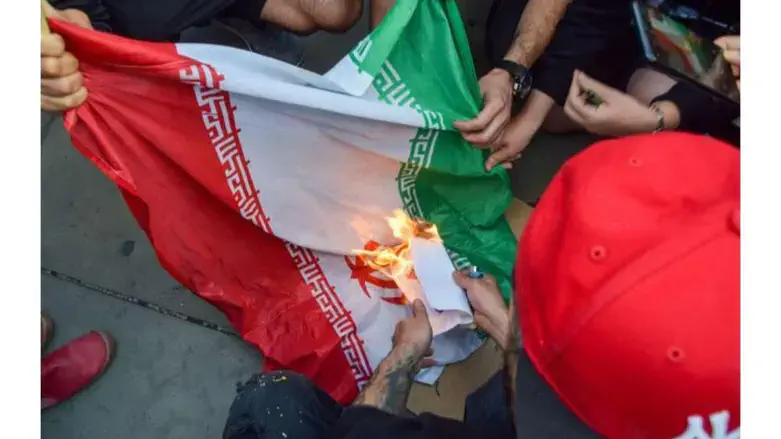
Iran today stands at a moment of profound rupture. A society gripped by despair is steadily transforming into a society defined by anger. Public resentment and deep-seated hatred toward the ruling establishment have reached a historic peak. Amid this tension, even the judiciary-under figures like Gholam-Hossein Mohseni-Eje'i-calls for more executions, while a fearful nation looks ahead to an uncertain and increasingly dark future.
Iran’s situation is chaotic, critical, and dangerously fragile. The country has fallen into darkness-an imposed silence that cannot be denied-and the ruling establishment is in a state of naked weakness and internal erosion. After the bloody suppression of protests in January 2026, and in the shadow of tensions and confrontation with the United States and Israel, there is no longer any trace of a reliable order or rule of law in Iranian society. What remains is an unvarnished image of a structure in the process of collapse.
A regime that, by shutting down the internet nationwide, seeks to bury the truth-so that the people and the families of the victims cannot share images and videos of one of the most horrific massacres of the 21st century with the world. This blackout has not only suffocated the public sphere, but has also exposed the regime’s constant obsession with controlling the narrative.
Within just 48 hours, the apparatus of repression attempted to extinguish the protests through a massacre on a shocking scale; and then, by holding staged trials in the Islamic Republic’s thuggish courts, sentenced hundreds of people to execution on fabricated charges-an ultimately desperate attempt to put out flames that are still alive beneath the ashes and continue to flare.
Although the atmosphere of censorship and suffocation is unprecedentedly heavy, the people, with great difficulty and at every opportunity, find ways to access information and news. A regime devoid of legitimacy is not accepted by society, has no justification in argument, and its discourse has reached a dead end-thus it has taken refuge in censorship. At the same time, the disruption of internet access has deprived people of the ability to show the depth of the catastrophe that has cast its shadow over the land and society of Iran.
Long-term stability in today’s Iran, more than a plausible scenario, resembles a delusion. Waves of unemployment, repression, war, and the crisis of poverty are gradually forming a mass of the dispossessed who can challenge the foundations of the government amid turbulence and chaos.
One of the direct consequences of the internet shutdown was the unemployment of thousands whose livelihoods depended on the online economy. Since January 2026, declining employment, widespread joblessness, market stagnation, waves of runaway inflation, and the shutdown of industries and production have pushed Iran’s economic condition into a deeper crisis than before.
The authorities, at enormous cost, promote a specific political message across social media and seek by any means to control the narrative; a form of organized media operation in which thousands of fake accounts simultaneously reproduce and amplify a single message.
If in the 20th century the Shiite clerical establishment used tools such as terrorism, street demonstrations, shroud-wearing, mosque pulpits, and the machinery of issuing fatwas to impose its will, today it pursues the same function through a propaganda machine and thousands of social media accounts-modern tools serving the same old logic of influence and manipulation of minds.
Alongside this, every night in the streets, with loud noise and so-called “Islam parties," they stage a display of power-a performance more symbolic than rational, akin to theatrical religious gatherings. For this regime, propaganda and deception are not merely tools, but a vital necessity-at times even more important than reality itself. Relying on the limited presence of supporters, they reflect the same image in their media apparatus and present it as a sign of legitimacy.
Although the political will of the Iranian people receives little attention in global media, in reality, i posit that Iranian society seeks regime change-a reality for which the heavy price of approximately 45,000 lives has been paid. The double-edged sword of war, executions, and repression may have given the regime a temporary breathing space, but this tense and unstable condition cannot ultimately guarantee its survival.
The reaction of parts of society to news of the killing of military and security officials is often one of satisfaction-a sign of the deep rift between the ruling establishment and the people. The dominant mindset within Iranian society is defined above all by hatred and aversion toward the structure of power. A regime that, by some estimates, may have around five percent support-support that in many cases is tied more to financial and ideological interests than to genuine public belief. If such loyalty truly exists, a simple question remains: why is the internet not opened?
The psychological condition of Iranian society seems no longer one of passive endurance; it is a volatile mix of despair and accumulated rage. The widening gap between state and society has eroded even the illusion of mutual recognition. What we are witnessing is not merely dissatisfaction, but a profound rejection of the governing order. The language of fear, once effective, now coexists with a silent but growing readiness for another confrontation-an undercurrent that cannot be indefinitely suppressed.
At a deeper level, this government is seen by many Iranians as being in opposition to national identity. In such a context, patriotism can become one of the few remaining assets of society-a determining force that plays a role of resistance against religious extremism and the structures built upon it. In this path, external developments and the actions of some international actors, including the United States and Israel, have also indirectly contributed to the removal of certain obstacles.
During the recent conflict, according to official institutions such as the Foundation of Martyrs, around 2,000 military and security personnel were killed. However, in the eyes of a segment of society, there is no clear distinction between institutions such as the IRGC, Basij, the army, and other military forces; all are seen as components of a single structure whose primary mission is to preserve the survival of the ruling system.
Ultimately, this system has not fallen-it has merely been delayed. What is called “government" today is, more than anything, a temporary condition on the edge of decline, not a sign of stability. This regime may still be alive, but it is not legitimate; it may possess the instruments of power, but it no longer controls a society that is boiling from within. The roots of this situation must be sought in years of adventurism, delusion, and the destructive thinking of rulers who have replaced the logic of survival with the logic of destruction-a structure akin to a closed cult that, rather than thinking about the future, seeks to impose its will until the very last moment. In such a framework, even a “scorched earth" scenario is not far-fetched; it is as if they prefer to leave behind a worn-out and ruined country before their collapse.
But a society that has reached this level of awareness, accumulated anger, and will, will ultimately find its path. Imposed silence does not endure, and this situation-however prolonged and costly-will not last.
At the same time, a troubling disconnect persists among certain self-proclaimed opposition figures-those who, rather than confronting the entrenched machinery of repression, direct their energies toward symbolic rivalries and historical grievances. Yet Iranian society has, in many ways, moved beyond such narrow preoccupations. It is more aware, more politically mature, and far more focused on the fundamental question of governance and national future.
In the end, history is rarely shaped by the loudest voices on the margins, but by the silent momentum of a society that has crossed an invisible threshold. Iran today may well be such a society-wounded, watchful, and waiting. And when that moment arrives, it will not be defined by slogans or factions, but by the unmistakable will of a people who have decided that silence is no longer an option.
Erfan Fard is a counterterrorism analyst and Middle East studies researcher based in Washington, with a particular focus on Iran, Islamic Terrorism, and ethnic conflicts in the region. His latest book is The Black Shabbat , published in the US. You can follow him at erfanfard.com and on X @EQFARD