
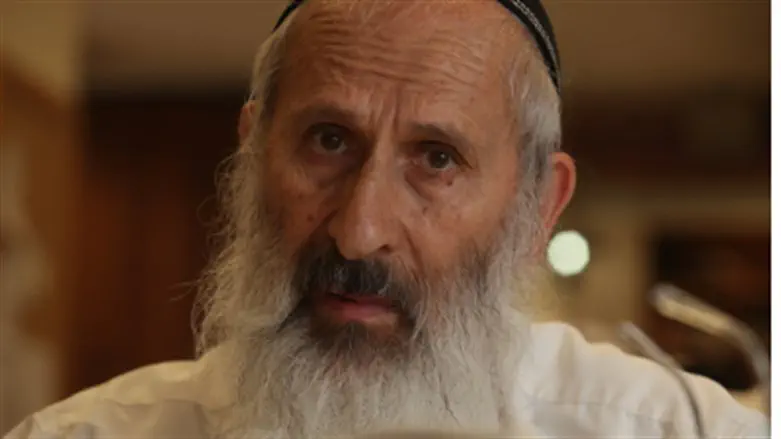
Rabbi Shlomo Aviner is Head of Yeshivat Ateret Yerushalayim.
Question: A politician once said: “War is like cholent - you know what you put in, but you don't know what comes out." Is that an accurate description?
Answer: Yes and no. One must look at war from two perspectives: from our side and from the perspective of the King of the World.
A. From our side.
According to the Torah there are two types of war: an optional war ('milchemet reshut'), to expand Israel's borders and increase its greatness and renown (Rambam, Laws of Kings and Wars 5:1); and a compulsory war ('milchemet mitzvah'), which, according to the Rambam, is the classification of all our current wars, 'the salvation of Israel from an enemy' (ibid. 5). According to the Ramban, a milchemet mitzvah is the conquest of the Land of Israel, including the defense of the Land and keeping it under Jewish sovereignty (Additions to Rambam's Sefer HaMitzvot, negative commandment 4).
Our wars today are defensive wars, wars of last resort. The name of the IDF is the Israel Defense Forces.
The Torah obligates us to go out to war in a milchemet mitzvah to save Jews from an enemy. We do not know what will the results will be. The Torah verse states: “When you go out to war" (Deut. 21:10). It does not say: when you win in war. To what is this comparable? It is a mitzvah to marry, but being blessed with children does not depend on us. The husband and wife may want children, but Hashem decides what will be. Nevertheless, we try our best, as the Gemara in Shabbat (50a) says: “When one is brought into judgment they say to him... ‘Have you engaged in procreation?'" meaning, did you endeavor to fulfill the mitzvah. And so in war - soldiers go forth to war willing to risk their lives.
In Masechet Shevuot (35b) it states: “Shmuel said: a kingdom that loses one sixth of its population does not get punished" - 'My vineyard before the thousand go, Solomon, to the kingdom of the heavens; and two hundred to guard its fruit' - to the earthly kingdom. If one-sixth of the people fell in war, the king is not punished. Shmuel learns this from the verse in Song of Songs - out of 1,200, 1,000 remained. The Tosafot there note that this refers to a voluntary war.
Rav Shlomo Goren explains: for a milchemet mitzvh there is no limit! The dead are not counted on the way to victory. But all this only to the extent that there is a likelihood of victory. If there is no likelihood, this is not considered effort, it is suicide (see the essay “The Hasmonean War in Light of Halakha" in Sefer Torat HaMoadim, pp. 178-179).
Therefore, from our side, we fulfill what is required of us according to Halakha in going to war, even though we do not know what will truly result from the war.
B. From the Perspective of the King of the World.
In the morning prayer, in the blessing “Creator of the lights," we call Hashem “the Master of Hosts." Many times, and especially in wartime, people say: “The Master of Hosts brings forth salvations." After every war, whether wars between the nations and Israel, or wars among the nations, salvation blossoms for the people of Israel, as Rabbi Kook says in Orot (see Chapter 2 on war).
But people forget the middle term in the list of Hashem’s listed attributes, “sowing righteousness." This comes to assure us there will be salvation, but when a farmer sows it takes a long time until he sees the growth. Certainly there are salvations today, but they are not yet understood.
For example, in the Gemara Shabbat (21b) regarding the establishment of Hanukkah: only “the next year they established and made days of praise and thanksgiving," meaning they saw the miracle and began to understand only after a year.
At the time of the Purim miracle, they established the festival accordingly on the days on which the Jews rested from their enemies" (Esther 9:22). The victory was outside Shushan on the 13th of Adar but they celebrated on the 14th; the victory in the capital occurred on the 14th of Adar and they celebrated on the 15th of Adar. Why did they not celebrate on the day of victory? One needs time to observe and digest what happened.
And after Israel’s War of Independence, many Rabbis instructed the public to recite Hallel on Independence Day with a blessing, but only after the Six-Day War did the broad public begin to do so. Therefore, from the perspective of the Sovereign of the World, war is not like cholent, a balagan of this and that, but a precise thing that will bring salvation to the people of Israel.
The heart aches for the fallen, for the wounded, for what the kidnapped endured, and yet, we are a heroic people, we overcame and will overcome. And we will even gain, and we have already gained. We have gained the revelation of national strengths, not new forces that did not exist but hidden inner forces of courage and kindness. We continue and fight, by God's grace upon us. And though we may not discern the triumph at first, we will continue to win.
And we pray: Master of Hosts, bring forth salvations.
[Transcribed by Rabbi Mordechai Tzion]