
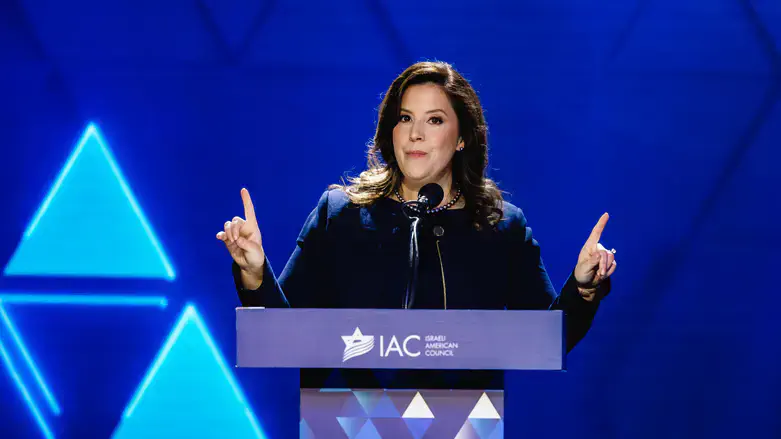
Review of Elise Stefanik, Poisoned Ivies: The Inside Account of the Academic and Moral Rot at America’s Elite Universities (New York: Threshold Editions / Simon & Schuster, 2026. ISBN: 978-1-6680-8753-4
America’s higher education system is undergoing a long-overdue reckoning. In “Poisoned Ivies," Congresswoman Elise Stefanik offers a forceful indictment of elite American universities and the culture of moral confusion, ideological conformity and institutional cowardice that now defines too much of higher education.
The book is not simply about one congressional hearing, though that hearing made Stefanik a household name among Jews and supporters of Israel. It is about the collapse of a once-trusted compact between the American people and the universities that were supposed to educate the country’s future leaders. Stefanik argues that many of these institutions have abandoned academic excellence, open inquiry and moral seriousness in favor of political activism, censorship and a rigid progressive orthodoxy.
At the center of her argument is the December 2023 congressional hearing where Stefanik questioned the presidents of Harvard, MIT and the University of Pennsylvania after the explosion of antisemitism on campuses following Hamas’s October 7 massacre in Israel.
Her question was direct: “Does calling for the genocide of Jews violate university rules on bullying and harassment?"
It should have been the easiest question of the day. Any morally sane person would have answered yes. Instead, the presidents equivocated. Their answers, in effect, were that “it depends on the context."
That phrase became the defining slogan of elite academic decay. It exposed what Jewish students had already learned the hard way: the universities that speak endlessly about safety, inclusion and harm could not bring themselves to say that calls for the murder of Jews crossed a red line.
Stefanik rightly understood the exchange not as a legal technicality, but as a moral test. The presidents failed it. They failed it publicly, arrogantly and with the world watching.
The damage was immediate. Liz Magill resigned as president of the University of Pennsylvania. Claudine Gay later resigned as president of Harvard amid the combined fallout from her congressional testimony and allegations of plagiarism. MIT’s Sally Kornbluth survived institutionally, but the reputational damage to MIT and to elite academia more broadly was done.
Stefanik’s book makes clear that this was not an isolated failure of public relations. It was the predictable result of years of institutional rot. The universities had trained themselves to speak in bureaucratic evasions. They had become fluent in the language of “harm" when politically favored groups were offended, but suddenly became procedural absolutists when Jewish students were threatened.
That double standard is one of the most important themes of “Poisoned Ivies." Elite universities have built vast administrative machines around Diversity, Equity and Inclusion. They police speech, regulate student conduct, investigate microaggressions and enforce ideological conformity. Yet when Jewish students faced harassment, intimidation and open support for terrorist violence, many administrators froze, equivocated or hid behind process.
This is not neutrality. It is selective enforcement.
Stefanik also highlights the donor revolt that followed. The Wexner Foundation ended its long relationship with Harvard. Major University of Pennsylvania donors, including powerful financial figures, threatened or withdrew enormous gifts. These were not symbolic gestures. They were market signals. The people who had funded and legitimized these institutions no longer trusted them.
That matters. Elite universities are not merely private campuses. They shape judges, diplomats, journalists, corporate leaders, policymakers and cultural gatekeepers. If the Ivy League becomes morally unserious, the consequences do not remain inside Cambridge, New Haven or Philadelphia. They spread into government, media, law, finance and international affairs.
This is why Stefanik’s intervention deserves credit. She asked one clear question and refused to let credentialed evasions pass as wisdom. She exposed the moral hollowness behind the prestige.
The Jewish community should appreciate the significance of that moment. For years, Jews have watched universities excuse anti-Zionism that curdles into antisemitism, tolerate calls for “intifada," rationalize Hamas propaganda and pretend that hostility to the Jewish state has nothing to do with hostility to Jews. After October 7, that fiction collapsed. Students and faculty did not merely criticize Israeli policy. Many celebrated, minimized or justified the worst massacre of Jews since the Holocaust.
Stefanik forced university leaders to answer for the environment they had created.
Her critics accuse her of political theater. But there are moments when theater reveals truth. The hearing did exactly that. A simple question pierced through decades of jargon. It showed that leaders of America’s most prestigious universities could not state the obvious: genocide against Jews is wrong, and calling for it should violate any serious code of conduct.
The broader lesson of “Poisoned Ivies" is that antisemitism is rarely only about Jews. It is a warning sign of civilizational decline. When institutions lose the ability to protect Jews, they usually have also lost the ability to defend truth, standards and moral order. Antisemitism flourishes where reason has been replaced by ideology and where courage has been replaced by career management.
Stefanik’s book is therefore more than a defense of Jewish students.
It is a call to restore accountability in American higher education. Universities that receive federal funds, enjoy tax benefits and claim moral authority must be held to basic standards. They cannot demand public trust while tolerating open intimidation , harassment and violence. They cannot preach inclusion while abandoning Jews. They cannot claim academic excellence while producing ideological conformity.
The rot did not happen overnight, and it will not be repaired overnight. But Stefanik’s questioning marked a turning point. It gave parents, donors, alumni, legislators and students a clear frame: the problem is not one bad statement or one bad president. The problem is systemic.
Elise Stefanik deserves credit for saying plainly what too many others were afraid to say. She exposed the cowardice of elite academia at precisely the moment when moral clarity was required. She has distinguished herself as both a champion of the Jewish people and of the nation. For that, Jews and all Americans who still care about the integrity of higher education owe her their highest respect and utmost gratitude.
Dr. Alex Grobman is the senior resident scholar at the John C. Danforth Society, a member of the Council of Scholars for Peace in the Middle East, and serves on the advisory board of the National Christian Leadership.