

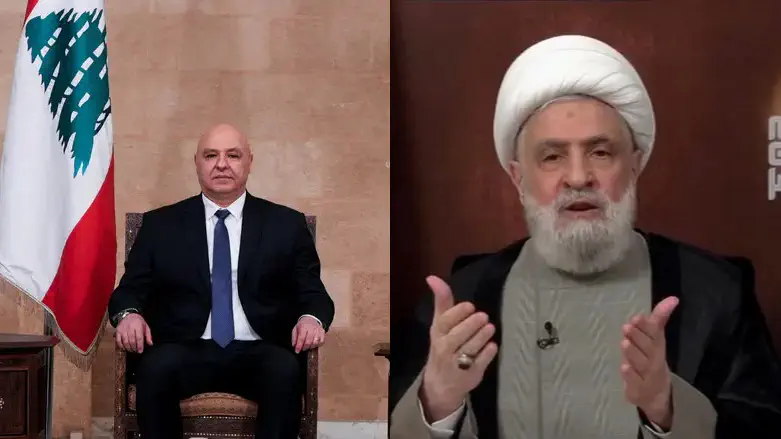
Lebanese President Joseph Aoun on Monday defended his government’s approach to direct negotiations with Israel, sharply rejecting accusations from Hezbollah and accusing those who led the country into conflict of committing “treason."
Speaking during a meeting with a delegation from the Hasbaya region in southern Lebanon, Aoun said that his objective is to bring an end to the state of war with Israel, referencing the 1949 armistice agreement between the two countries.
“My goal is to reach an end to the state of war with Israel, similar to the armistice agreement," Aoun said, asking, “Was the armistice agreement a humiliation? I assure you that I will not accept reaching a humiliating agreement."
In a response to Hezbollah criticism, Aoun questioned the group’s stance on national consensus, stating: “Those who dragged us into war in Lebanon are now holding us accountable for choosing negotiations under the pretext that there is no national consensus. My question to them is: when you went to war, did you first have national consensus?"
He added, “What we are doing is not treason. Rather, treason is committed by those who take their country to war in pursuit of external interests."
The remarks came after Hezbollah Secretary-General Naim Qassem launched a broad attack on Lebanese authorities earlier in the day, accusing them of making concessions to Israel and rejecting any form of direct negotiations.
Qassem described the negotiations as a “serious sin" and warned that such steps could push the country into a “cycle of instability."
In a statement, Qassem said, “These direct negotiations and their outcomes are as if they do not exist for us and do not concern us at all," adding, “We will not give up our weapons."
The exchange comes amid ongoing efforts to maintain a ceasefire following the latest round of fighting between Israel and Hezbollah, which began on March 2.
Following initial talks in Washington between the Lebanese and Israeli ambassadors, the first such discussions in decades, US President Donald Trump announced a ceasefire that took effect on April 17 for ten days, later extended by three weeks after a second round of talks.
Lebanese officials have repeatedly stated that the negotiations, held under US auspices, aim to end the war, secure an Israeli withdrawal from southern Lebanon, and enable displaced residents to return to their homes after more than one million people were uprooted by the fighting.
Despite the ceasefire, violations have been reported by both sides. Israeli air and artillery strikes have continued, particularly in southern Lebanon, alongside large-scale demolition operations in border towns, where Israeli forces have declared a “yellow line" separating dozens of villages from the rest of the country.
At the same time, Hezbollah breached the ceasefire, attacking Israeli troops and launching drones into Israel.
Since the ceasefire began, at least 36 people have been killed in Israeli strikes, including 14 on Sunday, according to figures based on Lebanese Health Ministry data.
Since the start of the war in early March, at least 2,509 people have been killed and 7,755 wounded in Lebanon as a result of Israeli attacks, according to the Health Ministry.