
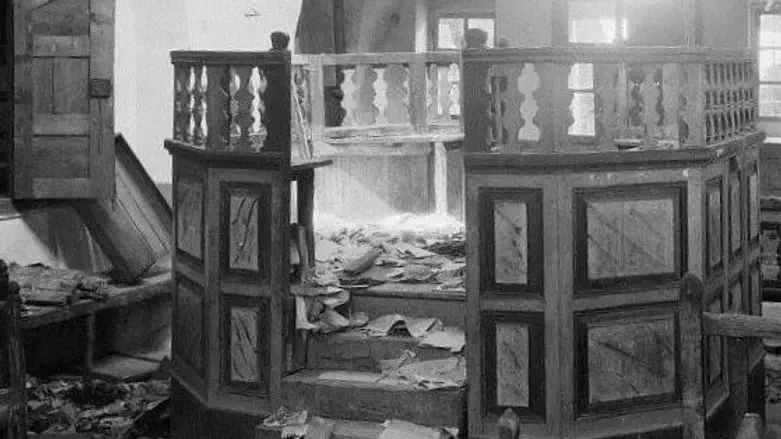
The August 1929 massacres did not begin or end in Hebron or Safed. They began in Jerusalem, around the Western Wall, when a local dispute over religious “status quo" rules was weaponized into a broader campaign of incitement.
The riots followed a period of rising friction that Colonel Frederick Kisch, head of the Palestine Zionist Executive, had already flagged to the British Colonial Office as a major threat to peace. The crisis broke on August 15, when the British allowed a few hundred Jewish youths to march to the Western Wall. Kisch viewed the march as a protest against deteriorating conditions at the site; and while the group eventually left peacefully and without any clashes, one participant’s decision to raise a Jewish flag proved irresponsible. By the next day, August 16, a fundamentally different Arab demonstration was organized, also with the government's official blessing.
The immediate spark came when Jewish worshippers placed a divider screen (to separate men from women worshipers, as is the norm in Orthodox prayer, ed.) at the Wall for Yom Kippur. Muslim leaders, led by the Grand Mufti, Haj Amin al-Husseini, a rabid antisemite, portrayed the act not as a modest religious accommodation, but as the first step in a Jewish plan to seize the Al-Aqsa Mosque. A dispute over prayer was transformed into a national and religious rallying cry to “defend the holy sites."
Kisch wrote in his “Palestine Diary" that following morning mosque prayers, a "vast crowd literally poured over the small pavement" used for Jewish prayer, where the "Shamash [who assists with running services] was beaten, and Hebrew prayer books were torn to pieces and burnt."
That is how the violence moved from agitation to pogrom. Religious language gave the campaign emotional force. Rumor and fear supplied the fuel. Within days, Jewish communities throughout Palestine (a geographic name unconnected to a people) that had lived for generations among their Arab neighbors were attacked with shocking brutality.
The Hebron and Safed massacres were the two most notorious episodes of that terrible week.
Hebron, August 24, 1929
Historian Naomi Cohen reports that the Hebron massacre began on August 24 at 9 a.m., when enraged Arab mobs attacked the Jewish community. Among the murdered were eight American students from the Slobodka Yeshiva; 15 others were wounded.
Three weeks later, a journalist who had seen the aftermath privately described the scene as an “appalling sight," adding that the attackers had “behaved like the wildest of savages untouched by the hand of civilization." Many victims were killed in the home of Rabbi Jacob Slonim, whose appeals for British protection had been “either ignored or rebuffed."
One American survivor recalled that about 40 Jews had gathered in Rabbi Slonim’s home, believing his local standing would protect them. Then the gate was breached and “savage Arabs burst through the door." Rabbi Slonim was killed first. Young men, “unarmed and unable to protect themselves," were murdered while praying. The survivor lived only because she was “buried under a load of dead bodies."
The massacre generated outrage in the United States. American witnesses accused British police of being absent or “standing idly by," while Jews who attempted to arm themselves were imprisoned. A British observer noted that although American Jews generally admired Great Britain, injustice in the Holy Land would be “quickly and actively resented."
The Palestinian Jewish press conveyed the catastrophe through graphic photographs and stark words such as “slaughter" and “butchery." And afterward, the British administration was initially reluctant to provide food rations to the 400 survivors in Hebron.
Helen Bentwich, a member of a Hadassah Medical Organization relief committee and wife of the British-appointed attorney general, described Jewish refugees being forced into “any odd hole" they could find. Eventually, the administration agreed to assist roughly 2,000 displaced Jews with food and housing.
Touring the hospitals, Bentwich saw children with “fractured skulls from being beaten with clubs and other ghastly wounds." She recorded one case in which a mother tried to shield her children, only for the attackers to “deliberately slash each child’s head" and kill her as well. Another woman lost her mind after hiding with her baby beneath corpses.
Yet Bentwich also made an important point: “many Jews were saved by their Arab neighbors, even in Hebron." The massacre was not committed by every Arab in Hebron. But it was committed by enough people, and enabled by enough official failure, to destroy one of the oldest Jewish communities in the Land of Israel.
Safed
The violence soon reached Safed. As in Hebron, a mob of local Arabs and fellaheen from surrounding villages stormed the Jewish quarter. Armed with “swords and knives," they murdered between 18 and 20 Jews and wounded roughly 80. British reports noted that after the initial slaughter, the attackers concentrated on looting and burning Jewish homes and shops.
Helen Bentwich found a devastated community that had lost all faith in the government. The Arab population, she wrote, viewed the administration with “open contempt." Arab police officers who had stood by during the “horrible atrocities" remained in their posts, while only the intervention of a Hadassah physician prevented a serious disease outbreak.
When Kisch arrived in Safed, he found “the Jews confined in the Police Barracks where they had been brought for protection, and living there under the most appalling conditions." He arranged guards for parts of the Jewish quarter that had not been destroyed and tried to persuade Jews to return home. But many were too frightened, and those who returned believed it was unsafe to leave their houses even during the day without a military escort.
“The Jewish quarter … is a terrible sight," Kisch wrote. Sephardim Street, where the attack began, had been “entirely gutted and pillaged." The attackers, he reported, were not content with shooting and stabbing their victims; they brought tins of petrol to set the area on fire. “The houses have been reduced to a mass of ruins."
Kisch also heard from an elderly Jew who recognized his attackers as neighbors with whom he had traded for years. When he protested, they continued to beat him. Kisch then saw five orphaned girls whose father, mother, and grandfather had been murdered in their presence.
By the time British forces restored control, the week of unrest had left 133 Jews and 116 Arabs dead. Most Arab casualties were killed by British police and military fire during attempts to suppress the rioting.
The British Refusal to Arm the Jews
One of the bitterest lessons of 1929 was the refusal of the British administration to arm Jewish civilians for self-defense. Norman Bentwich, the British-appointed attorney general, later criticized this policy. On August 24, the Palestine Zionist Executive formally asked Harry Luke, the deputy commissioner for Jerusalem, to enlist and arm 500 Jewish youths to protect isolated Jewish communities.
Luke refused.
His rationale was familiar: reinforcements were supposedly on the way, and arming Jews might inflame the situation. Brigadier General William Dobbie also opposed arming Jews, arguing that Britain had to maintain “impartiality" and avoid provoking the Muslim Council. Luke even disarmed and disbanded the few existing Jewish special constables, replacing them with British nationals to preserve the appearance of neutrality.
British "neutrality", in practice, meant that Jews were left defenseless while mobs attacked them. The lesson was not lost on the Yishuv. According to Cohen, the 1929 riots convinced the Jewish community in Palestine that survival could not depend on British promises. Early Haganah defense groups began developing into a more professional military force. The Yishuv continued building the economic, political, and military infrastructure that would enable Jewish statehood in 1948.
The violence spread far beyond Hebron and Safed. In Jerusalem, Mea She’arim, Yemin Moshe, Talpiot, Ramat Rachel, and the Bukharan Quarter came under attack. Outbreaks also occurred in Jaffa and in Haifa’s Hadar HaCarmel and Nachala districts. Attempts to attack Tel Aviv were blocked, but Jews in Gaza, Nablus, Jenin, Tulkarem, and Beit She’an were forced to flee under British escort.
Rural communities also suffered. Motza was evacuated after a horrific assault. Beer Tuvia, Hartuv, Hulda, Migdal Eder, Kfar Uria, and Ein Zeitim were looted, demolished, or abandoned. Mishmar HaEmek was ransacked after its residents were ordered out. Other communities, including Beit Alfa, Heftziba, Kfar Malal, Kfar Hittim, Atarot, and Neve Yaakov, stood their ground and fought off attackers.
The events of 1929 became a turning point in the Arab-Jewish conflict.
Historian Hillel Cohen has called this period “Year Zero," because it shattered the remaining illusions of peaceful coexistence and pushed both communities toward deeper political radicalization. Jews remembered the riots as unprovoked, murderous massacres. Arabs remembered them as an uprising against colonial encroachment. The Shaw Commission, presented to the British Parliament on March 12, 1930, concluded that while the immediate trigger was the Western Wall dispute, the deeper causes included Arab fears over Jewish immigration and land.
Jews Return to Hebron
In May 1931, Kisch found that more than 60 Jews-15 families-had returned to Hebron, one of Judaism's three holiest cities, leasing homes from Arab landlords outside the Old City. Despite economic depression, Jewish communal life was slowly resuming, with a new synagogue and plans for a school and clinic. Kisch also reported that King Ibn Saud had rebuked Hebronites during their pilgrimage to Mecca, demanding: “Show me in the Holy Books where you are authorized to murder Jews; God will never forgive you for what you have done!"
Kisch was deeply moved to see a 600-year-old Jewish community restored. But the restoration did not last. In 1936, during the Arab Revolt, the British again evacuated Hebron’s Jews for their safety. A permanent Jewish presence returned only after the Six-Day War in 1967, with a milestone return to Beit Hadassah in 1979.
The lesson of 1929 is not historical trivia. The pattern is painfully familiar: a false accusation about Jewish designs on Muslim holy sites, amplified by religious leadership, transformed into violence against Jews.
In 1929, as in later decades, the cry that “Al-Aqsa is in danger" was not a warning; it was a weapon.
Dr. Alex Grobman is the senior resident scholar at the John C. Danforth Society, a member of the Council of Scholars for Peace in the Middle East, and on the advisory board of The National Christian Leadership Conference of Israel. He holds an MA and PhD from The Hebrew University of Jerusalem.