

Stephen M. Flatow is an attorney and the father of Alisa Flatow, who was murdered in an Iranian-sponsored Palestinian terrorist attack in 1995. He is author of A Father’s Story: My Fight for Justice Against Iranian Terror (now available in an expanded paperback edition on Amazon.com) and is the president of the Religious Zionists of America-Mizrachi. An oleh chadash, he divides his time between Jerusalem and New Jersey.)
When Bashar al-Assad fell, policymakers in Washington and Europe made a calculated bet. Syria’s new leadership under Ahmed al-Sharaa would be given room to consolidate power in exchange for something basic: restraint, stability, and protection of minorities.
That bet is now under serious strain.
In recent months, Damascus has moved decisively to centralize authority. Kurdish-led forces that once controlled large parts of northeastern Syria-key U.S. partners in the fight against ISIS-have been pushed aside or absorbed into state structures. What is described as “integration" looks, to many on the ground, like forced consolidation.
At the same time, the security picture is deteriorating in ways that should alarm anyone who remembers how the last decade unfolded. The fragile system of detention camps and prisons holding thousands of ISIS fighters and affiliates has been disrupted by shifting control on the ground. Some detainees have been transferred; others have disappeared into the fog of conflict. Islamic State propaganda has reemerged, calling for renewed attacks and portraying the current leadership as weak and compromised.
This is not an abstract threat. It is how insurgencies regenerate.
Minority communities feel that risk most acutely. Kurdish populations now face the loss of autonomy they built at great cost. Christian and Yazidi communities-already battered by years of war and jihadist violence-are watching closely to see whether the new government offers protection or simply demands submission.
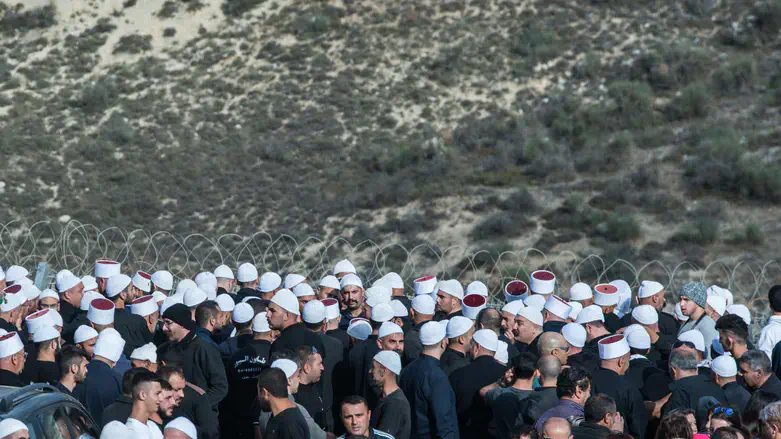
For Israel, the stakes are not theoretical. Nowhere is that clearer than in southern Syria, where the Druze community sits astride a volatile border-and where many Druze have close family ties to Druze citizens of Israel. Instability there does not remain contained. It reverberates across the border, turning distant conflict into immediate concern.
That reality has already produced action.
Earlier violence involving Druze communities in southern Syria prompted direct Israeli military intervention. Israel did not issue statements and wait. It acted-striking positions that threatened Druze civilians. Those decisions were driven by more than humanitarian concern. They reflected a hard security calculation: when hostile forces or chaos take hold near Israel’s borders, the threat is not hypothetical.
The Druze connection only sharpens that calculation. When communities under threat include people with family across the border, the pressure on Israel to act is not just strategic-it is societal. Governments can ignore distant suffering. They cannot ignore crises that reach into their own communities.
This dynamic is unlikely to fade. If anything, it is becoming more entrenched.
Israel’s position is clear. It cannot allow southern Syria to become a lawless zone where jihadist elements regroup or where minority communities are subject to intimidation and attack. Nor can it rely on assurances from a government still proving its ability-or willingness-to enforce order. That leaves Israel with a familiar conclusion: it must be prepared to act independently when necessary.
Meanwhile, in Washington, the policy response remains uncertain. Sanctions were eased. Diplomatic channels reopened. The assumption was that a post-Assad Syria would gradually move toward responsible governance. But policy built on assumptions must eventually confront reality.
And reality is complicated.
Syria today is not the fractured battlefield it once was. Authority is being reasserted. But that authority is being tested simultaneously by internal dissent, minority distrust, and the ever-present risk of jihadist resurgence. Centralization without legitimacy does not produce stability. It produces pressure.
Beyond Syria, the implications widen. ISIS affiliates remain active across multiple regions, including Africa, where extremist violence continues to target vulnerable populations. These are not disconnected theaters. They are part of a broader ecosystem of instability that feeds on weak governance and unprotected communities.
That is why developments inside Syria matter far beyond its borders.
The question now is not whether Syria’s new leadership can take power. It already has. The question is whether it can exercise power in a way that prevents the return of the forces that once tore the region apart.
That means more than defeating remnants of ISIS on the battlefield. It means securing detention systems, honoring commitments to former allies, and-most fundamentally-protecting minority populations from coercion and violence.
So far, the signals are mixed at best.
For the United States, this moment demands clarity. Engagement should not be mistaken for endorsement. Relief from pressure should not be unconditional. If expectations were set-on minority protection, on counterterrorism cooperation, on responsible governance-then those expectations must be enforced.
Otherwise, the cycle repeats.
The fall of Assad closed one chapter. The next chapter is being written now-not in speeches, but in actions taken in Kurdish towns, in Druze villages, and along a border where instability is never just someone else’s problem.
Power has been consolidated. Trust has not been earned.
And along Israel’s northern border, where Druze families span both sides, instability is never distant. If Syria’s new rulers cannot secure that frontier, Israel will-because for Israel, the defense of its borders and the protection of vulnerable communities are one and the same.