
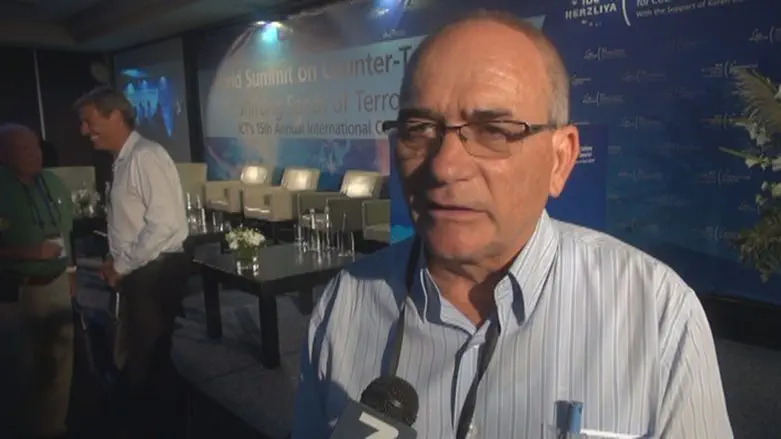
When I was a member of the Israeli team that met with the Obama administration ahead of 2015 nuclear negotiations with Tehran, we warned the U.S. team not to allow Iran to continue enriching uranium, since that would ultimately give rise to a nuclear crisis posing an existential danger to Israel and the West. Instead, Washington and the five other world powers negotiating with Iran 11 years ago capitulated to demands that Tehran continue enriching uranium. Even the minimal restrictions agreed to on paper were due to lapse by 2030 - making the Iran nuclear deal less a solution to a foreseeable global threat than a safe path for Iran to develop a large arsenal of nuclear weapons.
Tehran hasn’t been idly waiting for 2030 to roll around. After the U.S. pulled out of the deal in 2018, Iran accelerated the development of its military nuclear program, accumulating sufficient quantities of highly enriched uranium to produce fissile material for at least 10 nuclear bombs within months. Iran also expedited its production rate of highly enriched uranium and began preparations for weaponizing it, at long last prompting the International Atomic Energy Agency to declare Iran in breach of its non-proliferation obligations.
In addition to developing nuclear material, Iran has also increased its production of long-range ballistic missiles, which it used in the U.S.-Israel war with Iran in March to attack civilian population centers, civilian infrastructure and military bases across the Middle East. In addition to the damage the missiles can inflict on their own, they are also a critical component of Tehran’s nuclear program, as they are capable of delivering nuclear warheads to any target not only in the Middle East, but also to the parts of western Europe, Asia and Africa that lie within a 4,000-kilometer (2,500-mile) radius of Iran.
The March war has made it extremely difficult for Tehran to move forward with its development of either nuclear weapons or long-range ballistic missiles, and at the same time severely weakened Iranian military capabilities and fanatic Iranian leadership.
These goals were accomplished by striking not only nuclear facilities, which were the primary focus of the June 2025 war with Iran, but also by attacking the nuclear and ballistic missile supply chain: factories producing the explosives, the steel structure of the missiles, the navigation systems and the fuses, along with many launch sites.
Many Iranian military command posts and bases were hit, as were many IRGC leaders, who were replaced by progressively weaker and less experienced figures lower down in the hierarchy. In addition, the Iranian air force and navy, along with its air defenses, were severely impaired.
What’s next for Iran?
The March war has brought us closer to denying Iran the capability to produce nuclear weapons - exactly the goal that the Israeli team I was on had urged the U.S. to pursue back in 2015. Yet while the U.S. and Israel achieved - and in some cases exceeded - the direct and measurable goals of the war within six weeks, there are other significant objectives that have not yet been achieved. If a cease-fire leads to an agreement, then the war is over.
Iran must give up its military nuclear program and deliver to the U.S. the 450 kilograms of highly enriched uranium the Iranians already have, as well as the uranium enriched at lower levels, and guarantee they will not enrich more uranium in the country. Pledges alone are not enough, of course, and must be monitored by the U.S. and the International Atomic Energy Agency.
In addition, Iran must not be allowed to produce long-range ballistic missiles that are capable of carrying nuclear warheads, and must reopen the Strait of Hormuz for free and unimpeded shipping.
Finally, any negotiation with Tehran must ensure that Iran is no longer able to continue supporting its terror proxies, including Hamas in Gaza, the Houthis in Yemen - and Hezbollah in Lebanon, which joined Iran in attacking Israeli civilians and is infringing on the Lebanese government’s sovereignty over the use of force in its own country.
These objectives must be met because in spite of the heavy damage inflicted on its leadership, military and security apparatuses, the Iranian regime has remained in power and continues to function.
Iran has maintained the capability to launch missiles and drones towards Israel and the Gulf states throughout the war, has deterred Iranian civilians from renewing the protests that left thousands massacred by the IRGC earlier this year, has closed the Strait of Hormuz, and has coordinated missiles attacks with its proxies.
If the cease-fire doesn’t lead to an agreement, it remains possible that the war could resume. The failure of the first round of talks has already prompted the Trump administration to announce a blockade of the Strait of Hormuz, to pressure the regime without causing a lasting damage to Iran's infrastructure. In addition, it’s still possible that the U.S. and Israel will carry out their threat to hit Iranian power plants and oil facilities, and if this does not work, then boots on the ground may be needed to achieve what air strikes alone cannot.
The March war has given the world a rare and fleeting window of opportunity. Iran’s nuclear and military capabilities have been diminished, its leadership has been weakened, and its proxies are feeling the heat. But the history of negotiations with Tehran has repeatedly shown that without ironclad guarantees, verified by rigorous international oversight, any agreement risks becoming another roadmap to the very outcome it was meant to prevent. This time, the United States and Israel must not repeat the mistakes of 2015.
The conditions for a durable, enforceable agreement have never been more favorable - but only if we have the resolve to demand nothing less than full compliance. The alternative is a world in which Iran eventually crosses the nuclear threshold, and no amount of military strength will be able to undo what the world has the power to prevent right now.
Yossi Kuperwasser, a retired Israeli brigadier general, leads the Jerusalem Institute for Strategy and Security. He is a former head of the research division of the Israel Defense Forces’ military intelligence directorate and director-general of the Israeli Ministry of Strategic Affairs.