

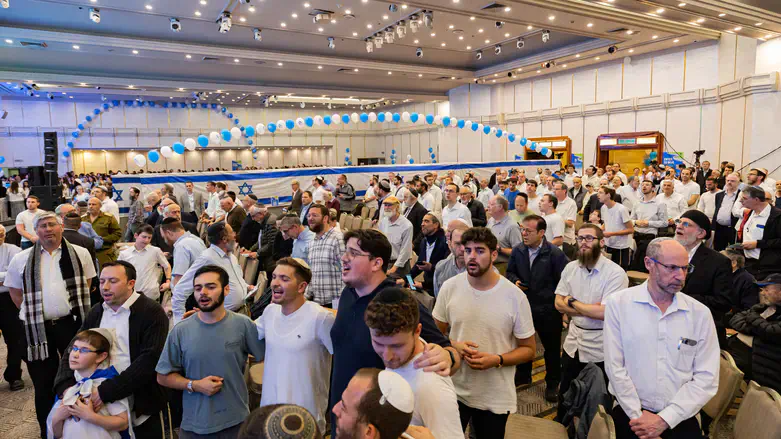
Just hours after the siren of Yom HaZikaron pierced the heart of the nation, more than 2,000 people gathered Tuesday night at the Ramada Hotel in Yerushalayim for OU Israel’s Yom HaAtzmaut tefillah and celebration, in an evening that captured the pain, faith, gratitude, and unbreakable spirit of Medinat Yisrael.
The crowd was made up largely of English-speaking olim and students, but what filled the room was something far greater than demographics. It was the sound of a nation carrying memory and hope at the same time. In one room stood every generation of Jewish life in Israel: a 102-year-old Holocaust survivor dancing and davening, parents holding infants, teenagers singing with full hearts, students swaying arm in arm, and families celebrating the miracle of the Jewish state while honoring those who made that miracle possible.
Among those in attendance were OU Israel Executive Director Rabbi Avi Berman, OU Israel Director of Torah Initiatives Rabbi Sam Shor, OU Israel President Rabbi Stuart Hershkowitz, and Jerusalem Deputy Mayor Arieh King.
The evening began with a moving ceremony marking the transition from Yom HaZikaron to Yom HaAtzmaut, that uniquely Israeli passage from heartbreak to resilience, from tears to thanksgiving.
Sima Kellner, Director of OU Israel’s Yachad Israel program for English-speaking individuals with special needs, shared the story of her nephew, Maoz Morrell Hy"d, who fell in battle. Her words brought the room into that sacred space Israelis know so well: the place where private loss becomes part of the national story.
“When we made aliyah three years ago, I was excited to have the opportunity to connect with my nephews, not just occasionally, but in a deep way," she said. “Maoz was quiet, and I thought it would take time. Unfortunately, a deep face-to-face acquaintance never fully happened. But after his fall, I discovered so much about who he was. Maoz was determined. He planned everything with precision and lived with purpose.
“When he went to fight in Gaza, he brought with him a small Mesillat Yesharim, which he kept in the front of his vest. When others went to sleep, Maoz would open the book and learn. He was there for 95 days, until the day a grenade was thrown into the room where his team was stationed. He continued providing cover while others were being treated, until he himself was wounded. Maoz will not have children, but if others take from his character, from his legacy, then he does continue in this world."
Rabbi Avi Berman opened the evening by reflecting on the extraordinary privilege of celebrating the State of Israel while carrying the memory of those who gave their lives for it.
“In these days, I look at the prosperity and miraculous growth of the State of Israel, thanks to those who have given their lives to defend it," Rabbi Berman said. “We celebrate tonight because of them, in their merit, and with gratitude to the Ribbono Shel Olam, who gave the Jewish people the strength, devotion, and faith to be worthy of the gift of Medinat Yisrael.
“I am certain each of us had a meaningful Yom HaZikaron. We drew strength from this day, and now we carry that strength with us as we thank our heroes, the soldiers of the IDF, all security personnel, and those who gave their lives so that we could live here in this extraordinary country."
Jerusalem Deputy Mayor Arieh King, who came directly from military reserve duty, spoke powerfully about the contradiction that defines Israeli life.
“It was important to me to come from the military base not far from here and take part in this moving event," he said. “Just a few hours ago the siren sounded. I met the wives of friends buried on Har Herzl, and now we are about to celebrate and dance. This contradiction is the character of the People of Israel and the State of Israel. On one hand, the Kotel and the missing Beit HaMikdash, and on the other, skyscrapers. From darkness to light, that is our definition."
Following the ceremony, the evening rose into a powerful and deeply emotional musical tefillah led by Rabbi Shlomo Katz, rabbi of Shirat David in Efrat. What followed was not merely a service, but an outpouring of soul.
The room came alive with singing that swelled from every corner. Voices rose together in Hallel, in prayer, in gratitude. People danced with a joy that did not ignore the pain of the day, but emerged from it. This was the sound of a people who know what they have lost, and exactly why they must continue to sing.
There was something breathtaking in the sight itself: generations joined together, strangers singing like family, young and old moving to the same rhythm, hearts lifted in thanks to Hashem for the gift of Jewish sovereignty in Eretz Yisrael. A 102-year-old Holocaust survivor danced in the same room as a two-week-old baby. Survivors, soldiers’ families, olim, students, and children all stood together in a living portrait of Jewish continuity, resilience, and faith.
At the conclusion of the tefillah, the shofar sounded, and the crowd burst into song and dance, filling the hall with the words “L’Shanah Haba’ah B’Yerushalayim." It was not a slogan. It was a declaration. A room full of Jews, in Yerushalayim, singing with tears, gratitude, and fierce hope for the future of Am Yisrael.
Rabbi Sam Shor, Director of OU Israel’s Torah Initiatives, reflected on the significance of the annual event.
“For the past nine years, we have had the privilege of hosting this special evening of tefillah, song, and gratitude," he said. “It is an opportunity to pause and recognize the tremendous gift of living in this period of Jewish history, and to thank Hashem for the privilege of contributing to aliyah, absorption, and the spiritual growth of the English-speaking community in Israel.
“It is my personal privilege to be part of the OU and to help create meaningful moments like this for our community. Each year, this gathering reminds us of who we are, what we are building, and the extraordinary blessing of being part of the unfolding story of Medinat Yisrael."
In a year marked by pain, sacrifice, and uncertainty, the evening was a powerful reminder that the spirit of the Jewish people remains alive and unshaken. The dancing was real. The tefillah was real. The gratitude was real. And so was the message that filled the room from beginning to end:
They will never break our spirit.