


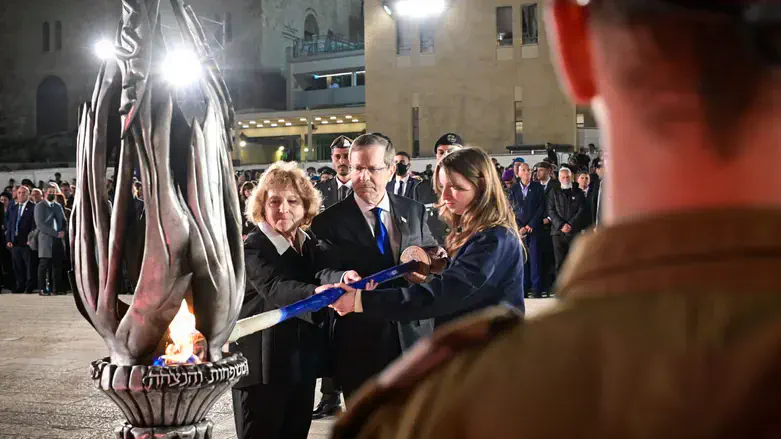
President Isaac Herzog on Tuesday addressed the official State Ceremony on the eve of Memorial Day for the Fallen Soldiers of Israel’s Wars and Victims of Terror at the Western Wall in Jerusalem, centering his remarks on the memory, sacrifice, and spiritual legacy of Israel’s fallen.
Opening with the story of Major (res.) Dr. Eitan Menachem Neeman, Herzog recounted how the Soroka Medical Center physician rushed to save lives on October 7 and then insisted on answering the call for reserve duty. Herzog described how Neeman fell in battle near Sderot after charging forward against terrorists, and related how his family later learned he died while gripping a live grenade thrown at his unit.
Herzog linked Neeman’s story to a liturgical poem recovered from the Cairo Geniza, written by Rabbi Natan ben Yeshua upon the death of his son nearly a thousand years ago, saying a thread of pain and creation binds generations together. Quoting the ancient text, Herzog cited the words, “Weeping, I weep," as an expression of personal grief interwoven with national memory.
The President offered a prayer for IDF soldiers and security forces, saying the nation stands behind them while Israel remains in the midst of a campaign. He said war is a national test being met with determination and resolve, while expressing gratitude to members of the security forces, emergency services, and rescue teams.
Reflecting on the silence that follows battle, Herzog described the grief borne by bereaved families, speaking of the silence of parents, spouses, children, and grandchildren left with absence. Addressing bereaved families directly, he said he stood before them “in sacred awe" and asked permission, on behalf of the nation, “to sit with you, to be with you, to weep with you."
Herzog said the land has been filled with the images and words of the fallen, describing memorial stickers and personal messages left behind as a “sticker song" and “the song of the departed soldiers." He said those who fell fought for the right of the people “to carry the song of life."
Throughout the address, Herzog highlighted the writings and lives of fallen soldiers, including Captain Be’eri Hazak, Staff Sergeant Adi Odeya Baruch, Master Sergeant Zechariah Pesach Haber, and Sergeant First Class Maher Khatar, presenting each as part of what he called “A Song of Soldiers." He cited Be’eri Hazak’s plea, “Please enhance the power of Your signals," and quoted Adi Odeya Baruch’s words, “I want you to celebrate life, and not mourn my death."
Herzog said these soldiers represented thousands of fallen women and men whose deeds, writings, and creations left behind spiritual treasures. “The sword is a tool in our hands," he said, “but the spirit is the purpose that guides us," emphasizing that the spirit of the nation is what Israel fights for.
Quoting Arik Einstein’s “A Song After a War," Herzog said every generation rewrites an ancient song of soldiers, adding that this generation must dare to dream of the day after the war and “write the song that comes after the war." He said this generation deserves “a song of hope."
Turning to the theme of national unity, Herzog cited the words of fallen Lieutenant Ivri Dickshtein about rising together from different places as one people. He said Israel is a nation with “one song, a song of many voices," and warned that history teaches danger grows when voices silence one another, while the nation rises when voices sing together.
At the Western Wall, where generations of soldiers have been sworn into the IDF, Herzog called on the nation to vow never to forget the fallen and to continue “to sing the song of life."
Concluding, Herzog said the memory of the fallen should be a blessing and prayed that “the song of their lives be bound in our hearts, our souls, and our spirits for all eternity."