
Gaza is a devastated territory that needs to be reconstructed. It is a necessary humanitarian project that will require tons of concrete and billions of donor dollars. But beneath the rubble of Gaza lie layers of history stretching back four millennia, and much of that history is unmistakably, undeniably Jewish.
This is an archaeological fact, ensconces in the Talmudic record, and documented communal memory. Gaza has four thousand years of Jewish history and memory. What follows is a powerful American parallel worth considering.
For most of the twentieth century, the United States government refused to formally acknowledge what history made plain: that Native American tribes had legitimate, documented claims to lands from which they had been expelled by force, their communities destroyed, their sacred sites built over, and their presence erased from the official narrative.
The Jewish connection to Gaza begins in the Torah itself. The patriarch Isaac dug wells in Gerar, the ancient region between Be'er Sheva and Gaza. The territory was allotted to the tribe of Judah. Samson's story plays out against the backdrop of Gaza's gates and its Philistine temple. The Hasmonean leader Yonatan conquered Gaza in 145 BCE, and his brother Shimon resettled Jews there. That resettlement was not temporary - it was the beginning of a Jewish community that would persist, with interruptions, for over two thousand years.
During the Talmudic period, Gaza was a major center of Jewish life. The city boasted a renowned yeshiva, and the Talmud mentions a Jewish village in the area called Kfar Darom - "the southern village" - as a settled, inhabited community (Sotah 20b).
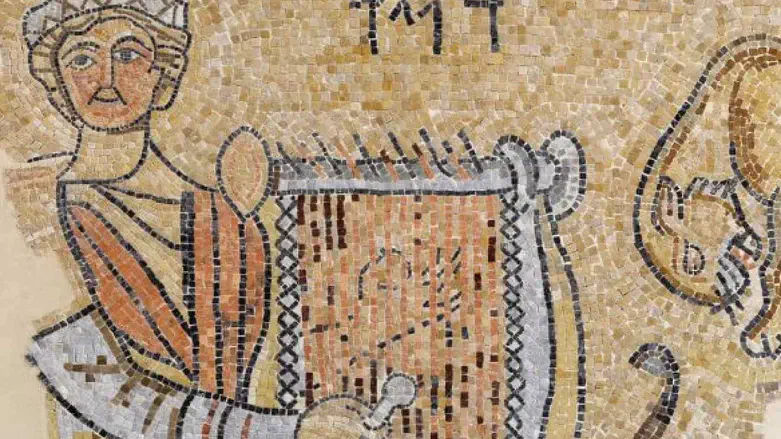
Near the ancient harbor of Gaza-Maiumas, archaeologists in 1965 unearthed a magnificent sixth-century synagogue with a stunning mosaic floor depicting King David playing his lyre, his name inscribed in Hebrew above him. An inscription in Greek records that the mosaic was donated by "Menachem and Yeshua sons of Yishai, lumber merchants, as a sign of admiration for the holiest site." That synagogue's mosaic - carefully preserved - now sits in the Museum of the Good Samaritan in the West Bank, a refugee from the land it once graced.
During the Byzantine period, when Jews were unfairly barred from Jerusalem, Gaza alongside Tiberias became one of the primary pilgrimage destinations for Jews from across the land. A Karaite source records: "From the four corners of the land, they came to Tiberias and Gaza." Even the Great Mosque of Gaza - still standing until recently - incorporated a pillar bearing carved Jewish symbols: a lulav and etrog, a shofar, a menorah, and Hebrew inscriptions, physical evidence that the mosque was built on or with stones from an ancient synagogue. That artifact was reportedly destroyed by nationalist Arabs following the 1987 Intifada.
The Jewish quarter of Gaza - known in Arabic as Harat al-Yahud, the Jews' Quarter - was a living, vibrant community in the Ottoman period. It produced towering figures. Rabbi Yisrael Najara, composer of the beloved Shabbat hymn Yah Ribbon Olam, served as Gaza's chief rabbi and died there in 1625, buried in the city's Jewish cemetery. Rabbi Avraham Azoulai fled an epidemic in Hebron and spent his final twelve years in Gaza, writing his kabbalistic masterwork Chesed l'Avraham there. Nathan of Gaza, the brilliant but ultimately tragic prophet of the Sabbatean movement, made Gaza in the 1660s the center of Jewish mystical ferment felt across the entire Diaspora.
The last indigenous Jewish community in Gaza City was expelled not by armies, but by rioters. In August 1929, as Arab mobs massacred the Jews of Hebron, the British Mandate authorities - worried that Gaza's Jews would suffer the same fate - forcibly evacuated Gaza's remaining fifty or so Jewish families. They were never allowed to return.
Nineteen years later, the Egyptian army overran the Gaza Strip and occupied it. Nineteen years after that, Israel liberated it in the Six-Day War. And between 1970 and 2005, twenty-one Jewish communities were rebuilt in the Gaza Strip - agricultural settlements that grew insect-free vegetables for export, built schools and synagogues, raised children in the dunes. They were called Gush Katif.
In August 2005, Ariel Sharon's government forcibly evacuated those nine thousand Jews from their homes. The greenhouses they left behind as a goodwill gift to Gaza's Arab population were burned. The synagogues were razed. Jewish graves were exhumed and removed before the withdrawal. The rest is history - Hamas seized power in 2007, and Gaza descended into what it became: a terror statelet that launched rockets, dug tunnels, and culminated in the massacre of October 7, 2023.
The Present Moment: A Window and a Warning
The Gaza peace plan, which the Trump administration proposed in October 2025, entered its first phase when Israel and Hamas agreed to a ceasefire, supported by a UN resolution that November. The plan has now shifted to its second phase, after Israel confirmed in January 2026 that Hamas had returned the remains of the last hostage from the October 7 attacks, fulfilling the terms of the first phase. Council on Foreign Relations
The framework now being constructed - however imperfect and incomplete - represents the first genuine international architecture for a post-Hamas Gaza since the October 7 attack. The plan calls for complete demilitarization of the Gaza Strip, including the destruction and prevention of rebuilding of military, terror, and offensive infrastructure, as well as the permanent decommissioning of weapons from non-state armed groups. This framework is likely a vain hope, but if it does happen, United Nations Interim governance would be handled by a technocratic Palestinian Arab committee overseen by a new international body called the "Board of Peace," with former UK Prime Minister Tony Blair playing a significant role - managing redevelopment until a reformed Palestinian Authority can assume control. FDD Action
This would be a moment of genuine possibility. But it will be squandered if the Jewish historical and moral claim to Gaza is not placed on the table alongside every other consideration. Here is what a possible genuinely responsible, historically grounded rebuilding plan could look like.
A Practical Framework for Rebuilding Gaza - With Justice for Its Jewish Past
Phase One: Complete Demilitarization as the Non-Negotiable Precondition
Gaza must be verifiably disarmed. Only after verifiable demilitarization should Israeli forces withdraw from Gaza and let reconstruction of the razed and battered Strip begin in earnest. This is elementary logic. Communities cannot be rebuilt in a war zone. An International Stabilization Force must have real teeth, real enforcement authority, and real accountability to Israel's legitimate security interests. Demilitarization benchmarks must be independently verified, not self-reported.
Phase Two: Archaeological and Heritage Preservation Before Construction
Before bulldozers move a single load of rubble, an international team of archaeologists - including Israeli, American, and other experts - must survey the entire Gaza Strip for sites of historical significance. The ancient synagogue site at Gaza-Maiumas must be protected. The location of the historic Jewish quarter must be identified and marked. The site of Kfar Darom - known today as Wadi as-Salqa - must be catalogued. Gaza sits on top of thousands of years of human history, much of it Jewish, and the rebuilding process must not pave over what the war did not destroy.
This would be a prerequisite for any honest reckoning with Gaza's past - and therefore with its future.
Phase Three: Internationally Supervised Governance with Zero Tolerance for Incitement
The Board of Peace framework must condition reconstruction funding on the elimination of antisemitic and anti-Israel incitement in Gaza's educational curriculum, media, and public discourse. This was the condition that was never enforced in the Oslo years, and the omission was catastrophic.
The Palestinian Authority has stated it is committed to changing school curriculum as part of its reform program. Wikipedia That commitment must be legally binding, internationally monitored, and tied directly to aid disbursement - dollar for dollar.
Phase Four: The Right of Jewish Return Must Be on the Table
The Torah itself commands: צֶדֶק צֶדֶק תִּרְדֹּף לְמַעַן תִּחְיֶה וְיָרַשְׁתָּ אֶת הָאָרֶץ - "Justice, justice shall you pursue, so that you may live and possess the land" (Devarim 16:20). That charge is not merely procedural. It is a moral imperative that applies here.
This should be stated plainly rather than avoided. Jews were expelled from Gaza in 1929, in 1948, and in 2005. Their communities, their cemeteries, their synagogues, their agricultural enterprises - all were destroyed. The argument that Jews cannot or should not live in Gaza is the acceptance of ethnic cleansing as a permanent fact. A truly just rebuilding plan must, at minimum, acknowledge the right in principle of Jewish return to Gaza, and create legal and security frameworks under which it could eventually be exercised.
This does not mean immediate resettlement under current conditions - that would be reckless and dangerous. But it means that the "Board of Peace" framework and any long-term governance arrangement must not assume that Gaza is and always will be Judenrein. The Talmudic community of Kfar Darom, the kabbalists of Harat al-Yahud, the farmers of Gush Katif - they all have successors who would return if conditions permitted. That aspiration deserves a voice.
Phase Five: Economic Development Tied to Coexistence
The United Nations predicts the cost of reconstruction in the territory will reach approximately $70 billion, with an estimated 90% of buildings in Gaza damaged or destroyed. That staggering investment - which will come primarily from Gulf states, international donors, and the United States - must be conditioned not just on governance reform, but on demonstrated coexistence.
The agricultural model of Gush Katif - which produced world-class, export-quality produce in the desert and employed Arab workers alongside Jewish ones - is a good template. Technology, agriculture, and trade can flourish in Gaza, as they once did. But they require security, rule of law, and the absence of a terror state as the governing authority.
It took generations of legal battles, the Indian Claims Commission Act, the American Indian Religious Freedom Act, and ultimately a broader cultural reckoning before Washington began - imperfectly and incompletely - to recognize the rights of Native American, restore some lands, and acknowledge the historical record honestly. No one argued that acknowledging Native American claims meant dismantling modern American cities.
Acknowledgment and practical coexistence proved compatible.
The Jewish people's connection to Gaza is similarly documented - in the Talmud, in archaeology, in the accounts of medieval travelers, in the living memory of families expelled as recently as 2005 - and it deserves the same honest reckoning that America, however belatedly, extended to its own indigenous dispossessed.
To rebuild Gaza while pretending that history began on October 7th, or in 1948, or at any other convenient starting point, is not peace-making. It is the perpetuation of a very old lie.
The Navi Zechariah commanded: אֵלֶּה הַדְּבָרִים אֲשֶׁר תַּעֲשׂוּ דַּבְּרוּ אֱמֶת אִישׁ אֶת רֵעֵהוּ אֱמֶת וּמִשְׁפַּט שָׁלוֹם שִׁפְטוּ בְּשַׁעֲרֵיכֶם - "These are the things you shall do: speak truth to one another, render judgments of truth and peace in your gates" (Zechariah 8:16). A peace built without truth is no peace at all.
Rabbi Yaakov Emden ruled centuries ago that Gaza is an intrinsic part of the Jewish people's national heritage. "Gaza and its environs are absolutely considered part of the Land of Israel," he wrote in Mor U'ketziyah. "There is no doubt that it is a mitzvah to live there."
The world is now in the business of rebuilding Gaza. Billions of dollars will be spent. International institutions will draft governance frameworks. Technocrats will design infrastructure. But if all of that proceeds without acknowledging the four-thousand-year Jewish story embedded in that land - without protecting its archaeological remnants, without demanding coexistence as a condition of aid, without leaving open the door for Jewish return - then it will not be rebuilding. It will be the final erasure.
Gaza's future must be built on truth. And the truth is that the Jews were there first, returned again and again, and were expelled each time by force. A just and durable peace requires something more than concrete and a Board of Peace. It requires honesty about what Gaza is, what it was, and what - with courage and vision - it could yet become.
The author can be reached at yairhoffman2@gmail.com.