
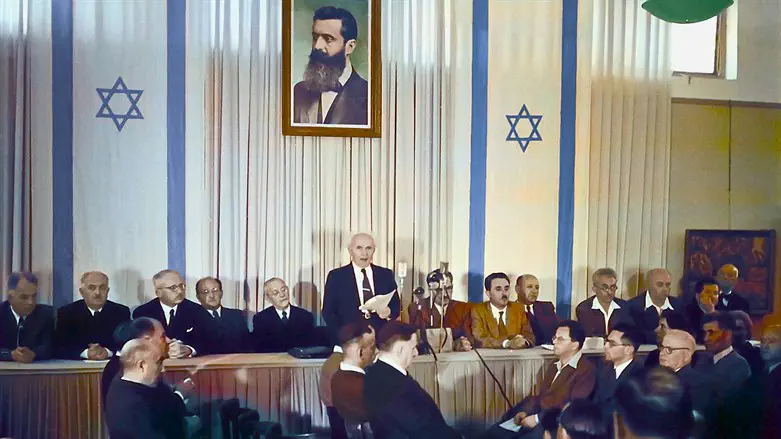
There are moments in Jewish history when an event is so immense that ordinary language seems inadequate to describe it. The proclamation of the State of Israel on the 5th of Iyar 5708 - May 14, 1948 - was one of those moments.
For Jews in Tel Aviv, Jerusalem, New York, and London, the establishment of the first Jewish state in nearly 2,000 years was greeted with jubilation, prayer, and disbelief. But for the shattered remnants of European Jewry-for the survivors who had emerged from ghettos, camps, forests, and hiding places-the meaning of Israel’s rebirth was even more profound. For them, Jewish sovereignty was not a political abstraction. It was the final refutation of Hitler.
Among those who witnessed this extraordinary moment was U.S. Army Chaplain Lt. Col. Oscar M. Lifshutz, an officer responsible for Jewish affairs who visited displaced persons camps in postwar Europe. His account of what occurred at Camp Riedenberg in Salzburg, Austria, on May 18, 1948, deserves to be remembered, because it captures not only the emotion of that hour, but the civilizational meaning of Israel’s birth.
Lifshutz arrived at the camp four days after David Ben-Gurion proclaimed the establishment of the State of Israel in Tel Aviv. What he encountered was no ordinary gathering. In the parade grounds of an old, run-down former German barracks, there was shouting, dancing, and celebration. The Jewish displaced persons-people who only a few years earlier had been hunted, degraded, starved, and marked for annihilation-were dancing openly.
Even more striking, the American Military Police who had been guarding the camp were dancing the hora with them.
That image alone tells a remarkable story. The Jews of Europe, who had so recently been reduced to numbers, had once again become a people.
And the soldiers of the United States, whose country had helped defeat Nazi tyranny, were joining them in their joy.
Then something even more moving occurred.
A jeep carrying officers pulled up to the gate. A colonel stepped out and made his way toward the flagpole. Lifshutz greeted him and asked how he could help. The colonel’s answer revealed that he understood, at least in part, the historic and even biblical significance of the moment.
According to Lifshutz, the officer told him: “This is a great day for you Rabbi, and I am here to see to it that we are going to do things in the right way."
When Lifshutz asked what he meant, the colonel replied with striking candor: “Rabbi, I am a Christian and I feel that I, too, have had a hand in helping to bring the Children of Israel to the Promised Land. I want to tell my children that I helped a people find a homeland. I have been away from my home for three years to regain freedom for all people. And, I am going to ask you, as a Rabbi, to help me do something."
He then ordered two MPs to the flagpole. At the command of a lieutenant, the soldiers stood at attention as the American flag was slowly lowered. Folded with military precision, it was handed to the colonel, who then presented it to the camp leader with words that deserve to be remembered:
“Please remember us. Remember, will you, that a lot of my men fought and died to achieve this day. I am proud to have the honor to present you with this flag of my country, the United States of America, as a symbol of freedom."
What happened next was the answer to centuries of Jewish powerlessness.
The camp leader signaled to one of the refugees, who brought forward a large wrapped package. It was opened slowly. Inside was a large blue-and-white flag. Two refugees attached it to the halyard and began to raise it. As it climbed the pole and caught the wind, it unfurled in full view.
There, Lifshutz recalled, “almost within the shadow of Hitler’s Retreat area, flew the flag of Israel in all its majestic glory."
That phrase should stop us cold.
Not far from the machinery of Nazi evil, not far from the continent that had become a vast Jewish graveyard, the flag of the Jewish state was now flying openly. The Germans had sought to erase the Jewish people from history. Instead, the Jewish people had returned to history as a sovereign nation.
When the lieutenant again ordered everyone to attention, the DPs stood taller and sang Hatikvah. This was not merely the singing of an anthem. It was the vindication of a people who had survived when survival itself seemed impossible. Lifshutz wrote that when the final notes ended, he felt “as if a sacred prayer had just been sung by a celestial choir."
He then watched as the colonel dismissed his men, climbed back into the jeep, and said to him: “Carry on, Chaplain. I envy you today. Thanks for helping me."
But the most unforgettable part of Lifshutz’s testimony came in the final scene. As the jeep disappeared in a cloud of dust, he looked at the camp leader and the DPs. They were all staring upward at the flag. Their faces were wet with tears. Then he realized that he, too, was crying.
“I was a witness," he wrote, “to the rebirth of Israel."
That is exactly what he was witnessing-not simply the birth of another nation-state, but the rebirth of the Jewish nation after an assault that was meant to end Jewish history forever.
Too often, Israel’s establishment is discussed in sterile diplomatic language, as though it were merely a UN vote, a legal declaration, or a geopolitical event. It was all of those things, but it was far more. For the survivors in the displaced persons camps, Israel was the answer to exile, helplessness, and slaughter. It was proof that Jewish blood would no longer be ownerless. It was the restoration of Jewish dignity, Jewish agency, and Jewish hope.
That is why this scene in Salzburg matters. It reminds us that Israel was born not in comfort, but in the immediate aftermath of catastrophe. It arose while the ashes of European Jewry were still warm. It was not a colonial enterprise, nor a political convenience, nor an historical accident. It was, for those who had every reason to despair, the visible sign that the Jewish people lived on.
The tears at Camp Riedenberg were not only tears of grief. They were tears of astonishment, gratitude, and redemption. A people that had been marched to the pits now stood at attention beneath its own flag.
And that is a sight no honest student of history should ever forget.
Excerpted from Miriam Braver Lifshutz, The World is My Pulpit: The Amazing Life of Remarkable Rabbi, Chaplain (Lt. Col.) Oscar M. Lifshutz. The late rabbi and rebbetzin’s son, Ira M. Lifshutz, and his family live in Englewood, New Jersey.
Dr. Alex Grobman is the senior resident scholar at the John C. Danforth Society, a member of the Council of Scholars for Peace in the Middle East, and serves on the advisory board of the National Christian Leadership Conference of Israel. He lives in Jerusalem.