
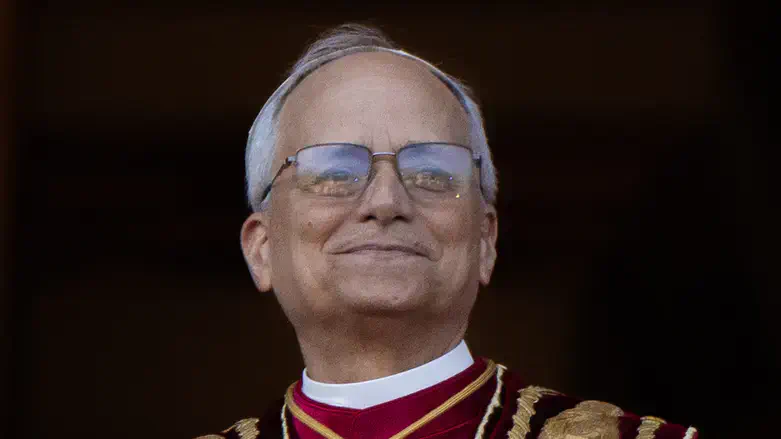
At a moment of extraordinary geopolitical peril, when the specter of a nuclear-armed Iran looms ominously over both the Middle East and the broader international order, the voice of moral authority should be unmistakably clear. It should distinguish between aggressor and defender, between tyranny and those who resist it, between regimes that brutalize their own citizens and nations that struggle-often imperfectly-to preserve freedom and security.
Instead, Pope Leo XIV has chosen a path of moral equivocation.
His public criticism of President Donald Trump and the American-Israeli campaign against Iran has not merely urged caution or restraint but has, troublingly, blurred the essential distinctions that define this confrontation. In doing so, the pontiff risks diminishing the gravity of the threat posed by the Iranian regime and, more broadly, undermining the very principles he seeks to uphold.
To understand the stakes, one must begin with an unvarnished assessment of Iran itself.
This is not a conventional state pursuing ordinary geopolitical interests.
It is a theocratic regime that has, for decades, governed through repression, violence, and ideological extremism. The numbers alone are staggering: more than 1,600 executions in 2025, the highest figure in decades, averaging more than four per day. These are not aberrations; they are manifestations of a system that crushes dissent with ruthless efficiency.
Nor is Iran’s brutality confined within its own borders.
It has systematically armed and financed proxy groups across the region, fueling instability from Lebanon to Yemen. Even Gulf Arab states-hardly prone to rhetorical excess-have described Iran’s actions as posing an “existential threat," citing its expanding arsenal of missiles and drones.
Most alarming of all is the regime’s unwavering pursuit of nuclear capability.
Iranian leaders have repeatedly invoked the destruction of both Israel and the United States in their rhetoric. These are not idle threats. They are declarations that, if paired with nuclear weapons, would transform the global security landscape in profoundly dangerous ways.
A moral voice confronting such a regime should begin here-with clarity, not ambiguity. Yet Pope Leo XIV’s intervention has, by many accounts, done the opposite.
Rather than articulating the fundamental difference between a regime that oppresses its own people and destabilizes its neighbors, and the nations seeking to counter that threat, the Pope's language has flattened the moral terrain. In emphasizing the dangers of war without equally emphasizing the nature of the adversary, he risks creating a false equivalence-one that obscures rather than illuminates.
This is not to argue that military action is beyond reproach or that the conduct of war should escape scrutiny. On the contrary, any use of force must be subject to rigorous moral evaluation.
But moral evaluation requires context. It requires acknowledging that sometimes the preservation of peace demands confronting those who systematically undermine it. History offers sobering reminders that inaction in the face of aggression can carry consequences as grave as action itself.
Nowhere is this dynamic more acute than in Israel.
For the Jewish state, the Iranian threat is not abstract. It is immediate and existential. Iranian-backed forces have entrenched themselves along Israel’s borders. Missiles and rockets have been aimed at its cities. And the prospect of a nuclear-armed Iran represents a danger that Israeli leaders-across the political spectrum-have consistently described as intolerable.
In this context, the decision to confront Iran is not merely a matter of strategic preference. It is, in the eyes of the majority of Israelis, a matter of survival.
That reality deserves recognition, particularly from those who claim to speak with moral authority on matters of war and peace.
The Vatican’s engagement with questions of Jewish sovereignty and security carries a long and complex history. For much of the 20th century, the Holy See opposed the establishment of a Jewish state and delayed formal recognition of Israel until 1993. Theological reservations about Jewish national claims persisted for decades, shaping the Church’s approach to Zionism and the Middle East.
Equally significant are the historical debates surrounding the Church’s response to the Holocaust. Scholars, including Pulitzer Prize-winning historian David Kertzer, have examined the actions and inactions of Pope Pius XII, raising difficult questions about the extent to which the Vatican spoke out against Nazi atrocities in real time.
These historical episodes form part of an institutional memory that cannot be entirely separated from contemporary perceptions.
When the Vatican speaks about Israel, it does so against this backdrop-one that demands particular sensitivity and clarity.
This is why Pope Leo XIV’s intervention invites scrutiny.
Would his critique have been as forceful, as immediate, if the conflict in question did not involve Israel? Would the moral urgency he has displayed have been directed with equal intensity toward the Iranian regime itself, given its record of repression and aggression?
These are not questions posed lightly. They arise from the observable imbalance in emphasis: a willingness to condemn the conduct of those confronting Iran, coupled with a relative reluctance to articulate the full extent of Iran’s culpability.
Consistency is the cornerstone of moral authority. Without it, even well-intentioned statements risk being perceived as selective or incomplete.
The role of a global religious leader is not to endorse military campaigns or political agendas. It is to provide ethical guidance that transcends immediate circumstances. But such guidance must be grounded in reality.
It must recognize that there are regimes whose actions fundamentally violate the principles of human dignity and international order. It must acknowledge that confronting such regimes may, at times, require difficult and imperfect choices.
Above all, it must avoid the temptation to equate all sides in a conflict when the underlying realities are profoundly unequal.
The confrontation with Iran represents one of the defining challenges of our time. It is a test not only of military and diplomatic strategy, but of moral clarity.
Pope Leo XIV had an opportunity to articulate that clarity-to condemn unequivocally a regime that executes its own citizens, threatens its neighbors, and pursues capabilities that could imperil the world. He could have coupled that condemnation with a call for restraint, accountability, and the protection of innocent life.
Instead, his intervention has left too much unsaid and too much indistinct.
In an era when the line between aggression and defense can be obscured by rhetoric and complexity, moral voices must strive to illuminate rather than blur. The stakes-for Israel, for the region, and for the broader international community-demand nothing less.
Fern Sidman, a former NY correspondent for Arutz Sheva, is the current editor-in-chief of The Jewish Voice, a New York based publication. Her writings can be accessed at tjvnews.com