

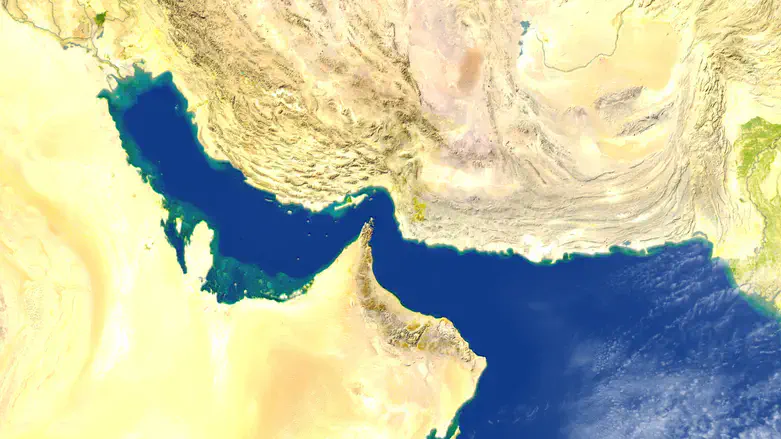
The current confrontation with Iran did not emerge in a vacuum. Iran’s move to close the Strait of Hormuz, the narrow artery through which a significant share of global energy flows, triggered a predictable response. The United States imposed a naval blockade on Iranian maritime trade, attempting to shut down the country’s economic lifeline.
From Washington, the messaging has been confident, at times overly so. Officials and commentators aligned with the Trump Administration have suggested that the pressure will bring Iran “to its knees" within a short period.
That expectation is the problem.
Not because the blockade lacks power, it clearly does. But because the strategy is being judged on a timeline it is unlikely to meet.
A blockade is not an instant weapon. It is a slow instrument of pressure. It works over time, not overnight.
The Map Explains Both Power and Time
Iran’s port system appears diversified, but is in fact highly concentrated. At first glance, the map shows multiple ports near the Strait, with names such as Shahid Rajaee and Bahonar, while Bandar Abbas itself does not appear.
This can be misleading.
These are not separate ports. They are terminals of the same system, the port complex of Bandar Abbas, Iran’s primary maritime gateway.
In reality, Iran does not have many interchangeable ports. It has one dominant gateway, surrounded by smaller and less capable alternatives.
This concentration explains why the blockade can be powerful.
It also explains why it takes time.
The Blockade Extends Beyond the Strait
The strategy does not stop at controlling the Strait of Hormuz.
It extends to the entire maritime system.
Ports outside the Strait, such as Chabahar Port on the Gulf of Oman, are also subject to pressure and monitoring. Southern ports such as Bushehr Port and Khorramshahr Port cannot function freely at scale under sustained enforcement.
Even northern routes through the Caspian Sea, including Bandar Anzali and Amirabad Port, face indirect constraints. The Caspian is a closed basin, dependent on transit through other countries such as Russia and regional partners, which limits its effectiveness as a true alternative.
In other words, the blockade is not confined to a narrow chokepoint. It applies pressure across Iran’s available maritime options.
That is what makes it powerful.
Why Chabahar Is Not a True Alternative
Some argue that Iran can shift its trade to Chabahar Port, located outside the Strait on the Gulf of Oman. On a map, this appears to solve the problem.
In reality, it does not.
Chabahar is not designed to replace the role of Bandar Abbas. Its capacity is significantly smaller, and even with expansion, it cannot handle the volume of trade that flows through Iran’s primary gateway.
The limitations are not only about size.
Chabahar is geographically distant from Iran’s main economic centers, which are concentrated in the western part of the country. That distance requires long overland transport routes to move goods inland.
This creates a second constraint, infrastructure.
Rail links and transport corridors connected to Chabahar are incomplete or underdeveloped, making large scale logistics slower, more expensive, and less reliable.
A third constraint is external dependency.
Unlike Bandar Abbas, which is fully integrated into Iran’s domestic system, Chabahar depends on foreign investment, international cooperation, and stable external conditions. Sanctions and geopolitical pressures have repeatedly limited its development and use.
The result is clear.
Even without any blockade, Chabahar functions as a supplement, not a substitute.
Chabahar does not fail because it is blocked. It falls short because it was never built to replace the system it is meant to substitute.
Why the Pressure Builds Slowly
Iran’s vulnerability is not only economic, it is fiscal.
A large share of government revenue, roughly one third to one half in normal conditions, comes from oil exports, most of which move by sea.
A blockade therefore strikes at the state’s primary source of income.
But this pressure does not produce immediate results.
Governments adjust. They reduce spending, shift burdens internally, and reprioritize resources. Trade does not disappear, it contracts, reroutes, and adapts.
Economic systems degrade over time. They do not collapse overnight.
The inability to replace Bandar Abbas explains why the blockade can inflict serious damage. It does not mean that damage produces immediate collapse.
The Real Risk Is Not Failure, It Is Impatience
The strategy can work.
A sustained blockade can reduce revenue, constrain imports, and create increasing internal pressure. Over time, that pressure can translate into leverage.
But only over time.
The greater risk is not that the blockade fails, but that it is judged too early.
If expectations are set for rapid collapse, and if that collapse does not occur quickly enough, pressure will build not on Iran, but on the strategy itself.
Calls will emerge to abandon the approach, to escalate prematurely, or to declare failure.
In that sense, unrealistic expectations can defeat a strategy that is otherwise viable.
A Note on Expectations
By presenting the blockade as a short term maneuver leading to a quick solution, the Trump Administration creates a strategic self-inflicting vulnerability.
If results take time, and they will, the gap between expectation and reality can generate internal dissatisfaction and pressure to stop before the strategy has matured.
A more effective approach is to align expectations with the nature of the tool.
Not rapid collapse, but sustained pressure.
Not immediate victory, but gradual leverage.
The model is not triumphalism. It is closer to the tone of Winston Churchill in WWII, who prepared his public for endurance rather than speed.
What Does Winning Look Like?
Not collapse. Not surrender.
Winning is leverage, but leverage must produce results.
Negotiations alone are not success. Negotiations without outcomes can become a tool for delay.
A successful outcome requires:
- No nuclear weapons capability
- No enrichment path to nuclear weapons
- Destruction of long range missiles and an end to missile development
- An end to support for proxy forces and terrorism
- Restoration of free navigation through the Strait of Hormuz and the Red Sea
These outcomes take time.
The Bottom Line
A blockade can work.
It is powerful. It is broad. It reaches beyond the Strait to Iran’s alternative ports and routes.
But the outcome is not instant.
It is a strategy of endurance.
Success will not be determined by how quickly pressure is applied, but by how long it is sustained.
In this case, the decisive factor is not only control of the sea.
It is control of expectations.
Dr. Avi Perry is a former professor at Northwestern University and a former researcher and executive at Bell Labs. He served as Vice President at NMS Communications and represented the United States on the UN International Telecommunication Union (ITU) Standards Committee. He is the author of the thriller novel “72 VIRGINS", and of “Voice Quality Engineering in Wireless Networks." Recently, he published “Unlocked: A Practical Guide to Learning and Applying Artificial Intelligence (AI) to Solve Real-World Problems" as well as “A Winner’s Playbook: How to Win by Spotting and Using the Rules Governing Human Behavior," practical rules that guide the path to success. He is a regular op-ed contributor to The Jerusalem Post and Israel National News