

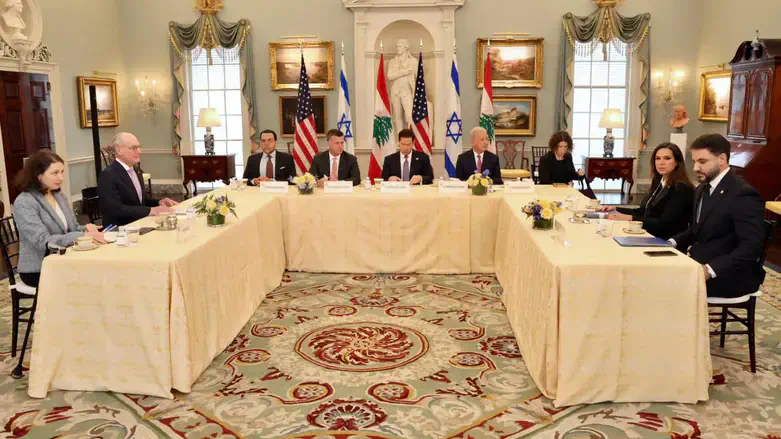
Lebanese-Israeli talks under US auspices have resulted in agreement on a framework that falls short of a formal ceasefire but is expected to pave the way for negotiations aimed at disarming Hezbollah and advancing toward bilateral peace.
According to a report by Lebanese newspaper Annahar, the meeting between Lebanese and Israeli representatives, held with US mediation, opened the door to discussions that could eventually develop into peace negotiations. The reported framework seeks to address shortcomings of the November 2024 ceasefire agreement, which did not achieve its primary objective of disarming Hezbollah and failed to ease the impact of ongoing Israeli military activity on Lebanese civilians.
The 2024 agreement, brokered by the administration of previous US President Joe Biden, was initially seen as having stronger prospects than other regional ceasefire arrangements, due in part to the role of the Lebanese government. However, over time, disagreements emerged, particularly regarding a defined timeline for disarmament. The Lebanese government was slow to task the army with establishing a plan to monopolize weapons, while the army avoided direct confrontation with Hezbollah.
Annahar reported that Israel also declined to withdraw from areas it controls and continued military operations against Hezbollah, contributing to the collapse of the ceasefire arrangement.
The report noted that the earlier agreement included mechanisms supervised by Washington, such as intelligence-sharing through the Lebanese army and dispute resolution channels between the sides. Despite these elements, the core issue of disarmament remained unresolved, with neither the army nor the political leadership taking sufficient steps to enforce it.
Following renewed fighting lasting several weeks, diplomatic efforts have resumed with an agreement to hold further talks. Recent strikes on Beirut reportedly strengthened the Lebanese government’s position, leading to the deployment of the army in the capital in an effort to establish it as a demilitarized zone. The Lebanese president also moved forward with the negotiations despite attempts to obstruct them.
A key point of contention remains the issue of military operations. Lebanon is seeking a ceasefire to alleviate humanitarian conditions and support negotiations, while Israel has rejected halting operations without progress on limiting weapons in the hands of Hezbollah.
Despite these differences, both sides are said to have an interest in reaching a compromise. The report indicated that a limited arrangement could be achieved, potentially involving restrictions or a temporary suspension of Israeli operations in certain areas for a defined period, placing pressure on the Lebanese army to demonstrate effectiveness.
Sources cited by Annahar suggested that disarmament efforts could begin in northern areas before moving southward, alongside an expanded role for US monitoring mechanisms and the inclusion of field elements to oversee implementation.
In parallel with security discussions, the talks may also address broader issues between the sides, potentially leading in an initial stage to normalization. However, the report noted that achieving full peace would be challenging and dependent on favorable regional conditions.
The renewed negotiations are viewed as an opportunity for US diplomacy to secure a political achievement amid stalled talks with Iran and a lack of progress in Gaza. According to Annahar, reaching an agreement will require diplomatic flexibility, including commitments on restricting weapons, limiting military operations, and launching parallel security and political negotiations.