

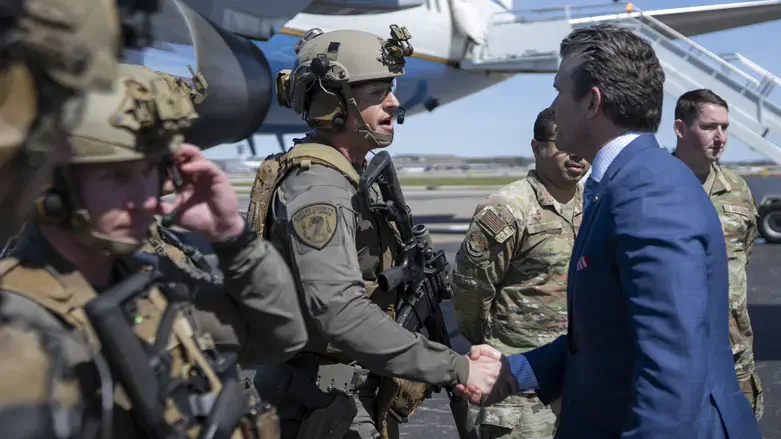
The Pentagon is preparing to deploy thousands of additional troops to the Middle East in the coming days, as the Trump administration increases pressure on Iran amid ongoing tensions in the region.
US officials cited in a report by The Washington Post said the deployment includes approximately 6,000 personnel aboard the aircraft carrier USS George H.W. Bush and its accompanying warships. An additional 4,200 troops assigned to the Boxer Amphibious Ready Group and the 11th Marine Expeditionary Unit are expected to arrive later this month.
The reinforcements are set to join roughly 50,000 US personnel already involved in operations aimed at countering Iran, as a two-week ceasefire approaches its scheduled expiration on April 22.
President Donald Trump has also announced a maritime blockade targeting Iranian ports, seeking to compel Tehran to reopen the Strait of Hormuz and halt its nuclear program as part of negotiations led by Vice President JD Vance. Talks stalled over the weekend, though the administration has indicated they could resume in the coming days.
According to The Washington Post, the expanded US naval presence will provide military commanders with additional operational flexibility should diplomatic efforts fail. The buildup is expected to bring the number of US aircraft carriers in the region to three, alongside multiple warships positioned to enforce the blockade.
The USS Abraham Lincoln has been operating in the region since January, while the USS Gerald R. Ford arrived in the eastern Mediterranean earlier this year. The USS George H.W. Bush is currently en route and expected to join them.
The Boxer Amphibious Ready Group departed Hawaii last week and is also heading toward the region. Its Marine unit includes more than 800 infantry personnel, as well as helicopters and landing craft.
US forces have already begun intercepting vessels suspected of supporting Iran as part of the blockade. Officials said that in the first 24 hours, six merchant ships were stopped and redirected back to Iranian ports without incident.
Military officials have acknowledged that such operations carry risks, including potential confrontations with Iranian forces. Boarding missions, in particular, are considered hazardous due to the possibility of armed resistance or attacks using drones or fast-moving boats.
President Trump warned that any vessels approaching US forces could face immediate destruction, referencing existing maritime enforcement tactics.
Officials also indicated that contingency planning is underway for possible escalation, including potential ground operations inside Iran. Options under consideration reportedly range from targeted missions involving special operations forces to broader deployments aimed at securing strategic locations.
Current and former officials noted that while enforcing the blockade presents logistical challenges, ground operations would carry significantly greater risks, including the likelihood of casualties.
The Pentagon and US Central Command declined to comment on the developments.