

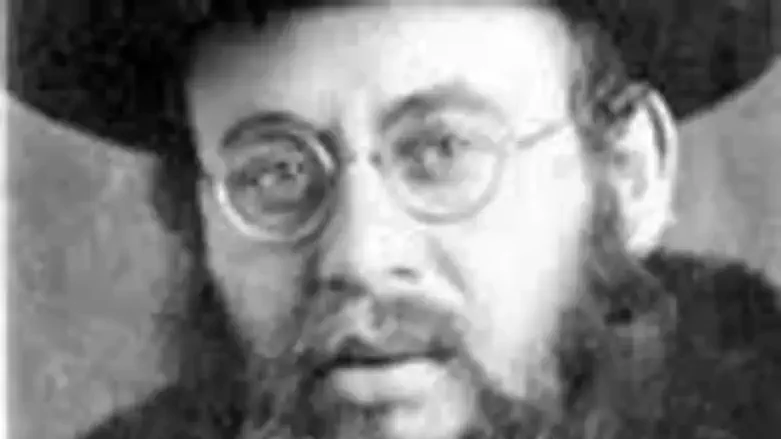
The holy Tzaddik, Rabbi Yisachar Shlomo Teichtel HY"D wrote the book “Eim HaBanim Smeichah" from where this article is excerpted. Rabbi Teichtal was a leader of the then ant-Zionist Hassidic community in Hungary, and was murdered while being transported in a crowded railway car from Auschwitz to the death camp Mauthhausen. Once a fierce anti-Zionist, he realized his error when he was forced to go into hiding during the Holocaust. Without any books whatsoever, he reviewed the entire Torah with his extraordinary photographic memory and reached the conclusion that, “The sole purpose of all the afflictions which smite us in our exile is to arouse us to return to our Holy Land…."
Excerpted from the Second Introduction to “Eim HaBanim Semeichah," translated by Rabi Moshe Lichtman:
The purpose of this work is to raise our Land from the dust and stimulate love and affection for it in the hearts of our Jewish brethren, young and old alike, so that they may yearn and strive to return to our Land, the Land of our forefathers, and leave the lands of exile. The Midrash states this explicitly, “It is preferable to dwell in the deserts of Eretz Yisrael than the palaces of the Diaspora" (BeReishit Rabbah 39:8).
Furthermore, the sole purpose of all the afflictions which smite us in our exile is to arouse us to return to our Holy Land. This can be inferred from the story of King David and the plague, when God sent him Gad the prophet. And Gad came to David...and said to him, “Go up and establish an altar to the Lord" (II Shmuel 24:18). The Midrash explains: This can be likened to a father who beat his son, but the son did not know why he was being punished. After the beating, the father said, “For several days I have been commanding you to do something, and you have ignored me. Now go and do it!"
So too, the thousands who fell in the days of David died only because they did not demand the building of the Beit HaMikdash. From this we can derive a kal vachomer. If they, in whose days the Beit HaMikdash was neither built nor destroyed, were punished for not having demanded its construction; then we, in whose days the Beit HaMikdash was destroyed..., certainly [deserve punishment], for we do not mourn nor supplicate (Midrash Tehillim 17).
Rashi on Hoshea (3:5) cites the following: R. Shimon ben Menassiya said: “The Jewish people will not be shown a good sign until they once again request the kingdom of Heaven, the kingdom of the House of David, and the rebuilding of the Beit HaMikdash. As it is written, Afterwards, the Children of Israel will return and seek out the Lord their God and David their king...(ibid.)."
In truth, our desire to return to Eretz Yisrael encompasses these three elements. Firstly, “He who dwells in Eretz Yisrael is like one who has a God" (Ketuvot 110b). Also, the rebuilding of the Beit HaMikdash will occur (with God’s help) when we assemble in Eretz Yisrael, as explained in Megillah (17b-18a). Afterwards, Mashiach, who represents the kingdom of the House of David, will arrive, as I will demonstrate in this volume. First and foremost, though, we must strive to return to Eretz Yisrael and then, with God’s help, we will attain these three objectives.
We only truly cling to God in Eretz Yisrael
The Tosefta comments on the verse And I will truly implant them in this Land [with all My heart and with all My soul] (Yirmiyah 32:41): If they are not upon the Land, they are not truly implanted before Me, neither with all My heart nor with all My soul (Tosefta, Avodah Zarah 5:4).
It is striking that the Holy One blessed be He says that when the people of Israel are not in Eretz Yisrael they do not cling to His heart and soul. Therefore, we should not be astonished by what has happened to us in our times, or by the lack of Divine Providence that we are experiencing, for we live in the lands of the nations, and we do not cling to God’s entire heart and soul. However, when we strive to return to Eretz Yisrael, we will immediately cling to His entire heart and soul.
One who strives to go to Eretz Yisrael is considered as if he is already there.
The Kuzari explains that even though Chazal say that the Shechinah does not reside outside the Land (Mo'ed Kattan 25a), it did rest upon Yechezkel, because he prophesied for the sake of Eretz Yisrael. Rabbeinu Chayim, the brother of the Maharal of Prague, expresses a similar idea in his Sefer HaChayim. He writes that even though we maintain that those who die outside the Land will be resurrected only after suffering the pain of rolling through underground tunnels, nonetheless, he who strives to move to Eretz Yisrael but dies outside the Land, will be spared this pain. He is considered as one who resided in Eretz Yisrael and will, therefore, be resurrected in an upright position. Our master, the Mabit, concurs with this view in his work Beit Elokim.
Thus, he who sets his eyes and heart upon moving to Eretz Yisrael is considered as if he is already there. It follows, then, that if we dedicate our thoughts to return to our Holy Land we will immediately cling to God’s entire heart and soul. His Divine Providence will keep a watchful eye over us to rescue us from our enemies and bring success to our endeavors. We will go up joyously to Zion, and the Children of Israel will go forth with a high hand from both physical and spiritual exile. Hashem will renew our spirit so that we yearn to serve Him completely by fulfilling the Torah and mitzvot, as written in His holy Torah.
We must take the first step and then God will assist us.
The essential point is that Hashem is waiting for us to take the initiative, to desire and long for the return to Eretz Yisrael. He does not want us to wait for Him to bring us there. Therefore, He told us, And I will truly implant them in this Land. That is to say, when we, on our own volition, truly and with all of our strength, desire and strive [to return to the Land], then God will complete the work for us beneficially.
The Zohar writes in a similar vein. Although King Shlomo’s Temple was erected miraculously, the Holy One blessed be He waited for our initiative and only then did He complete the edifice (Zohar 1:74a). The same is true of settling Eretz Yisrael. We must endeavor with all of our strength and to the best of our abilities, and then Hashem will complete our handiwork. May the pleasantness of the Lord be upon us so that our handiwork be established and successful.
When David consults with the people of Israel, it says, And David said to the entire Congregation of Israel, “If it seems good to you and to the Lord our God, let us send abroad to our remaining brethren in all the lands of Israel" (I Divrei HaYamim 13:2). One might ask, why did David place the people of Israel before Hashem...when the [Mishnah] at the end of Yadayim (4:8) forbids this? It seems to me that the answer lies in Rashi’s comment: “David said to them, ‘You have already occupied yourselves with your own self-improvement, now occupy yourselves with God’s honor.’ " That is, the advice was to act for God’s honor and restore the holy ark to Jerusalem. But, David wanted to begin with Israel, rather than God, in order to arouse them. Since God’s honor was involved it was proper for the awakening to come from Israel first. Afterwards, assistance would come from above... This teaches that regarding any godly matter, man must perform the initial act and afterwards he will receive assistance from above.
The brilliant and holy rabbi who resembles an angel of the Lord of Hosts, our honorable R. Eliyahu, Av Beit Din of Greiditz, concurs: “Furthermore, human intellect dictates that we initiate the process of redeeming the Land, and then Hashem will complete it. One must understand the great importance of this matter, for the evil forces (kelipah) gain strength even among the most righteous individuals, in order to nullify this good. This is so because the kelipah’s entire strength depends on exile; when the exile dissolves, so will the kelipah, as the Talmud states in Sukkah."
Thus, this holy Jew, whom the author of Nefesh Chayah calls “The holy Rabbi who resembles an angel of the Lord of Hosts," states explicitly that the reason there are tzaddikim who oppose this is because the kelipah has become strong within them. It entices them to nullify this great matter which the Holy One blessed be He continuously longs for. He longs for us to yearn to return to our forefathers’ inheritance, for every Jew has an obligation to strive to return to our Holy Land (as I will unequivocally prove from the words of Chazal, later on). In this way, we can bring the final redemption closer, speedily in our days. Amen.