

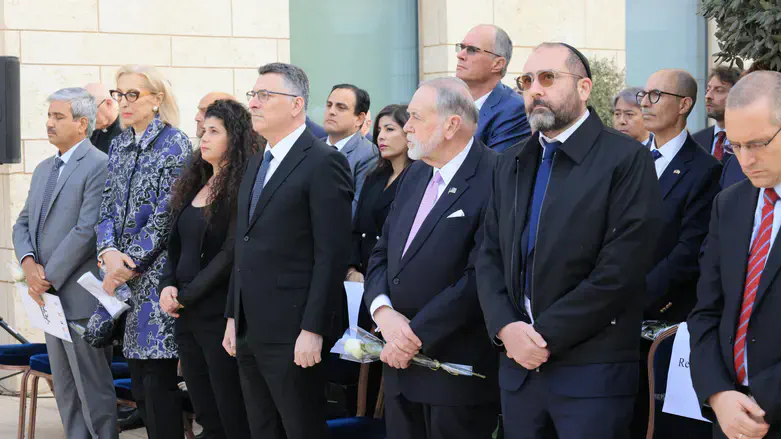
Minister of Foreign Affairs Gideon Sa’ar addressed a Holocaust Memorial Day ceremony at the Ministry of Foreign Affairs honoring diplomats recognized as Righteous Among the Nations, alongside foreign ambassadors serving in Israel.
Opening his remarks, Sa’ar quoted from Paul Celan’s “Death Fugue," invoking the memory of the Holocaust and its victims. He emphasized the obligation not only to remember the Holocaust but also to commemorate the moral courage of those who acted to save Jews during that period.
Sa’ar highlighted several diplomats who risked their lives to rescue Jews, including Giorgio Perlasca, who issued protective documents in Budapest while posing as a Spanish official; Swiss Vice-Consul Carl Lutz, who provided thousands of letters of protection and remained in the city during the siege; and Japanese Consul Chiune Sugihara, who defied orders to issue transit visas to Jewish refugees.
Reflecting on the Holocaust, Sa’ar cited statements by Nazi officials and described the regime as “pure evil," noting its systematic plan to annihilate the Jewish people. He argued that the failure of the free world to confront Nazi Germany in its early stages enabled its expansion across Europe and the murder of six million Jews.
He described a pattern of appeasement, referencing the Munich Agreement and the subsequent occupation of multiple European countries by Nazi forces. According to Sa’ar, Hitler’s eventual defeat was largely the result of strategic errors, including the invasion of the Soviet Union and developments that drew the United States into the war.
Turning to current threats, Sa’ar said the world today faces “another pure evil regime" in the Islamic Republic of Iran. He accused the regime of repressing its own population, targeting civilians with missile attacks, and supporting terrorist organizations including Hamas, Islamic Jihad, Hezbollah, and the Houthis.
He stated that Iran continues to pursue nuclear capabilities in violation of international obligations and warned that its missile range already extends across Europe. Sa’ar also accused Tehran of expanding its influence globally and engaging in subversive activities in multiple regions.
Sa’ar criticized what he described as a lack of decisive action by much of the international community, warning against what he called a recurring pattern of appeasement. “It’s not our war," he said, is a response heard too often, drawing a parallel to pre-World War II attitudes.
He stressed that Israel has drawn lessons from the Holocaust, emphasizing the necessity of self-defense. “We’re strong because we have no choice," he said, adding that Israel acts based on present threats rather than historical trauma.
According to Sa’ar, Iran and its proxies have developed both conventional and non-conventional plans aimed at Israel’s destruction, including missile attacks and efforts to acquire nuclear weapons. He stated that Israeli actions, including recent operations carried out with the United States, were intended to prevent such outcomes.
Sa’ar referenced past Israeli strikes on nuclear facilities in Iraq in 1981 and Syria in 2007, noting that those actions were initially condemned internationally but later viewed differently.
Quoting former Prime Minister Menachem Begin, Sa’ar underscored the responsibility of leadership to prevent existential threats.
“We will never let our enemies obtain a nuclear weapon to realize their ambition of our elimination," Sa’ar stated.
Concluding his remarks, Sa’ar described Iran as the greatest threat to global peace and called on free nations to act against what he termed “modern evil." He reaffirmed Israel’s commitment to remembering the victims of the Holocaust and to upholding the pledge of “Never Again."