

Artificial intelligence is not necessary. Just turn on French TV.
Interviewer on street: “Is this neighborhood of Marseille peaceful?"
A left-wing woman: “Yes, peaceful and diverse, we live in peace."
Suddenly a guy appears on the street threatening a French man because he is smoking during Ramadan, saying that “it is haram and provocative."
A scene like this live on TV cannot be invented.
Who would have ever said it? Even George Soros’s Open Society found that “30 percent of Marseille’s population is Muslim" (the report is from 2011, so the data are already old and must be increased).
Amid the usual giggles of commentators and Twitter users, ten years ago Donald Trump shocked the respectable classes by stating that “no-go zones" were emerging in Europe. No-go zones? It must be another Trump fake, they scoffed.
Since then it has become an open secret and even Angela Merkel admitted the existence of this reality in Europe, while former French socialist president François Hollande said: “How can we avoid secession? Because that is what is happening: secession."
It happens when you think cultures are interchangeable like items of clothing. And secession prevails over the “narrative."
In the areas where they have just been elected, the mayors of La France Insoumise (LFI) are already making themselves noticed. Use of violence and sectarianism: a chilling picture of France in the hands of the far left.
In Saint-Denis, the mayor Bally Bagayoko, of Malian origin, elected in the first round, now finds himself leading a city of over 150,000 inhabitants. The handover to the new teams did not take place peacefully. In the hours following the victory of the LFI mayors and their allies, images circulated showing violence, insults and pushing directed at outgoing mayors, sparking outrage.
In some cases, outgoing mayors were even escorted by police.
After Saint-Denis and Creil, Mantes-La-Jolie and Le Blanc-Mesnil: the list of the cities where outgoing mayors were escorted out amid threats and mockery in a toxic atmosphere is a long one, giving the impression that the new mayors were celebrating a territorial conquest rather than an electoral victory.
There are up to a thousand “no-go zones" across Europe and thousands of other “sensitive neighborhoods" as a consequence of decades of mass immigration policies and the failures of multiculturalism.
The report, titled “No-Go Zones, Immigration and the Rise of Parallel Societies," produced by the think tank New Direction Foundation for European Reform, estimates that there are between 900 and 1,000 urban areas that can be considered “no-go zones," characterized by high levels of crime, social fragmentation and weakening of state authority.
The analysis is based on data contained in official reports, media and academic sources, such as Eurostat, the European Drugs Agency, OECD, Pew Center and estimates. Considered factors include presence of gangs, attacks on police, episodes of antisemitism.
Drafted by Maxime Hemery-Aymar of the Observatory on Immigration and Demography of France, the document directly links mass immigration and open-border policies to high-crime areas, deterioration of social norms and even support for Islamist terrorism. The think tank found that 63 percent of Islamist terrorist attacks in Europe between 2010 and 2025 had a “verified link" with an identified no-go zone.
These range from La Castellane in Marseille to Neukölln in Berlin, from Chorweiler in Cologne to Raval in Barcelona, from Rosengård in Malmö to Feijenoord in Rotterdam.
In North Rhine-Westphalia, Germany’s most populous state and the one hosting the largest Muslim population in the country, there are 44 no-go zones.
While some governments have tacitly acknowledged the existence of no-go zones, often disguising them with euphemistic terminology, mainstream media have tried to deny their existence, often reacting with disbelief to a literal interpretation that they themselves created.
The Migration Research Institute of Budapest, linked to the prestigious Mathias Corvinus Collegium, had already estimated 900 areas out of control across Europe.
What are they like? In these territories police, social workers and ambulances do not enter or must be protected. High birth rates ensure longevity and expansion. They are places where a woman can be openly harassed during the day, insulted for what she wants to wear. Journalist Jean-Paul Brighelli, of Italian origin, who lives and taught in Marseille, wrote in Le Point: “Here the police are reluctant to patrol certain areas of the city. It is not a problem limited to the northern districts of a sick city: it is a gangrene that affects one end before reaching the rest of the organism."
The main German weekly Die Zeit reports of “forbidden zones" for Jews in Germany.
The president of the Jewish community of Marseille, Zvi Ammar, asked fellow believers not to wear Jewish symbols outside the home.
“In Sweden there are 60 ‘risk areas’," reports The Spectator. Areas like Alby, a suburb of Stockholm known as “little Baghdad." Here only one inhabitant out of ten is Swedish. Swedish ambulance staff want gas masks and bulletproof vests to protect themselves from the escalation of attacks, “similar to equipment used by those working in war zones."
In Stockholm, an Iraqi Christian refugee, Salwan Momika, was killed during a live social broadcast for having burned the Quran.
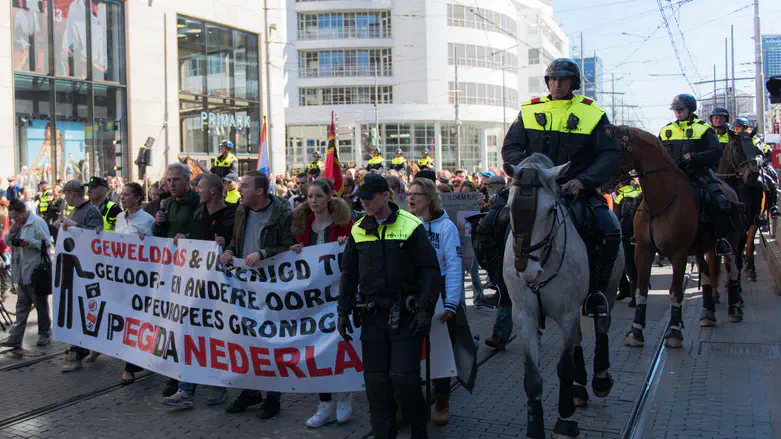
The Netherlands has mapped 40 zones. The most famous is Schilderswijk, in The Hague, where the 2012 census already told us that ethnic Dutch are just under ten percent of the population and ethnic violence often erupts. They call it “sharia wijk," the sharia district.
The DGSI, the French domestic intelligence agency, has mapped 150 districts “in possession" of Islamists. Neighborhoods, districts, enclaves now in the hands of fundamentalists who shape them according to their ideology of submission. According to former number two of the French DGSE, Alain Chouet, who published the book Sept pas vers l’enfer, “these districts are in 859 cities and are home to 4 million people, that is 6 percent of the total population of France."
The situation is such that, as Eric Delbecque, former director of the Institut national des hautes études de la sécurité, explains in L’Express, “the state has not even put itself in a position to regain control of these neighborhoods and once started it can take up to ten years."
The problem is that many European governments seem to have concluded that it is too late to prevent an Islamized Europe and that all that can be done is to cushion its effects in the short term and hope that the destruction is limited to those no-go zones, preferably not theirs.