
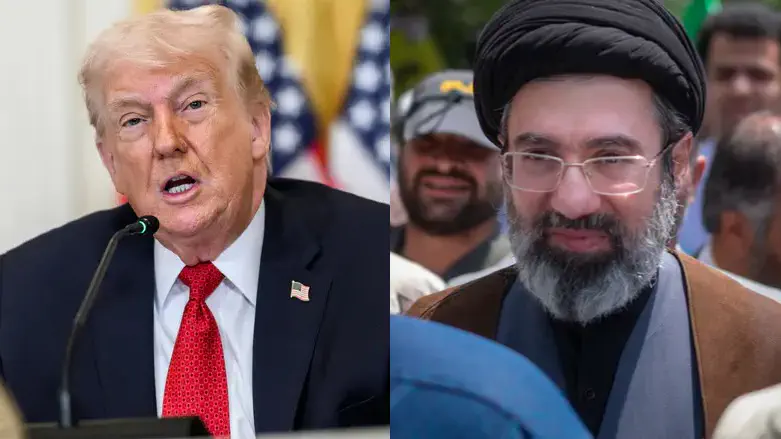
Iran's new supreme leader Mojtaba Khamenei said in a written message that the Islamic republic did not want war with the United States and Israel, but would protect its rights as a nation, state television reported, according to France 24.
Whether it is really Khamenei or the IGRC trying to create the impression that he is in charge, is unknown at present. However, it is the message that must command our attention.
At a time when Israel and the United States are confronting the Islamic Republic directly, clarity matters more than ever. The regime in Tehran is not a misunderstood regional actor seeking calm. It is not a victim of circumstances. And it is certainly not a government pursuing peace.
It is a regime that wants to be at war.
For years, the Islamic Republic has tried to hide behind slogans, diplomatic theater, and carefully engineered narratives designed to confuse the international community. Its latest message “No to War," flaunted in the West, is one of its most cynical yet. It is not a call for peace. It is propaganda issued by a regime that has spent more than four decades exporting terror, suppressing its own people, and threatening Israel’s existence.
That lie is collapsing in full view of the world.
Iran has been actively launching missiles at Israeli population centers. Ballistic missiles aimed at residential neighborhoods, civilian infrastructure, and major cities are not abstract “escalation." They are acts of war. A missile hitting a building in Haifa is not “indirect conflict." It is the deliberate targeting of human life. Four people were killed in Haifa in an Iranian missile strike several days ago, reinforcing what should already be obvious: Israel is not facing rhetoric. It is facing an enemy trying to murder civilians.
This is the reality that much of the world still refuses to name clearly.
Even after significant damage to parts of its military and production infrastructure, the regime continued to fire what it could at Israel. That fact alone reveals the nature of the Islamic Republic. It is a revolutionary regime determined to inflict damage for as long as it retains the capacity to do so. The language of “No to War" is not restraint. It is deception.
And like so much else in the Islamic Republic’s political vocabulary, it is meant for foreign consumption.
The regime understands that narratives matter. It knows that if it can frame itself as cornered, threatened, or unfairly targeted, it may still win sympathy from parts of the international press and policy establishment. It wants the world to forget who armed Hezbollah, empowered the Houthis, financed militias across Iraq and Syria, and built an entire architecture of terror around Israel’s borders. It wants observers to ignore the years of missile proliferation, proxy warfare, and genocidal rhetoric and instead focus only on the consequences now arriving at its doorstep.
But the current war did not emerge in a vacuum. It is the direct result of a regime that has invested enormous national wealth into weapons, terror networks, ideological warfare, and military confrontation rather than the wellbeing of its own people. Iran’s rulers built this crisis. And now, even under pressure, they are proving again that they would rather endanger the Iranian people than abandon their obsession with destruction.
That is why the internal Iranian dimension of this war must not be overlooked.
The same regime firing missiles at Israel is the one that has terrorized its own population for decades. It is the same regime that crushed the 2019 protests with bloodshed, that tried to silence the “Woman, Life, Freedom" uprising with bullets and prison cells, and that continues to rely on executions, torture, and fear to survive. Human rights groups and international monitors have repeatedly documented Iran’s heavy use of executions and arbitrary detention, especially against dissidents and protesters.
This is not incidental. The regime’s violence abroad and its repression at home are not separate issues; they are expressions of the same political system. A government that brutalizes Iranian women, students, workers, journalists, and protesters is entirely capable of launching missiles at Israeli civilians while calling itself a force for peace.
In fact, it depends on that contradiction.
For many Iranians, this is not merely a geopolitical confrontation; it is a moment of profound moral and national clarity. They know the Islamic Republic does not represent Iran, and they know its wars are not the wars of the Iranian people. More than that, many understand that as long as this regime remains in power, neither Iran nor the wider region will ever be free from the cycle of repression, violence, and manufactured crisis it has sustained for decades. They know that every missile launched outward, every proxy armed abroad, and every act of aggression committed in the regime’s name has been financed by a population forced to endure inflation, corruption, fear, isolation, and stolen generations.
This is why the regime’s attempt to weaponize anti-war language is so offensive. The Iranian people understand that this is not a war against Iran, but a confrontation with the Islamic Republic the regime that has held their country hostage for more than 46 years. Many Iranians recognize that actions aimed at dismantling the regime’s military and repressive machinery are not directed against the nation, but against the very system that has oppressed, isolated, and endangered it for decades. For that reason, many view Israel’s and America’s actions with gratitude and hope. Their fear is not that the regime is being confronted too forcefully, but that the world may once again stop before the job is done, leaving the same rulers in place to continue their executions, repression, regional aggression, and destruction. The Iranian people’s desire for peace must never be confused with tolerance for the regime that has denied them peace, freedom, and dignity for nearly half a century.
Inside Iran and throughout the diaspora, there is a growing recognition that the country cannot survive indefinitely under a regime that has turned militarism, ideological extremism, and internal repression into the foundations of state power. And as that realization grows, so too does the demand for a credible national alternative and for unity among those who seek a democratic future for Iran.
That demand is no longer abstract. It is urgent.
The regime is weaker than it wants the world to believe, but it is also more dangerous than many are willing to admit. Authoritarian systems often become most reckless when they are cornered. And the Islamic Republic today is cornered: militarily pressured, economically strained, diplomatically exposed, and deeply unpopular at home.
None of that has made it humane. None of it has made it peaceful. Instead, it has made it more desperate and, therefore, more willing to kill.
That is why Israel’s position in this moment deserves moral clarity, not equivocation.
Israel is not confronting a hypothetical threat. It is defending its people against an ideological regime that has spent decades promising destruction and is now acting on that promise more openly than ever. No sovereign nation can be expected to absorb missile fire on its cities and simply pretend it is witnessing another phase of “regional tension." This is war, and Israel has every right, indeed, every obligation to defend its civilians and dismantle the machinery aimed at them.
The same is true for the United States.
The Trump administration has framed its current objective as preventing the regime from sustaining its missile threat, rebuilding military capacity, and preserving the infrastructure that underpins its war-making ability. The White House has repeatedly described the campaign as focused on destroying Iran’s missile, naval, and military-industrial capabilities while preventing the regime from obtaining a nuclear weapon.
Whatever one’s politics, one fact should be obvious: regimes like the Islamic Republic do not moderate because they are indulged. They do not become peaceful because they are granted more time, more diplomatic ambiguity, or more room to manipulate perception. They stop only when they are confronted with real consequences.
That is the lesson of this moment.
For too long, the Islamic Republic benefited from a global reluctance to call things by their proper names. Terror was called “influence." Missile expansion was called “leverage." Proxy warfare was called “regional strategy." Domestic repression was treated as an internal matter. Even now, while Israeli civilians rushed to shelters and Iranians continue to suffer under a violent regime, too many still search for softer language.
There should be none.
The Islamic Republic is not a force for stability. It is not a misunderstood actor seeking dignity or balance. It is a revolutionary regime built on violence - violence against Israelis, violence against its neighbors, and violence against its own people.
Its slogan may be “No to War." But its missiles, its prisons, and its record say otherwise.
And the world should finally believe what the victims have known all along.
Negar Karamati is a journalist and former Persian language news editor, and an anchor who works in the legal field. She writes on Iran‘s political and social issues, including women's rights and Iran's religious minorities, particularly the Baha’i.