
Sometimes seemingly small actions bespeak a world of larger intentions.
A current and very meaningful example of this is the vulnerability of Jewish farmers and landholders and the State itself to the usurpation of their land by Arabs who clandestinely plant sprigs of tiny trees on open lands.
They then claim that not only are the plants theirs, but more importantly, the land itself is theirs and has been theirs since time immemorial. While on its face this seems absurd, ridiculous and at best bothersome, it is easy to misunderstand the perspective of the Israeli judicial system and process.
At a minimum the wheels of justice turn slowly and expensively. There is a plethora of NGOs who seek to defend the “rights" of trespassing and, yes, thieving Arabs who have no difficulty lying through their teeth.
What would seem to be straightforward, indeed no-brainer, issues of ownership and control can be tied up for years as Israeli courts often lean over backwards to accord legitimacy to Arab claims.
This reality is indeed a microcosm of what is taking place throughout Area C of Judea and Samaria today, as Arabs build illegally, pave illegal roads and deliberately do so as an encroachment on Jewish communities.
Their strategy is to create irreversible facts on the ground, confident that Israeli authorities will not undo their acts.
The amazing Regavim movement has spent years documenting this activity and has been tirelessly pointing out the toxicity of the Arabs’ initiatives and the risks of not addressing them.
Returning to the issue of the illegal plantings on Jewish farms, I am pleased to say that there has been a surprisingly effective Jewish response, one that I believe has great relevance for the larger scale illegal actions.
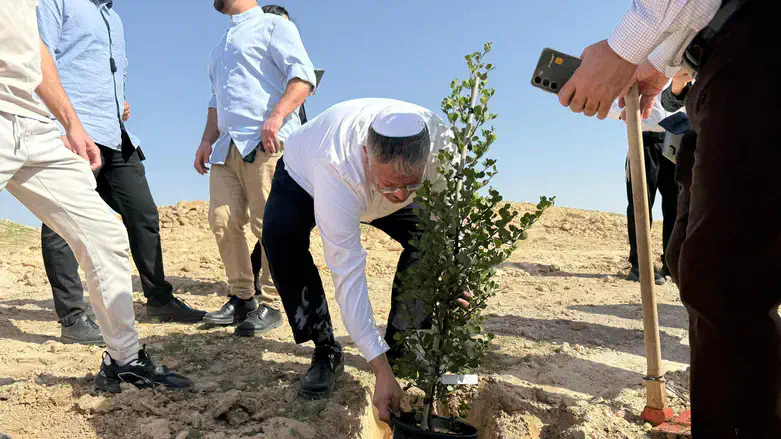
For several years now, Im Tirtzu, the grassroots Zionist organization where I am privileged to serve as Chairman of the Board, has been planting, at the request of farmers, young fruit trees on their open farmlands that might otherwise be vulnerable to a taking,
Working with our farmers, we provide them with young fruit trees, which are productive as well as defensive. Filling open lands means much less opportunity for Arabs to start their own plantings.
Since October 7th, these planting initiatives have also served as memorials for fallen soldiers. Groves, fields and small orchards have been designated as memorial sites and our soldiers are being remembered.
By doing so, our soldiers in a very real way continue to serve their nation, as these planted areas, their planted areas, protect their fellow citizens.
I would like to think that this strategy could have relevance and applicability on a larger scale. The proactive nature of the individual farm plantings bespeaks a post October 7th mindset: no longer waiting, assuming the rationality of the other side, but rather acting assertively to preclude bad outcomes and to facilitate good ones.
What this entails on the larger scale is not just the removal of illegal construction, but also widespread construction activity intended both to forestall illegality and even more importantly, to effect important strategic goals.
The recently announced plans for construction linking Maale Adumim and Jerusalem is a good example of this mindset being put into action.
Israel cannot assume forbearance, let alone good will on the part of our adversaries. Left to their own devices they will endeavor to tie our hands with illegal construction, confident that our own legal system will in effect ratify their behavior.
So, just as planting on Jewish farms assumes that absent such initiative bad things will happen, widespread connective construction throughout Area C recognizes Israel’s vulnerability, assuming that we are not aggressively dismantling illegal Arab construction.
In a perfect world, Israel would undo the damage caused by such construction. However, in the absence of such resolve, we need to strive to fill the voids, connect the dots, and provide for an Area C that will permanently reflect its Jewish character.
Regardless of the eventual disposition of Area C, it is imperative that a “first to plant, first to build" mindset must be the modus operandi of securing a safe, inviting, growing and thriving essential part of Israel.
- Douglas Altabef
The author is the Chairman of the Board of Im Tirtzu and a Director of the Israel Independence Fund