
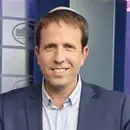
Tuvia Tenenbom, spoke to Arutz Sheva-Israel National News, following the publication of his new book.
After living with the Europeans and writing about them, and living with the Haredim and writing about them, and living with the Muslims and writing about them, Tenenbom decided to move to a community in Samaria and write about life in the communities of Judea and Samaria. Alongside his admiration for the local residents, he also offers considerable critique.
Tenenbom explains that his book, Excuse Me, Is This Yours? came about, as in previous cases, following a suggestion from his editor to go out and write about the residents of Judea and Samaria, similar to earlier assignments where he was asked to integrate into various communities and write about them.
What is unique about Tenenbom’s writing is the extended and meaningful time he spends within the community he writes about. Unlike journalists who visit a sector for only a few hours and then write about it, he moves with his wife to live in the subject of his writing. In this case, when writing about Judea and Samaria, the Tenenboms lived in different communities for eight months, switching towns every two weeks, absorbing the people, landscapes, conversations, foods, and sounds.
Regarding what surprised him during this period, Tenenbom mentions the short distances, which taught him just how small this region is. In his view, those advocating for “two states for two peoples" do not understand the reality, failing to recognize that this is a small land that cannot be divided. He was also struck by the realization that Israel has controlled Judea and Samaria for nearly sixty years but has yet to apply its sovereignty over the area. Logically, if the land belongs to Israel, there is no reason not to apply sovereignty; if it does not, then Israel should leave.
Tenenbom says that in conversations with right-wing Knesset members and ministers whom he questioned about this, he was told that there is no genuine desire to annex the area due to various concerns. This is where the title of the book, Excuse Me, Is This Yours?, comes from, as he asks right-wing leaders about the gap between the rapid Arab construction of multi-story homes aimed at taking control of the land, while Jewish homes are often nothing more than trailers or dilapidated structures.
Regarding the “Hilltop Youth," he speaks of his admiration for their lifestyle and worldview, yet notes, “No society is without its crazies. A society without lunatics will not survive…" But regarding the Hilltop Youth as a whole, he states, “It is a society that risks its life building a farm, surrounded by Arabs, while going out to graze sheep. It is an enormous risk."
To gain a more complete picture, Tenenbom also met with opponents of the Jewish communities in Judea and Samaria, who helped him access Arab areas, meet representatives from the Palestinian Authority, and enjoy authentic knafeh from Shchem (Nablus). In refugee camps, he refused to be afraid, even when identified as Jewish by Arabs. Fear, he says, is characteristic of those who have not come to the land and do not truly know the Arabs.
From the Jewish residents, he asks to see actions that demonstrate their sense of ownership over the land, meaning clear and unhesitant application of sovereignty.
Tenenbom’s book is expected to be published in several languages and has already been released in Czech, alongside Hebrew. The Czech Prime Minister posted on his X account urging readers to purchase the book, noting that its author understands the crucial reality of Judea and Samaria. He believes the book reflects the struggle between Israel and Judea, the internal conflicts between left and right, and within different sectors of Israeli society, serving as a kind of warning of what may occur if the divide continues.
He also notes that in his conversations with Arabs from Judea and Samaria, he tried to hear their stance on the two-state solution. The response was a complete rejection of the idea, with a desire to return Jews to the countries from which they came, the Diaspora. To us, the Jews, he calls on awakening, recognizing reality, and answering loudly whether this land truly belongs to us or not.