
Letter I - to Pope Leo XIV: (Note Letter II at end of this one: The Archbishop of York was sent a letter as well.)
To His Excellency, Pope Leo XIV, Bishop of Rome:
Greetings and blessings,
I write to you in my capacity as a member of the Interfaith Committee of the Chief Rabbinate of Israel, a role devoted to fostering mutual respect and moral responsibility between faith communities.
It is in that spirit that I wish to address your recent Palm Sunday remarks, in which it was stated that God “does not listen to the prayers of those who wage war," accompanied by the words of the prophet Isaiah, “your hands are full of blood." Your Palm Sunday remarks emphasized that God does not listen to the prayers of those who wage war and rejected the use of religion to justify violence.
These words carry immense moral weight. Precisely for that reason, they require careful application.
At this time, the State of Israel is not engaged in a war of choice. It is confronting an existential threat from forces that have openly declared their intention to destroy it, and which have actively pursued the means to do so, including the development of weapons capable of devastating entire populations.
In this context, even the ability to gather for prayer has been deeply affected. We note that on Palm Sunday Cardinal Pierbattista Pizzaballa, the Latin Patriarch of Jerusalem, was at first prevented by security restrictions from entering the Church of the Holy Sepulchre to celebrate the traditional Mass-an unprecedented interruption of a centuries-old custom. However, following careful coordination and recognition of both safety concerns and the importance of religious observance, access was subsequently granted and arrangements made for him and other church leaders to participate in Holy Week services in the Church despite the significant danger posed by ongoing security threats to Jerusalem’s holy sites. These measures arose from the grave responsibility to protect human life and affected Jews, Christians, and Muslims alike. At the same time, we reaffirm our unwavering commitment to safeguarding the sanctity and security of all holy sites in Jerusalem, which are sacred to billions of believers around the world.
A sweeping condemnation of “those who wage war," without distinction between aggressor and defender, risks creating a profound moral confusion. It places those who seek to preserve life in the same category as those who seek to destroy it.
The words of the prophet Isaiah were directed against injustice, corruption, and moral failure. They were not spoken to deny a people the right to protect themselves from annihilation.
Within the Jewish tradition, the preservation of life stands at the very center of religious duty. From the very beginning of the Torah, we are taught that every human being is created in the image of God, and that all humanity shares a common origin. It is precisely because of this that we feel so deeply the tragedy of war, and do not take lightly the use of force. Yet when those who seek our destruction rise openly and persistently, we are left with no choice but to act in order to protect life. We cannot remain silent, and we cannot stand idly by, when the lives of our children and our future are at stake.
Perhaps it is also important to recall the painful lessons of history. Within living memory, during the horrors of the Second World War and the Holocaust, a third of our people were destroyed in the most inhumane ways, while they stood largely defenseless. That reality has left an indelible mark on our moral consciousness. It is precisely because of that history that we cannot allow Jewish lives to be left unprotected in the face of those who openly call for our destruction. When such threats are declared and pursued, the responsibility to defend life becomes unavoidable. Our actions today are not born of a desire for conflict, but of the solemn duty to ensure that such a tragedy can never be repeated.
We share deeply in the yearning for peace. We pray for the day when humanity will no longer know war. But peace cannot be built on moral equivalence, nor on the expectation that a nation should stand defenseless in the face of existential threat.
At this critical time, the voice of religious leadership is more important than ever. It must be a voice that brings not only compassion, but also clarity.
It is with respect, and with a sincere desire for continued dialogue, that I ask that future statements reflect this essential distinction: the moral difference between those who initiate violence and those who are compelled to defend the sanctity of life.
May we all be guided to lead our communities with truth, responsibility, and a steadfast commitment to the sanctity of human life.
Respectfully,
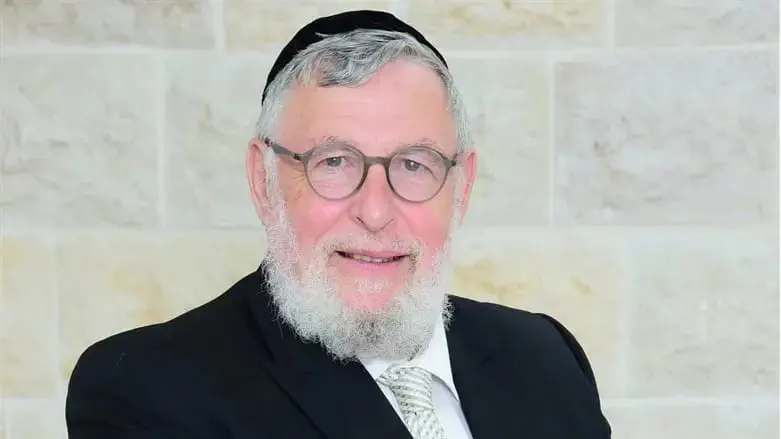
Rabbi Eliezer Simcha Weiss
Member, Interfaith Committee
Chief Rabbinate of Israel
***************************************************************************
Lettter II - to the Archbishop of York
7th of April, 2026 / 19th of Nissan, 5786
The Most Reverend and Right Honourable Stephen Cottrell
Archbishop of York, Bishopthorpe Palace York, YO23 2GE
Your Grace,
I write to you in my capacity as a member of the Anglican-Jewish Commission. I do so not only as a colleague in this dialogue, but as a man who has spent the last several hours in a bomb shelter. I write with the clarity that only an immediate threat to life can provide. I was deeply unsettled by your recent Easter Sunday sermon, in which you described the current conflict in the Middle East as "literally pointless."
As I sat down to draft this letter at 3:30 AM, our sirens were wailing. I, along with millions of others-the elderly and infants alike-was forced into a shelter. This scene was repeated again at 6:50 this morning.
For those of us clutching our children in the dark while missiles explode overhead, this struggle is not "pointless." It is a harrowing struggle for the basic right to exist. To label a nation's defense against annihilation as "pointless" is to ignore the existential reality we face every hour. Israel is not engaged in a war of choice; we are defending our homes against a regime that publicly and repeatedly vows to wipe us from the earth.
Your Grace, you speak from a city that bears a heavy historical scar. In 1190, the Jews of York were trapped in Clifford’s Tower, facing a choice between forced conversion and death. They chose to preserve the sanctity of their faith through the ultimate sacrifice because they had no one to defend them. Today, we have a state and an army, yet we are told our defense is "pointless." We have learned the bitter lesson of York and of the Holocaust: when people threaten to destroy us, we must believe them, and we must be able to defend ourselves.
You may argue that "the other side suffers too." All suffering is a tragedy, and as Jews, we mourn every life created in the image of God. But we must have the courage to ask: why is this happening? If the world had the resolve to condemn the ideology of Jihad instead of accommodating it, we would not be in this position. We must be honest with history: Was the war against the Nazis "pointless"? Or was it the only way to stop a darkness that refused to be reasoned with?
True leadership requires the courage to distinguish between those who seek to preserve life and those who are obsessed with destroying it. In our tradition, protecting life is the highest religious calling. When our future is targeted, defending it is a moral imperative.
This threat is not local. The Iranian regime has already targeted British interests 4,000 miles away. Their nuclear path threatens not just Israel, but the whole of Europe. Even the sanctity of Jerusalem-holy to us all-is being violated by Iranian fire.
Peace cannot be built on the false comfort of moral equivalence. As a member of the Commission tasked with fostering understanding between our faiths, I ask that your future words reflect the profound moral difference between the aggressor and the defender.
May we all be guided to lead our communities with truth, responsibility, and a steadfast commitment to the sanctity of human life.
Respectfully,
Rabbi Eliezer Simcha Weiss
Member, Anglican-Jewish Commission
Member of the Chief Rabbinate of Israel