

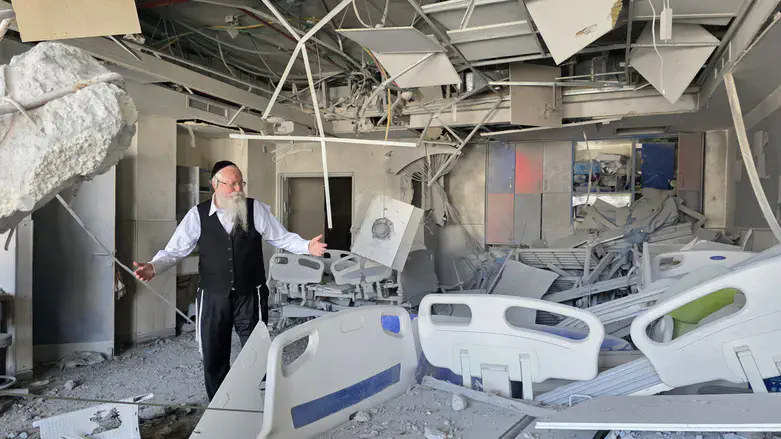
As missile fire toward central Israel continues, the ALEH rehabilitative center in Bnei Brak is operating under renewed threat, months after sustaining heavy damage from a ballistic missile strike.
In recent weeks, interceptions and falling debris have been reported across the Tel Aviv metropolitan area, including in and around Bnei Brak. The center remains open and active.
“We are no longer in a place of uncertainty," says Shimi Segal, spokesperson for ALEH. “We have already faced the worst-case scenario, a direct hit. Today, we operate with clear protocols, protected spaces, and an understanding that evacuation is not always possible."
The damage to the facility occurred in June 2025, when a missile strike in close proximity caused structural collapse and the destruction of treatment areas and medical equipment.
“It was a catastrophic event," says CEO Rabbi Yehuda Marmorstein. “Not just a building was damaged, an entire system of care was disrupted in a single moment."
No patients were inside the building at the time.
“That was a matter of timing," Marmorstein adds. “Under different circumstances, we could have faced a much more severe outcome."
Following the strike, operations were halted, and patients were relocated or discharged under complex medical supervision. The center underwent a detailed reconstruction process, including the rebuilding of specialized treatment environments and the installation of new systems.
“This is not standard construction," says a member of the staff. “Every room and every system is adapted to very specific medical needs."
Emergency procedures were also revised, with the introduction of internal relocation plans and designated protected areas.
With the beginning of the current escalation with Iran, the reconstruction process was nearly complete, and the center had returned to full operation.
“We had just reached the point of stability," says Segal. “And then the new round began."
The decision was made to continue operating.
“Unlike last year, this time we are not shutting down," Segal says. “We have systems in place, and we know how to function within this reality."
The nature of the care provided at the center does not allow for interruption.
“You cannot pause this kind of care," Segal explains. “These are children who depend on continuous support. Even during sirens, treatment continues."
Staff members now work in extended shifts and remain on-site to ensure immediate response.
“Everyone knows exactly what to do," he says. “There is no hesitation."
Families continue to rely on the center during this period.
“For us, this is not just a facility," says a father of one of the patients. “It is what allows our child to live in a stable and supported environment."
The organization describes its current approach as focused on maintaining continuity under changing conditions.
“After a direct missile strike, resilience becomes operational," says Marmorstein. “We strengthened our systems and improved our preparedness, but we are not immune."
He adds that the core mission remains unchanged.
“This is not only about infrastructure," he says. “It is about responsibility. These children depend on us for everything, and that responsibility does not change during war."
The center continues to function as part of the broader civilian system operating under ongoing threat.
“The reality has shifted," says a staff member. “Facilities like ours are now directly exposed."
Inside the building, daily routines continue.
“The machines are running, the staff is moving between patients," another team member says. “We are simply continuing the work."