

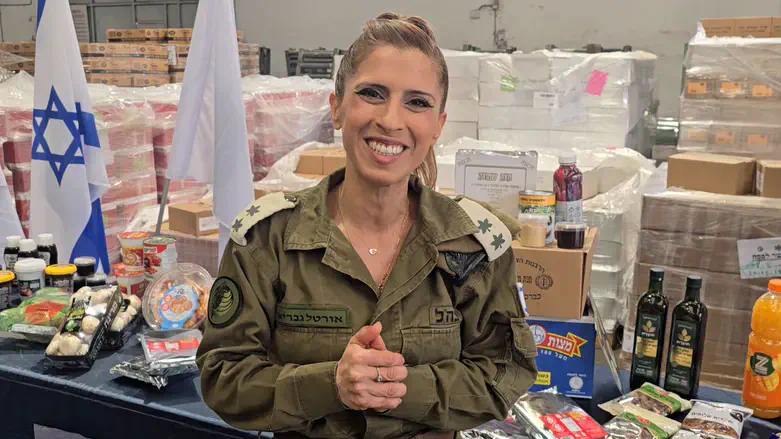
For most, Passover preparations boil down to cleaning and shopping. However, for Lieutenant Colonel Ortal Gavish, the head of the Food Distribution Department of the IDF General Staff Supply Center, the preparations are a nationwide project that began last July.
This year, in the midst of an intense war, the challenge to feed thousands of regular and reserve servicemembers, in protected mess halls, remote outposts, and inside the Gaza Strip and Lebanon has become a full-scale military operation.
"We at the General Staff Supply Center have been preparing for Passover for a long time," LTC Gavish shares in an interview with Arutz Sheva-Israel National News. "At around July-August, we begin preparing for Passover. The work includes a framework for those in mess halls and those who are away from a kitchen, with special field rations for the holiday. Within the IDF, in the mess halls, all products are kosher for Passover without Kitniyot (legumes, forbidden according to some customs). For our combat personnel, we provide both supplementary rations and rations tailored to our infantrymen, including kabanos sausages, tuna, and products available for Passover, including sweet and salty snacks."
LTC Gavish stresses that the system underwent a total revolution: "Our outposts have quick-to-prepare dishes, such as meat-stuffed eggplant, which can be used to make moussaka, stuffed artichoke, which can be used to make a very easy dish, fishballs, salmon - all products that you can just add sauce to and serve."
The main emphasis is on frontline combat soldiers. For them, supplementary rations have been developed, including protein bars, kabanos sausages, tuna, and even “treats" for energy such as kosher-for-Passover gummy candies. "Our kitchens have a very rich menu, whether that entails types of fish, meat, chicken, and meatballs. Our fighters have a nutritionally and kosher-adapted plan to provide their daily sustenance, be it protein bars, kabanos sausages, tuna, or salty snacks. We wanted them to have energy, and there are even gummy candies, so they have something that's both sweet and gives them energy."
The issue of kitnyot, which many have the custom not to eat, is addressed in a differentiated manner: while food in on-base kitchens does not contain kitnyot, combat personnel operating inside Lebanon and Gaza are permitted rations that contain them. At the same time, the military makes an effort to provide kitniyot-free kosher-for-Passover rolls to everyone.
One of the more surprising details of the interview was LTC Gavish's personal involvement in the development of the rations. To her, managing the operation is not just spreadsheets and purchase contracts. "It's important for me to know on a personal level whatever enters an IDF kitchen, to know that the menu is really tailored to the cooking abilities, and that the products are really high-quality. So, for example, we took the quick-to-prepare dishes, we made stuffed artichokes, we took ribs, and we made pulled beef and meat with sweet potato cream, and fishballs in sauce. In short, a rich menu. We also have a cookbook that we edited together with the nutrition administration, who are our partners."
As a mother of a soldier herself, she understands the emotional value of food. "We don't skip over anything to provide a feeling of home. I'm also the mother of a soldier, and I want there to be good service."
The emotion can be heard in Gavish's voice as she talks about the national importance of her job: "I know that while I sit at my holiday meal, we did as much as possible to provide a feeling of home. We are in an intense war, and this period has made us reinvent ourselves. Jumping into a wartime Passover was unplanned, and the advantage of the flexibility of thought and purchase, together with the creation of a complete plan, is an operation with which we will win."
Even in routine times, the IDF’s food sector strives for constant innovation. LTC Gavish describes adapting flavors to a younger generation: “You constantly have to adjust yourself, even change flavors. Take protein bars, for example, there’s an American version and an Israeli one. We bring different flavors and ask the soldiers what they like and what they want us to add. With kabanos, we also introduced beef jerky; the thinking is truly centered on the soldiers. One of the most meaningful moments for me was receiving a photo of soldiers on a Namer APC saying thank you, holding a bunch of grapes and a pineapple. That’s where the sense of pride comes from."
For her, prioritizing Israeli agricultural produce is a core value that also connects to her personal roots. “We make sure to use Israeli ‘blue-and-white’ agriculture. It’s something that matters to me because I come from a farming family, but also because in the end, you see it reaching the soldier on the front line."
In conclusion, she addresses one of the major complexities of the past decade: food sensitivities. “We have a dedicated response for vegans with field rations and self-heating meals, individual trays for those with celiac disease, and especially during Passover, a festive menu. The Passover rolls are gluten-free, and we have solutions for the ultra-Orthodox and for vegetarians. The big highlight will come after Passover, a special package for people with allergies only, with products purchased specially for them, because we want to reach them too."
When asked about her personal feelings ahead of the holiday, she concludes: “It’s truly moving. I know we’ve done everything to ensure that every soldier, wherever they are, feels they are part of the big family of the IDF and the people of Israel."