


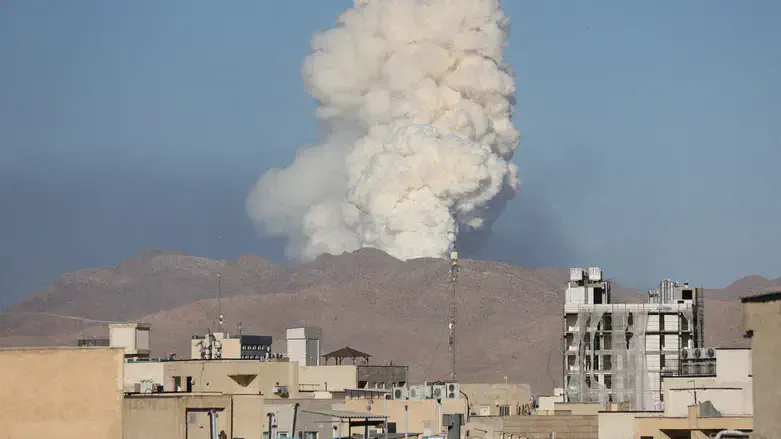
At some point, the American-Israeli war against Iran could assume a nuclear dimension. The Iranian nuclear threat is not just about creating a bomb. Even without chain-reaction nuclear explosives, Tehran could use portions of its enriched uranium stockpile to fashion radiation dispersal devices. At present, there is little that Israel or the US could do to capture this fissile material.
Even if Iran had no weapons-grade stockpile and was successfully prevented from further enrichment activities, the Islamic Republic would still present a threat to Israel’s nuclear reactor at Dimona. Plausibly, whatever its prior failures, Tehran might eventually get it right. There could then ensue a more-or-less catastrophic release of ionizing radiation.
Even a non-nuclear Iran could cause some form of nuclear war. Among other things, any continuously escalating use of conventional missiles against Israeli civilian populations and/or regional American military installations could provoke an American or Israeli “first use." In language of formal strategic theory, this scenario would describe an “asymmetrical nuclear war."
In Washington and Jerusalem, pertinent historical and legal backgrounds warrant immediate attention. To wit, what do American and Israeli decision-makers need to learn about these backgrounds? Since the Peace of Westphalia in 1648, world politics have been shaped by sovereignty-centered threats of aggression and reprisal. Considered rationally and systematically, this seventeenth-century system of competitive nationalism will eventually undermine every nation-state’s core survival interests. That grievous result, moreover, could be sudden or incremental.
Some things are not complicated. Unless national leaders finally take tangible steps to implement an “organic" planetary civilization, there will be no civilization at all. Right now, intellectual incoherence dominates every page of America’s strategic playbook.
A more thoughtful approach by the American president could yield a more insightful military axiom: There is no valid reason to assume that American threats of massive destruction would be any more effective against Iran than conspicuously calibrated threats. In fact, there are circumstances in which unmeasured threats would vary inversely with all desired operational outcomes.
There is a more fundamental background issue. In all world politics, not just in the current war against Iran, everything must begin and end with the individual. Generally, we humans fear solitude or "aloneness" more than anything else, sometimes even more than death.
Amid the murderous chaos now stampeding across entire continents, human beings remain staunchly loyal to the primal claims of "tribe." Always, almost everywhere, individuals desperate to “belong" wittingly subordinate themselves to the belligerent expectations of state or nation. Sometimes, especially in the Middle East, such subordination carries with it an ecstatic acceptance of "martyrdom."
Great scientific discoveries aside, whole swaths of humankind remain fiercely dedicated to every conceivable variant of "sacrifice." In the end, inter alia, this atavistic dedication could shape Iran’s “last resort" military choices. Though ignored by both Washington and Jerusalem, a desperate Iran could at some point transform itself into a suicide bomber in macrocosm.
On this scenario, because it would describe a unique or sui generis event, there could be no science-based way to assign meaningful probabilities. In logic and mathematics, probability assignments must always be based on the determinable frequency of relevant past events.
As a species, we humans remain determinedly irrational. How can this be true? The best answer lies in our shortsighted views of “realism." Examined in the clarifying light of history, science and logic, we ought finally to recognize the special wisdom of Italian film director Federico Fellini: “The visionary is the only realist."
Hope exists, we may still assume, but today it must “sing" softly, with circumspection, inconspicuously, almost sotto voce. Though counter-intuitive, the time for celebrating gleaming new information technologies and artificial intelligence is coming to an end. To survive on a continuously self-defiling and imperiled planet, each should now aim to discover an individual life that would struggle valiantly against collective nuclear death. What is most sorely needed are not vain ventures to colonize space, but amplified human intelligence reinforced by empathy and ethics.
In his landmark work, The Decline of the West, first published during World War I, Oswald Spengler inquired: "Can a desperate faith in knowledge free us from the nightmare of the grand questions?" This remains a profound and indispensable query. The necessary answer would accept that suffocating conflicts of life on earth can never be overcome by unthinkable weapons or threats of “obliteration."
In the final analysis, as we may learn from an ancient parable, it is high time to focus not only on the “many things" of US/Israel/Iran war, but also on the “one big thing" of a nuclear war. It’s not that the bewildering dialectics of Middle Eastern conflict should be minimized or disregarded, but rather that continually-changing interstate relations ought always to be understood “in context."
There is more. For Israel and the United States, a nuclear war in the Middle East could take place even while Iran remained non-nuclear. Its onset could take place in foreseeable and unforeseeable forms. Its proximate cause could be “deliberate" or “inadvertent."
There is one last point that generally goes unnoticed. For the moment, at least, any deliberate or intentional nuclear war would be “limited." As to an inadvertent or unintentional nuclear war, that class of conflict would express assorted outcomes of decision-making miscalculation, hacking intrusions or accident.
The ongoing war against Iran displays multiple issues of staggering complexity, but the most complex and urgent issue concerns nuclear war avoidance. Going forward, both President Trump and Prime Minister Netanyahu should assess all considered policy options with this overriding objective continuously in mind. If Iranian leaders are made to feel that their country’s last resort survival options are in grievous jeopardy, they would more likely initiate radiation dispersion attacks on Israel and/or conventional attacks on Israeli nuclear facilities. Also more likely would be Iranian placement of radiological weapons in the hands of Houthi or Hezbollah terror groups.
The ironies are manifold. A war designed to keep Iran non-nuclear could end up spawning some form of nuclear conflict. This is not to suggest that Israel’s preemptive actions were unnecessary or illegal, but only that the war has reached a point where further belligerency could possibly be net-negative and counter-productive.
LOUIS RENÉ BERES was educated at Princeton (Ph.D., 1971) and is Professor Emeritus of International Law at Purdue. Born in Zürich, Switzerland at the end of World War II, he is the author of many major books and articles dealing with world politics, law, literature and philosophy. Professor Beres' writings have been published in Jurist; The New York Times; Jerusalem Post; Yale Global; Harvard National Security Journal; International Journal of Intelligence and Counterintelligence; Israel National News; The Atlantic; Modern Diplomacy; Air-Space Operations Review (USAF); Oxford University Press; The Brown Journal of World Affairs; Parameters: Journal of the U.S. Army War College (Pentagon); Modern War Institute (Pentagon); The War Room (Pentagon); BESA Perspectives (Israel); INSS Strategic Assessment (Israel); Israel Defense (Israel); World Politics (Princeton) Princeton Political Review; Cambridge University Press and International Security (Harvard).. His twelfth book, Israel's Nuclear Strategy: Surviving amid Chaos, was published in 2016 (2nd. ed., 2018).