

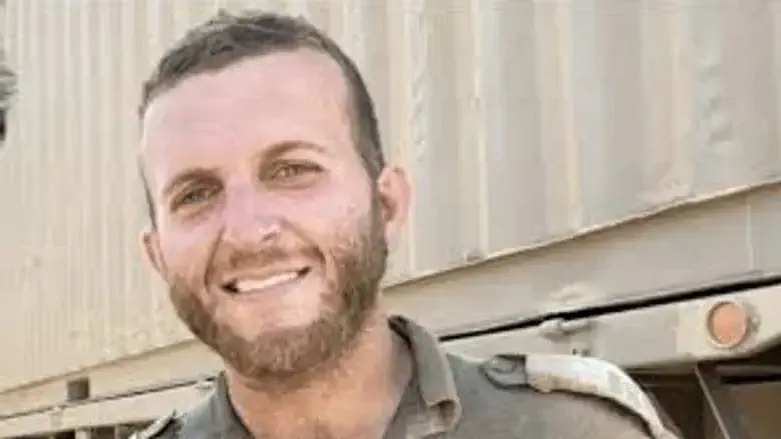
Below: From News in real time,posted on Instagram:
Subtitles (translation):Heartrending. This is a clip of Major Jalaa Ibrahiim, who fell in Gaza today, coming home on one of his rare IDF leaves
Lyrics (translation): Even if you look for another place to be, there is someone who thinks of you always. Come home. Mother is waiting at the door, let yourself breathe a bit, what more is there? Look - we are all here. Don’t think about tomorrow, be with us here. (Song: Coming Home, the Shlomi Shabbat and family album)
They were six stalwart sons. Now they are five.One is in the Police Force, one in the Border Patrol, four - now three - are officers in the IDF Combat Engineering Corps. The five sisters are educators.
“This is the story of my life. On the whole, I enjoyed it. Send my love to Mother," Jalaa once recorded laughingly as he braved the elements in a skydive. Today, watching the film of that moment, his siblings feel he would have repeated it on the day in Gaza when an RPG tragically ended his life at 25 years of age, each of those all-too-few years filled with action and accomplishments.
He would have repeated it because Jalaa and his family are the epitome of Druze loyalty to the state of Israel and its people, incontrovertible proof that the Druze community's fame as courageous, heroic IDF fighters is well-earned. His grandfather Mazeid Ibrahem was killed in Tulkarm in 1967 in a battle with terrorists in which he eliminated all of them except one who got away, turned back and shot him. He was awarded the Medal of Distinguished Service posthumously. Jalaa's father served with distinction in the Israel Police. "We were raised on the stories of our grandfather's heroism and values, " says Jalaa's brother Bhaa. "At his grave on Memorial Day we cry, but also swell with pride and feel a common destiny, identifying with the State. From an early age, Jalaa talked about defending our country."
Where does this loyalty come from?
The Jewish People's return to Israel is a form of biblical continuity. And many Druze in Israel see themselves as part of that narrative because their tradition defines them as descendants of Jethro the Midianite, father-in-law of Moses.
Jethro, the wise counselor of Moses, was also called a Kenite - the name of a tribe that travelled to the Promised Land with the Jews and is mentioned by Balaam in the Book of Numbers. They were nomads who pitched their tents close to the tribe of Judah in Canaan during biblical times, and in the Book of Judges, the Prophetess Devora blessed Yael, wife of Hever the Kenite, who courageously killed the Israelites’ Canaanite arch-enemy Sisera. Centuries later, Bnei Rechav the Kenites are lauded in the Book of Jeremiah for their asceticism.
Today, the Israeli Druze, mostly in the Galilee, have also tied their future to Israel. They were recognized by the Knesset as an independent religion in 1957 and in 1963 allowed to establish their own religious courts (this at their request, instead of being considered Muslims under Muslim jurisdiction). The Druze were up in arms about the Nation-State Law (passed July 2018), an Israeli Basic Law Nationalist Law which they thought discriminated against them by calling Israel the Jewish land, but after October 7, all that was put aside as they risked - and sacrificed - their lives for the State of Israel. Jalaa and his brothers fought in different areas for nine months straight.
In the two years of the Swords of Iron war, 13 Druze soldiers heroically lost their lives. And Major Jalaa Ibrahim was one of them.
Full of promise, he was the youngest of 11 children, the ben zekunim, but no spoiled youngest son he.
He was born with a large head for an infant and doctors checked for possible problems, but a battery of tests showed nothing. His mother said he was just extremely bright - and her instincts, as mothers’ instincts usually are, were right.
“In first grade, the principal called in my father to skip him 2 grades," Bhaa says. In 8th grade he was enrolled in 2 schools simultaneously, one near home so he could keep his old friends and another for the intellectually gifted in Carmiel. He managed to juggle the travelling and the double homework."
In the 10th grade, Jalaa's IQ brought him to NASA’s headhunters’ attention and he attended their summer camp in Europe, got involved in their space project and in astronomy, planning, with their approval, to be a future astronaut. His mathematical ability was simply astounding and he was also directed to the Israel Air Force.
Jalaa’s direction changed abruptly when he received his IDF call up notice just about the time his father spoke at the IDF Engineering Corps school when Jalaa’s brother Tira received a promotion in rank - and Jalaa, who had dreamed of exploring outer space, decided to serve in the IDF Engineering Corps first, because two months after that speech, his father died and Jalaa felt strongly that to honor his father’s memory, he should join the corps.
He even turned down the IAF, for which he had all the qualifications, to enlist in the Combat Engineering Corps where he reached the rank of Lt. Colonel (and was posthumously promoted to Major).He soon was sent to officers training and when his company commander was killed, simply took over. Eventually he taught the officers course.
What do combat engineers do? They go into danger ahead of everyone else, this to clear obstacles like mines and IEDs. They build bridges, construct fortifications (trenches/bunkers), and are also in charge of calculating the amount of explosives needed for demolitions. In Gaza, where demolition was the priority in order to eliminate booby-traps and terrorists as well as buildings that might cover tunnels or be filled with terrorists, time was of the essence, and Jala’a’s mathematical ability meant he needed only a few seconds to calculate the explosives needed for a mission, such as blowing up a many-storied building.
“Engineering corps officers", said his brother, “are the best. After the platoon commander they are the most respected. The engineering corps officer organizes the fighting, teaches the soldiers on the Puma tank how to use the engineering tools, even how to change the iron wheels under the treads. Jalaa almost lost two fingers doing that at one point, was flown by helicopter to Tel Hashomer hospital from Eilat, and his army profile went down to 45, so that he was told he was unable to be a combat officer anymore. The army told him he could not attend the military academy because of his inability to bear arms and fire."
“What did Jalaa do? He became a medic, studied the anatomy of the hand, figured out how to get his finger into the trigger, broke his fingers again on purpose and had an operation that enabled him to bear arms. He could now bend his fingers and the occupational doctor allowed him to take the company commander course. He ended up at the edge of the sword, as they say."
He never talked about what he did, telling his mother that nothing is happening and that he is just wasting time. He had a toy gun and that is what he would show her. His sense of humor was an integral part of his personality.
Jalaa was company commander of Engineering Corps Battalion 601of the 401st "Iron Tracks" Armored Brigade, in the 162nd Division, the first division that entered Gaza. First inside was the combat engineering unit he led, in charge of executing the explosions that cleared the way. Later, he was first into Rafah as well. He fell there in Tel Sultan on July 7,th 2024 in a move that saved his commander’s life.
That fateful morning, Jalaa was on mission to blow up a tunnel when he heard on the radio set that his second-in-command and two high-ranking commanding officers were caught in crossfire. He realized that he had to help rescue them and arrived just as a rocket hit their vehicle, stalling it. He saw terrorists coming closer, perhaps hoping to kidnap the officers and quickly moved his vehicle between them and the terrorists, climbed into the turrret and began shooting terrorists face to face, stopping their advance. Seconds later, a terrorist wearing civilian clothing and watching from a half-demolished building nearby, hurled an RPG at the turret, killing Jalaa instantly.
The message broadcast by Israeli media is all too familiar and every Israeli shivers when he hears the first words: "The IDF announces the death of Major Jalaa Ibrahem, aged 25, a company commander in the 601st Combat Engineering Battalion, who fell during combat in the southern Gaza Strip. His family was notified, and his funeral will take place on Monday at noon."
At the funeral, the head of the Sajur Local Council, where Major Jalaa lived with his family, said: “Jalaa is the pride of the Druze community and of every patriotic Israeli." Mowafaq Tarif, the spiritual leader of Israel’s Druze community, eulogized Jalaa, calling him "one of the best sons and commanders. The heart is simply torn to pieces." He added: "We discover again and again the partnership on the battlefield and the quality in the burden as well as in the loss..."
Recently, Jalaa's brother, Jaza, an officer in Battalian 91, was master of ceremonies at another memorial for Druze fallen soldiers. He said that “the last time Jala’a was at home was on June 15, the eve of one of our holidays. His friend Captain Wassim Mahmoud from Beit Ja’an fell that day and Jala’a drove to their home, came back to us to say goodbye and returned to Gaza. We begged him to stay longer, but he wanted to get back to his soldiers. I didn’t even say goodbye to him. We, the Ibrahim brothers, four of us officers in the Engineering Corps and two in the police and Border Patrol, feel this war every day. Everyone who serves, prepares himself for the worst possible news because in the end, probability and statistics hit all of us. And we were six, so it didn’t skip us, and although I was prepared for something to happen, it hurts - it is just hurts so terribly."
A moving initiative to keep the memory of Druze fallen soldiers alive, called “A candle for each hero," is sponsored by an organization known as “Druze in the hasbara forefront." They display a special memorial box for each fallen soldier on Israel’s Memorial Day which contains a photo, his life story and a candle symbolizing the great light each of them left behind. They have chosen to highlight the memories of the 13 heroic Druze fighters who fell in the Swords of Iron War, Jalaa among them.
Several months before his tragic death, Jalaa Ibrahem was interviewed from the battle front by Ayala Hasson, well known KAN TV broadcaster, and conquered the veteran anchor with his modest, deprecating smile. “It is important to tell people that we are doing a great deal here," he stated emphatically. “I don’t know how it is presented to those outside the battle sphere because we are cut off [from media] inside here, but the things we are doing are immeasurably significant."
"In the end, we want to have destroyed the Hamas terror organization. We did not go into Gaza to teach them a lesson, we want to ensure that they don’t exist anymore. We will stay inside until we finish the job," stating, as he often did to his men, that “if we don’t do it, no one else will do it instead of us. War exacts a heavy price, but the importance of what we are doing inside is above all. It’s tough in Gaza, but the spirit of our soldiers is stronger."
And he added: “My mother is the one to honor. I am sure you don’t envy her," a statement with which Hasson humbly agreed. “She deserves the thanks."
May his memory be blessed.