
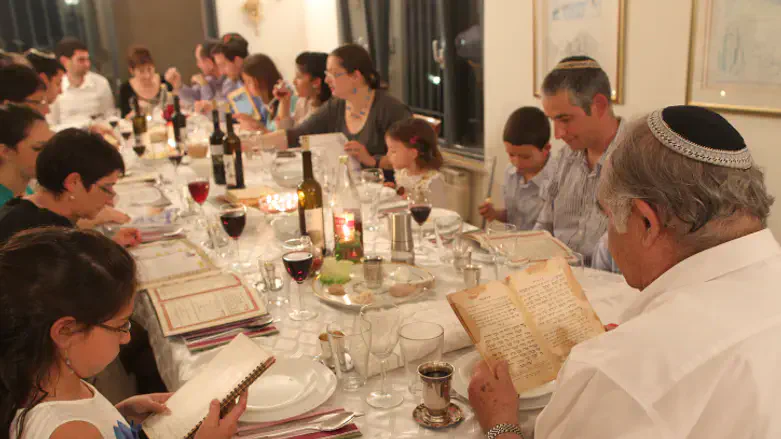
The Pesach Haggadah is a study in striking contrasts. On the one hand, we begin by bemoaning sordid origins as idol worshippers. On the other hand, we celebrate the miraculous redemption from Egypt and slavery.
We are most grateful for all of the good G-d does for us. Lest there be any doubt, we sing Dayenu, which makes it clear that it would have been sufficient even if G-d merely took us out of Egypt, let alone all the miracles that occurred, including bringing us to Israel and building the Beit HaMikdash
We are obligated, in every generation, to visualize ourselves as if we were there too exiting Egypt, as a part of the miraculous redemption, for the purpose of bringing us to and vesting us in the Promised Land of Israel. This is even more meaningful in our times, as we are ever so thankful that the prophesized redemption has begun, with the miraculous recreation of the modern State of Israel.
The Haggadah continues with our reaffirmation that we, therefore, have the sacred duty to thank and praise G-d, profoundly and exceedingly, for all these miracles that benefited our ancestors and us, including bringing us from slavery to freedom, from despair to joy, from mourning to a festival day, from darkness to light and from servitude to redemption. This is the statement recited just before we begin reciting the Hallel (praises of G-d).
For the most part, this string of antithetical couplets is easily recognizable, as referring to fundamental aspects of the story of Pesach, depicted in the Haggadah. However, I can’t help but wonder about the purported antithetical parallelism between mourning (Evel) in contrast to a festival day (Yom Tov)? A festival day is not exactly the antithesis of mourning. A more fitting expression of diametrically opposed sentiments might have been the contrast between mourning and consolation (Nechama). The reference to a festival day appears at first blush somewhat obtuse; how can a profound feeling of grief be compared to a disembodied festival day? They may be inconsistent; but one is not the antonym of the other. If this was meant as just another generic reference to the overwhelmingly painful nature of slavery in Egypt, then it appears duplicative and excessive. There are already a plethora of other striking comparisons of untoward to favorable conditions or emotions recited in the Haggadah, which already do this most effectively.
It is, therefore, submitted that the Haggadah has something specific in mind in using the Hebrew terms for mourning and a festive day. It is suggested that it does actually refer to an event of collective mourning, which ended with the observance of the Festival of Pesach, a Yom Tov. Hence, the reference is made, ‘from Evel (mourning) to Yom Tov (a festival day) to allude to the foregoing, as detailed below.
Rabbeinu Bachya notes the Plague of Darkness began on the first day of Nisan. The Plague lasted for seven days. If the surviving Jews began to sit Shiva immediately thereafter, then that would mean that they got up from Shiva on the fourteenth of Nisan, just in time to observe the Festival and hold the Seder that evening. It couldn’t have been easy to transition from a period of acute mourning to celebrating a holiday festival day. Many must have been torn and broken-hearted. On the one hand they survived and were poised finally to obtain freedom. Who couldn’t feel some joy about the prospect; even as they felt grief for the relatives they were leaving behind?
At the same time, they may have also felt apprehensive. As they sat closeted in their homes, enjoying that first Pesach Seder with family and friends, a maelstrom surrounded them. It was at this time that G-d visited the final climactic Tenth Plague on their Egyptian oppressors.
There was also the concern about the very public ritual of the Pesach sacrifice they had been commanded to observe. It was a test of faith. It began with the first commandment to fix the month in which the event known as Pesach was to occur. Everyone was to join in groups of family and friends. Each group was to slaughter a sheep and consume it communally, as a prelude to the Exodus from Egypt.
Consider the trepidation the Jewish people must have felt at that first Pesach Seder more than 3,400 years ago. Sheep were revered and worshiped as idols by the ancient Egyptians. Yet, here were a group of slaves fixing to slaughter these venerated sheep for personal consumption. Imagine the fervent atmosphere. The Jews were to corral the sheep and set them aside for slaughter days in advance of the celebratory event. There was a very real fear that a pogrom might break out, had the Exodus not occurred at the time it did.
The tension was further enhanced by the commandment that the blood of this original Pesach offering was to be used to mark the lintel and doorposts of each Jewish home. What an inviting target? Nevertheless, the Jewish people were commanded by G-d to set themselves apart from the prevailing mores and customs, put themselves at risk and trust in G-d to deliver them.
Not every Jew had been willing to throw in their lot with their brethren. Many were fully acculturated and integrated into the fabric of Egyptian society. Life in ancient Egypt presented some of the same challenges we face today, as well as, seductive charms. It was a superpower, which attracted many talented people from around the world. It boasted a cosmopolitan, permissive society, steeped in art, science and the pursuit of pleasure. Not everyone was a slave. Indeed, the Midrash records that some Jews benefited from Egyptian patronage and rose to prominence. These individuals were wealthy and well respected.
Assimilation was prevalent and the statistics cited in the Midrash are not much different from those reported in a recent Pew study of Jewish life in America. Indeed, it appears that other than Joseph and some other limited exceptions, the Jews in Egypt did not perform the Mitzvot. The Midrash reports that after Joseph passed away, for the most part the Jews in Egypt even ceased to perform the rite of circumcision, in order to more fully assimilate into Egyptian society and culture. Ezekiel castigates the generations in exile in Egypt for their pursuit of idolatry. Imagine, only a few generations after Abraham, his own descendants reverted to idol worship and abandoned the covenant of circumcision.
The net result, according to the Midrash, was that only approximately 20% of the Jewish people left Egypt, as a part of the Exodus; the rest died in the Plague of Darkness. Their fate was also figuratively shrouded in darkness and all but forgotten by history. Yet, it’s likely that few families were unaffected given the apparent scale of the tragedy. However, much like the actual circumstances, it would appear that any mourning rituals were also shrouded in mystery, as noted above.
This may also help explain another enigmatic tradition, at the Seder, about how Hallel is recited. The format used is unique to this observance. Instead of the usual one continuous prayer, it is broken into two parts, separated by the rituals attendant to the eating of Matzo and Maror, as well as the meal. We also do not invoke the usual blessings at its beginning and conclusion.
The Midrash offers an intriguing explanation of this practice. It reflects on how at a time when the Egyptian firstborns were dying in the Plague of the Firstborns that very night, it was inappropriate to be wholeheartedly happy and recite the entire Hallel at once with a blessing. I would humbly suggest, in addition to that sensitivity, there was also the grief they likely felt over the recent and untimely death of so many of their brethren, as noted above.
It was, nevertheless, a time of triumph, survival and miraculous redemption from slavery. The Pesach observance was meant to mark the occasion. The need to thank G-d for this miraculous turn of events was irrepressible. Of course, they were happy to survive and joyous that their children would no longer have to endure slavery. At the same time, it was also hard fully to celebrate, when so many brethren passed away in the Plague of Darkness.
The many, who had so recently lost relatives, must have been broken-hearted. How could they celebrate the moment of liberation unqualifiedly? Yet, as the Haggadah well states, it was, therefore, obligatory joyfully to praise G-d, exceedingly. However, it was hard to do so in one fell swoop. There was a need for some break to reflect and recompose, because the memory of the fallen could not just be fully repressed. The Hallel broken into two reflected the dichotomy between their own pure heartfelt feelings,
The custom of not saying the whole Hallel all at once and breaking it into two parts without a blessing memorializes the emotional turmoil and understandably ambivalent feelings most may have felt at the time. Moreover, isn’t this just the kind of practice that is a potent manifestation of our shared values and sense of unity? How fitting that we honor how the Jews felt and acted in that original Seder setting, by continuing this tradition of reciting Hallel broken into two parts without the usual blessing, in our own Seders, more than three millennia later.
In this regard, it is important to note the extraordinary acts of kindness the surviving Jews nevertheless managed to perform under these extreme circumstances. Remember, they had only just recently been oppressed slaves barely surviving under horrendous conditions. Those who had died in the Plague of Darkness had not suffered the misery of slavery nor apparently done anything meaningful to ease the suffering of their enslaved brethren. They also had many surviving children who were suddenly orphaned. Instead of casting them aside, the former Jewish slaves embraced and adopted them.
Thus, as the Targum notes, each family left Egypt with five sets of children, one comprised of their own and four sets from the four-fifths of their brethren who had chosen not to be a part of the miraculous redemption and, therefore, not survived. This level of compassion and humanity is virtually unparalleled. It is a striking example of the good people can do for each other, even under the most trying of circumstances.
Life is not simple and sometimes we are presented with circumstances that may generate all sorts of mixed emotions. I remember all too well when my father Z"L passed away on Purim day. We had to arrange the funeral and burial in the morning. We performed the mourner’s ritual of ripping clothes, as an overt sign of our grief and status as mourners. We then returned home and had to change our clothes and have a regular Purim Seudah. We were not allowed to exhibit outward signs of mourning the rest of the day; nor sit Shiva.
The whole experience was surreal. Inside, we were still in shock and outside we had to act correctly, as required in observance of the holiday of Purim. After Purim, we resumed the more natural posture of mourning and the observance of Shiva. I can’t help but wonder, was this the kind of emotional rollercoaster embodied in the conflict between the personal emotional state of Evel and the intervening occurrence of a Yom Tov?
I also can’t help but reflect on the feelings most everyone experiences on Yom HaShoah, Yom HaZicharon and Yom HaAtzmaut, in Israel. We visited Israel on the Seventieth Anniversary and were there for all three.
First came the Yom HaShoah observance. It was unlike any I had experienced in the US. Both my father Z"L and father-in-law Z"L were Holocaust survivors, who had lived through the horrors of Auschwitz. It was an especially solemn day, as we remembered them and all the others who perished in the Holocaust and since. However, it was nevertheless stunning to hear the siren ring out and see everyone stop in their tracks. Traffic came to a standstill and we all bowed our heads in silence, as we quietly remembered. The feeling of seeing everyone join in the observance was overwhelming and my eyes teared up. This time it wasn’t just a few Jews huddled together or even an assembly of many; it was an entire nation observing the moment in unison. I couldn’t help but feel a sense of pride too in the respect and sensitivity everyone displayed to each other.
A few days later came the observance of Yom HaZichoron. We attended a number of programs marking the occasion. We heard heart-wrenching tales of suffering from parents who lost children in terrorist attacks. There was not a dry eye in the audience; everyone shared their pain. And, then, just like that, it was night and in a moment the atmosphere changed, as Yom HaZichoron ended and Yom HaAzmaut began. It was suddenly music and celebrations; there was no transition.
Perhaps, this is also how the Jews in Egypt felt that evening at the Seder. However, those who suffered most intimately the recent loss of a close relative might have had the mixed emotions I felt that Purim, when my dad Z"L passed away. Outwardly they may have had to smile as a reflection of the happiness of those around them rightly celebrating; but inwardly it was somehow unsettling.
It is in this light that at our family Seder we continue another tradition established by my father Z’L and father-in-law Z"L, when they conducted the Seder, which resonates with this theme of the original Seder. In every generation we are confronted with all manner of challenges to our survival and, yet, thank G-d we have survived.
I can’t help but marvel at the extraordinary resilience and determination of my father to carry on, despite all the suffering he had endured. What’s more, he motivated himself to build a family in a strange new land and re-establish a traditional Jewish household. He was so happy at the Seder, reciting the Kiddush, reading the Haggadah out loud, singing the melodies he had heard at home and introducing us to all the Jewish rituals and traditions he remembered from his own childhood.
He had a strong and beautiful voice. When he sang, I remember my mom, aunts and uncles tearing up, as they too remembered how life had been in the old country. Their childhoods had been ripped away by the Nazis and their cohorts. Each had a miraculous tale of survival. In that intimate setting, I too felt how grateful they were to be alive, together with us, celebrating the Holiday of Pesach at the Seder. As we clung to each other, the warmth of the moment enveloped us. It is a memory I will always treasure.
What is it about Pesach that makes it so special? It brings out so much good in people. In our times, the Seder is often associated with luxurious surroundings, bountiful food and good wine; but this has not always been the case. It was not so long ago that Jews in Nazi concentration camps celebrated Pesach, even as they were starved, beaten and all but worked to death.
There are reports of those who bravely conducted a Seder in the camps, by each reciting those parts of the Haggadah they remembered. There was no food, let alone Matzo to eat. How to explain that kind of grit and determination to carry on an ancient tradition that seemed so remote from their circumstances? How were they able to sing about the miraculous redemption from Egypt, despite being slave laborers and in the face of near certain death?
As a young boy, my father-in-law Z"L endured the horrors of Auschwitz and the notorious Death March. He survived the Holocaust, was interned in Cyprus and eventually came to Israel, in time to fight in the War of Independence of 1948. He married, raised a family and worked as a policeman in Haifa. He fought in the 1956 War with Egypt and then eventually immigrated to the US with his wife and children. He would often regale us with stories from his youth, but Pesach was particularly auspicious time. There was a certain solemnity that marked his speech when he spoke of the Pesach of his youth. Missing was the usual jocularity that characterized his interactions with the grandchildren and then great-grandchildren.
It was also a time when he became extremely emotional in retelling his own personal story of miraculous deliverance in the Holocaust. We felt his trepidation as he recounted how he became separated from his mother on the line and found himself near a woman from his town Orshava, in pre-war Czechoslovakia, holding a child in each arm. He asked her to take him with her. She responded she had her own two kids to care for and couldn’t take responsibility for him too. But for her refusal, he would have been on the wrong line; the one leading to the gas chambers and certain death. Instead he continued to wander back and forth searching for his mother.
A Polish Jew assigned to gather up the clothing and property left behind at the train station at Auschwitz saw him wandering. He told him to put on some more clothes, puff himself up to look older and stronger and say he was at least 16 years of age. He then directed him to the right line, for labor and hence, life. He did as he was advised. He was on that line when he encountered the Angel of Death, Josef Mengele, who examined his face and striking blue eyes and asked him whether he was indeed Jewish.
He met his uncle on this line. When the gathered souls were asked whether there was a cook among them, only my father-in-law and his uncle refrained from raising their hands. The German Sergeant concluded the two of them must be the actual cooks and they were drafted into kitchen duty. This access to a little extra food saved him from starvation in the slave labor camp at Auschwitz. However, he was not content to eat his meager bit of extra ration alone. He shared it with others in the bunk; who were thereby enabled to survive as well.
This wholly altruistic gesture of profound goodness was characteristic of others who miraculously survived the Holocaust. My own Dad, of blessed memory was also a survivor of Auschwitz. He was a gifted and talented worker and when he did an outstanding job, a German soldier guarding the slave laborers in the machine shop would sometimes give him a treat to eat. He saved it and shared it later with others in his bunk. These little bits of extra nutrition were the difference between life and death in the netherworld of Auschwitz. My father would also speak just a little about his personal story of miraculous deliverance at the Seder.
The words of the Haggadah meant so much to my father and father-in-law. It is now our sacred duty to retell and figuratively relive the experience of their miraculous deliverance at the Seder. Those who still have the opportunity to have Holocaust survivors at their Seder, in person, embrace and treasure them. Their message is priceless. They are a living testament, in our time, to the original miraculous deliverance in the Exodus from Egypt and in every generation since, throughout history.
With the passing of my father-in-law and my dad, years ago, two heroic souls, an era has passed in our family. The gap is impossible to fill, but try we must to instill the new generations with the message they carried with them of Jewish survival in the face of unbearable suffering and despite super-human challenges. It was a miracle they survived and even more so that they went on to build generations of Jewish families and progeny devoted to preserving our traditions.
We are bound together by shared experiences and values with our brethren. This includes belief in the original miraculous Exodus and faith in the ultimate redemption, as well. Joining in the preparations for and the celebration of the Pesach Seder, as they traditional did, serves to reinforce these bonds. So too does performing acts of kindness and other good deeds that were so much a part of their lives. Indeed, there is no better testament to them than emulating their wonderful example of genuine kindness and heartfelt involvement in Gemilat Chesed.
The theme of performing acts of kindness and other good deeds is woven into the fabric of Pesach from its very inception. The Mitzvah of hospitality, which is intimately linked to the traditional observance of the Seder, also takes on a special meaning in this context. As Avot D’Rabbi Natan reports Rabban Yochanan ben Zakai said to Rabbi Yehoshua, in a world where we no longer have the Temple and sacrifices to offer for atonement, Gemillat Chesed serves this same important function. The Talmud expresses a similar concept, by noting so long as the Temple stood, the sacrificial Altar facilitated atonement for the Jewish people. Now, a person’s dining table has taken the place of the altar in the Temple and it provides atonement through the Mitzvah of feeding the poor or guests. What better place to offer genuine hospitality than at the Seder table?
The Pesach Seder, welcoming guests and hospitality are fundamental aspects of the traditional Jewish experience. Treasure them, because they’re priceless. Let’s all spread the good cheer and joyful experience of Pesach and the Seder by sharing it with family and friends and may we all merit the ultimate redemption.
Wishing everyone a Chag Kasher V’Sameach and Zissen Pesach.
Leonard Grunstein, a retired attorney and banker, founded and served as Chairman of Metropolitan National Bank and then Israel Discount Bank of NY. He founded Project Ezrah and serves on the Board of Bernard Revel at Yeshiva Univ. and the AIPAC National Council. He has published articles in the Banking Law Journal, Real Estate Finance Journal and more and is the co-author of "Because It’s Just and Right: The Untold Back-Story of the U.S. Recognition of Jerusalem as the Capital of Israel and Moving the U.S. Embassy to Jerusalem."