

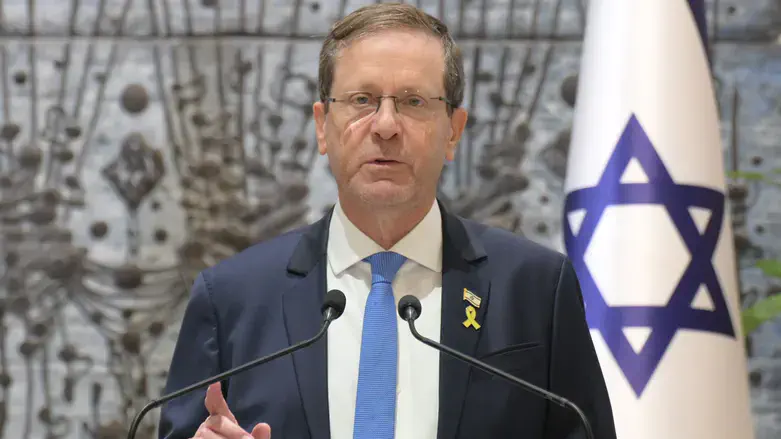
Israeli President Isaac Herzog on Monday responded to a letter from Diaspora Jewish leaders and rabbis expressing concern over a recent surge of violence by extremist elements in Judea and Samaria, emphasizing that such acts contradict the foundational values of the State of Israel and the Jewish people.
In his response, Herzog thanked the signatories for voicing their concerns and affirmed his agreement that the incidents of violence stand "in stark contradiction to the values upon which Israel was founded and to the enduring ethical tradition of the Jewish people." He cited the biblical commandment to "love the stranger" as a core moral tenet that underscores the sanctity of human life.
"To violate these principles is to strike at the very foundations of our society and our shared history," Herzog wrote, adding that "these grave offenses against innocent people undermine the rule of law and tarnish the moral foundations sacred to the State of Israel."
The President stated that he has been in contact with government security and law enforcement officials in recent weeks, urging them to use all available means to bring perpetrators to justice and to end what he described as an "unacceptable phenomenon." He stressed that "a nation governed by the rule of law cannot tolerate violence and vigilantism," calling such acts "a shameful crime against innocents."
Herzog further warned that the violence "interferes with the unceasing efforts of military and security agents to contend with clear and present Palestinian terror threats in the region," and added, "Rest assured, I am fully committed to the cause and carrying out best efforts to deal with this challenge."
Addressing the broader context, Herzog noted that Israel is currently engaged in a "bitter war against enemies that seek its destruction," while Jewish communities worldwide face "a fierce and rising tide of antisemitism." He cautioned that violence against innocents "plays directly into the hands of Israel’s detractors, fueling hatred that weakens us as a nation and jeopardizes Jews everywhere."
On the eve of Passover, Herzog invoked the biblical figure Moses, noting that his first act of leadership was "standing up for justice in the face of violence against the innocent." He emphasized that "safeguarding this core value is our unequivocal duty at this critical hour" and that the law must be enforced "with fairness, and resolve for the safety and well-being of all the residents of the area."
Herzog concluded by expressing appreciation for the sense of mutual responsibility conveyed in the Diaspora leaders’ letter and extended wishes for a "happy, kosher, and, above all, a safe Passover" to Jewish communities worldwide.
In their letter, Diaspora Jewish leaders referenced a previous appeal sent in August 2025 to Prime Minister Benjamin Netanyahu, signed by more than 6,300 individuals from 20 countries, calling for stronger enforcement against what they described as "the frequency and intensity of deadly violence by Jewish extremists is unprecedented" in Judea and Samaria.
The letter, facilitated by The London Initiative and signed by prominent figures in Jewish communities abroad, urged the government "to prevent attacks by settlers and their supporters and ensure arrests and prosecutions of those responsible."
The signatories stated that the situation has since worsened, writing that it has "reached a new nadir," and cited remarks by IDF Chief of Staff Lt. Gen. Eyal Zamir, who described attacks against Palestinian civilians and Israeli soldiers as "morally and ethically unacceptable" and "a major strategic threat to Israel’s security and future."
The Diaspora leaders argued that while Israel’s security forces are capable, "that they do not act decisively suggests a lack of directives from the government."
Describing the attacks as "an abomination," the letter stated, "The terror, death and destruction inflicted by Jewish-Israeli extremists against innocent Palestinians across the West Bank is an abomination," adding that it is "not only morally shameful but a strategic threat to the future of Israel."
The signatories warned that the violence "damages world Jewry and the relationship of future generations with Israel," and asserted that "based on events and on the statements of the most extreme coalition partners, it can be concluded that the violence now engulfing the West Bank is not only condoned by the government but is in fact policy."
They reiterated their commitment to Israel as the national home of the Jewish people, writing, "Our commitment to Israel as the national home of the Jewish People is unwavering," and emphasized that it is grounded in "the Jewish and democratic values enshrined in Israel’s Declaration of Independence."
The letter also highlighted what it described as "a dignified partnership between Diaspora Jewry, all citizens of Israel and the State of Israel," and noted Herzog’s past encouragement that Diaspora Jews have "both our right and obligation to speak up and speak out."
They called on Herzog to "share our profound concerns" with government leaders and to "use your position to implore the government to put an end to the abomination of Jewish-extremist terror and the era of impunity for its perpetrators."
Concluding their message ahead of the Passover holiday, the Diaspora leaders wrote that Jews will "reflect on the promise of freedom and responsibilities of power," warning that "should this scourge remain unchecked it will undermine the promise of the Jewish People’s freedom, security and sovereignty."