
HaRav Shmuel Eliyahu is Chief Rabbi of Tzfat.
On the Iranian Front
If we had seen the splitting of the Red Sea for seven days, for an entire week, we would probably have become accustomed to the miracle and thought it was natural. But in truth it is a miracle multiplied by seven that must be thanked for many times over. This is exactly what is happening to us on the Iranian front. Since the Rising Lion war last year, we have become accustomed to the fact that Israeli planes control the skies of Iran, which is seventy times larger than the State of Israel, and we freely bomb the strongholds of the regime of evil, while no one can stand in our way.
Also the wondrous miracle that not a single plane was lost in the first war in Iran or in this war, no soldier fell, no malfunction occurred - this is an immense wonder that one must not become accustomed to, and one must give thanks for it at every moment and every hour. Such a thing has never happened in any war since the creation of the world. There is nothing comparable, neither in the wars of Israel nor in the history of the nations.
On the Lebanon front
“The voice of the Lord breaks the cedars; the Lord breaks the cedars of Lebanon."
We read about the war in Lebanon in the prophecy of Ezekiel. There, the vengeance of God upon the nations that surround us is described. And since prophecies that were written were written for future generations, the prophet speaks about us as well. If we count the number of verses, we see that the prophet devotes six verses to the vengeance upon Ammon, four verses to the vengeance upon Moab and Seir, three verses to the vengeance upon Edom, two verses to the vengeance upon the Philistines (Ezekiel 26).
In contrast, he devotes three chapters, eighty-three verses, to the vengeance upon Lebanon (Ezekiel 26-28), upon the ruler whose heart grew haughty: “Son of man, say to the prince of Tyre, thus says the Lord God: because your heart was lifted up and you said: I am a god." Pride brought robbery and violence: “By the abundance of your livelihood your society was filled with violence and you sinned; therefore I cast you profaned from the mountain of God and destroyed you." Those who helped you and charted your path were the Persians: “Persia and Lud and Put were in your army, men of war; they hung shield and helmet in you; they gave you splendor." Therefore: “They shall destroy the walls of Tyre and break down her towers, and I will scrape her dust from her and make her a bare rock."
Redemption through Messengers
God says that He will destroy Tyre, Sidon, and their daughters. “Therefore, thus says the Lord God: behold I am against you, Tyre." God does not act directly; He has messengers: “And I will bring up against you many nations, as the sea brings up its waves." God brought us out by means of messengers from Egypt as well. He is the One who is behind it: “Therefore say to the children of Israel: I am the Lord, and I will bring you out from under the burdens of Egypt and save you from their service and redeem you with an outstretched arm and with great judgments."
Moses was the messenger who brought Israel out from under the burdens of Egypt and saved them from their service; he was the one who with his staff performed great judgments in Egypt. And Israel knew that he was the messenger and God was the commander: “And you shall know that I am the Lord your God who brings you out from under the burdens of Egypt" (Exodus 6).
In the Redemption process, God brings us out of exile, but He has messengers: “And the Lord your God will return your captivity and have mercy on you and will return and gather you from all the peoples where the Lord your God has scattered you" (Deuteronomy 30). The messengers sometimes do not keep all the six hundred and thirteen commandments. Thus the Rambam learns from Rabbi Akiva, who called Bar Kokhba the Messiah. From him we learn that not all the messengers kept all the commandments; in the end all the action of the messengers is attributed to God. “And I will take you from the nations and gather you from all the lands and bring you to your land" (see also Jeremiah 29:14; Ezekiel 11:17; 20:34; 20:41; 36:24; 37:21; 39:27).
This is the explanation of the Rambam who wrote (Laws of Kings 11:1) that the King Messiah is the messenger who gathers the dispersed of Israel. “And anyone who does not believe in him, or who does not await his coming, denies not only the other prophets but also the Torah and Moses our teacher, for the Torah testified about him as it is said: ‘And the Lord your God will return your captivity and have mercy on you and will return and gather you’ etc."
But the verses in Deuteronomy speak about God who redeems Israel - and from where did the Rambam learn that the Messiah redeems them? The answer is that this is always how God acts; thus it was in the Exodus from Egypt and thus it will be in the future Redemption.
What Does the Messenger Look Like?
If we choose the messenger, he is a righteous messenger: “engaged in Torah and occupied with commandments like David his father, according to the Written and Oral Torah, and he will compel all Israel to walk in it and strengthen its breaches, and fight the wars of God."
If God chooses the messenger, he may be like Bar Kokhba who did not keep all the commandments, and sometimes even like Cyrus: “Thus says the Lord to His anointed, to Cyrus, whose right hand I have grasped" (Isaiah 45). And of course there can be many messengers for the Almighty. And today - all the soldiers and pilots, observant and non-observant, of the IDF.
It Is a Commandment to Give Thanks for Your Miracles That Are with Us Every Day
There is great problem with a Rabbi in the United States who wrote that it is forbidden to rejoice in the victories of Israel, and that those who rejoice in them are, Heaven forbid, as if rejoicing and dancing before the golden calf. This distorted notion arose because he did not reflect on many verses in the Torah and the prophets in which God acts through messengers.
Heaven forbid to say that Hashem’s action through messengers is idolatry. Every miracle of Hanukkah and Purim was through messengers, and sometimes even Harbonah and Ahasuerus were messengers to carry out the Word of God.
In the miracle of the death of the army of Sennacherib it is written: “And an angel of the Lord went out and struck in the camp of Assyria one hundred and eighty-five thousand; and they arose early in the morning, and behold they were all dead corpses" (Isaiah 37:36).
Hezekiah, who did not give thanks to God for that great miracle, was punished in that he did not merit being the righteous Messiah. Therefore we give thanks every day in Modim: “for Your miracles that are with us every day" - and these are miracles that are done through messengers of all kinds.
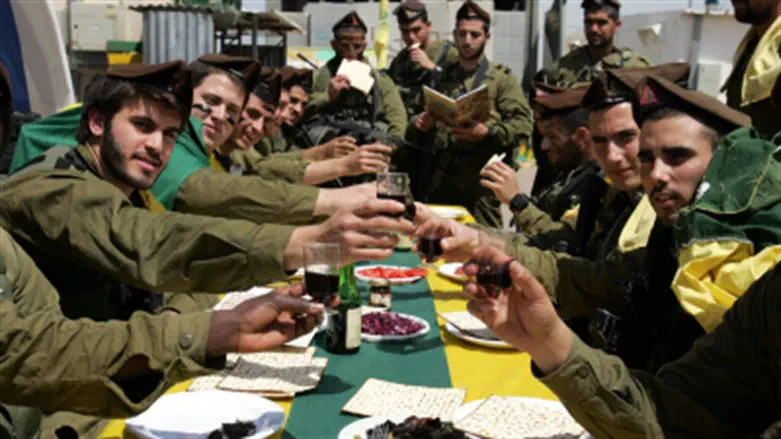
Seder Night for Soldiers at the Front
In the Shulchan Aruch, in the laws of Shabbat (267:2): “One advances to pray the evening prayer earlier than on weekdays, and from plag ha-mincha he may light and accept Shabbat in the evening prayer and eat immediately." And the Mishnah Berurah wrote that it is good to eat a little also at night after the appearance of the stars.
However on Passover it is written: “His table should be set while it is still day, in order to eat immediately when it becomes dark," and he concludes: “But he should not say Kiddush until it becomes dark" (472:2). This implies that the prayer and the Hallel may be done earlier.
The Blessing of Hallel in the Prayer
A soldier or any person who prays the evening prayer alone on the night of the Seder should recite the Hallel with great joy, with a blessing at the beginning and at the end (Shulchan Aruch 487:4; Kaf Ha-Chaim § 42). There are those who say that one should not bless on the recitation of Hallel before the appearance of the stars, but from the language of the Shulchan Aruch it is implied that it is possible to say Hallel before the appearance of the stars (472:1): “He should not say Kiddush until it becomes dark," implying that the prayer and Hallel may be recited earlier.
The Commandments of Passover - from the Torah and from the Rabbis
There is a commandment for every man and woman to eat matzah and maror and to drink four cups of wine. Likewise there is a commandment to tell the story of the Exodus from Egypt and to say Hallel on the night of the Seder. One must remember that telling the story of the Exodus, eating matzah, and the commandment of rejoicing on the festival are obligations from the Torah. In contrast, drinking the four cups, reclining, eating maror, korekh, and afikoman are obligations from the Rabbis.
Which Commandments Are Connected to One Another
These commandments are not necessarily connected to one another. The obligation to recite the Haggadah is a positive commandment from the Torah, and even one who does not have matzah and maror or cannot eat them is obligated in it. It is proper to say the Haggadah near matzah, which is called “bread of affliction - over which many things are answered." But this is not indispensable, and it is possible to say the Haggadah even without tasting or seeing matzah. It is not possible to make Kiddush when there is no matzah, for there is no Kiddush except in the place where there is a meal. Also drinking the wine cannot be done at once, but according to the order of the Haggadah.
The Mishnah Berurah wrote that concerning someone “who cannot eat an olive-size amount of matzah - the Chayei Adam wrote that he can say Yehalelukha according to all opinions. However in the blessing ‘Who has redeemed us’ he should not say ‘to eat matzah and maror with it,’ but only ‘and has brought us to this night; so, Lord our God, bring us’ etc." (Biur Halacha 473).
It Is Possible to Hear the Haggadah
It is not obligatory to say the entire Haggadah; it is possible to hear it. And the custom is to say aloud “Pesach, matzah, and maror." But in truth even this can be heard from others. And of course one must hear an actual voice and not a recording. A person may also hear from a woman and fulfill his obligation, for she too is obligated in the telling of the Exodus from Egypt (Shulchan Aruch 472:14; Pri Megadim 479, Eshel Avraham 2). There are those who say that one who recites the Haggadah himself should make it heard to his own ears, and not in a whisper.
Until Sleep Overtakes Him
It is written in the Shulchan Aruch (481:2): “A person is obligated to engage in the laws of Passover and in the Exodus from Egypt, and to tell of the miracles and wonders that the Holy One, blessed be He, did for our fathers, until sleep overtakes him." Therefore even someone who cannot fulfill all the commandments of the Seder should tell, in his own words, the story of the Exodus from Egypt and the story of the miracles of our generation, to the best of his ability.
Eating and Drinking before or during the Recitation of the Haggadah
The Shulchan Aruch wrote (473:3): “If he wishes to drink several cups, permission is in his hand; nevertheless it is proper to be careful not to drink between the first and the second [cup], unless there is great need, so that he will not become intoxicated and be prevented from conducting the Seder and reciting the Haggadah."
It is permitted to drink other beverages (Mishnah Berurah §16). It is also customary to eat nuts and eggs during the recitation of the Haggadah, but the matzot are eaten, at the outset, only after the recitation of the Haggadah. If there is great need, it is possible to eat before the recitation of the Haggadah (Responsa Shevet Ha-Levi, part 9, siman 118:1).
The Time for Reciting the Haggadah
Kiddush and Haggadah - ideally after the appearance of the stars
It is written in Kaf Ha-Chaim (472, §4) that on Sabbaths and festivals one may add from the weekday to the holy. Nevertheless on Passover one cannot advance the Kiddush, because the time for eating matzah is at night, as concerning the commandments of the Passover offering it is written: “With matzot and bitter herbs they shall eat it," and the Passover offering and the matzot with it are eaten only at night, as it is written: “And they shall eat the flesh on this night."
Although the Kiddush is said much earlier than the eating of the matzah, and if one began Kiddush before the appearance of the stars he will still eat the matzah afterward - nevertheless the entire narration and the four cups are part of the night of the Seder, and they too must be at the time when it is fit to eat matzah and maror.
If He Made Kiddush and Recited the Haggadah before the Appearance of the Stars
And in §6 Kaf Ha-Chaim wrote in the name of Shulchan Gavoah: “After the fact, if he made Kiddush while it was still day, and similarly regarding the commandments and the Haggadah and the eating of karpas, if he did so while it was still day - he has fulfilled his obligation. But the eating of matzah and maror, which is compared to the Passover offering, even after the fact he has not fulfilled."
According to the Maharil, he has fulfilled the obligation of Kiddush, but the obligation of karpas and of ‘telling’ he has not fulfilled. From the words of Terumat Ha-Deshen mentioned above and those who agree with him, it appears that he has not fulfilled even the obligation of Kiddush.
Therefore Kaf Ha-Chaim concludes: it appears that only regarding Kiddush may it be said that he has fulfilled the mitzva, and because of the principle of doubt in blessings we are lenient; but regarding the eating of karpas, matzah, and telling [of the Exodus], he must repeat them after it becomes dark. (In Responsa Minchat Yitzchak, part 10, siman 41, it is written that one should not make Kiddush while it is still day, even in pressing circumstances.
However, in Responsa Minchat Asher, part 3, siman 36, it is written that in pressing circumstances it is possible to make Kiddush while it is still day.
Likewise in the book Da’at Zekenim Segal, p. 69, it is brought in the name of Rabbi Y. Zilberstein, may he have long life, that after the fact it is possible to have fulfilled the mitzva of Kiddush while it is still day.
A Soldier or a Woman Who Cannot Wait until the Appearance of the Stars
A soldier or a woman at home who cannot wait until the appearance of the stars may begin arranging the Seder while it is still day, before Kiddush, and recite the Haggadah until the words “Rabban Gamliel says." After the appearance of the stars they should make Kiddush and continue the recitation of the Haggadah.
If it is not possible to wait that long, they should make Kiddush before the appearance of the stars, skip “Rabban Gamliel says," and skip the blessing “Who redeemed us" and the recitation of Hallel. They should begin the meal without washing hands and without ha-motzi, and eat all foods except the matzah.
After the appearance of the stars they should say “Rabban Gamliel says," bless “Who redeemed us," and recite the Hallel. Afterwards they should wash hands and eat matzah, maror, korekh, and afikoman.
A Quick Conducting of the Seder
How to Shorten the Haggadah
One who cannot remain awake until a late hour or has limited time and must shorten the conducting of the Seder should make Kiddush and drink the first cup while reclining. He should skip ahead and say “Rabban Gamliel says," “Whoever did not say" etc., bless the blessing “Ga’al Yisrael," and drink the second cup. If he has additional time, he should say “Ma Nishtanah" and “Avadim Hayinu," which is the primary obligation of telling the story of the Exodus from Egypt. If there is more time, he should say the rest of the sections of the Haggadah.
A Quick Meal
After “Maggid," he should wash hands and eat matzah, maror, and korekh. If he does not have time, he should eat only matzah. If he has more time, he should eat maror, and if he has still more time, he should eat korekh. After the meal he should eat an olive-size amount of matzah for the sake of the afikoman, bless Birkat Ha-Mazon, and drink the third cup. If he does not have time to drink the fourth cup, he should now bless the concluding blessing on the wine. If he has time, he should also drink the fourth cup and afterward bless the concluding blessing. However, if he has time to eat only one matzah, he should eat that matzah only at the end of the meal - the afikoman.
Continuing the Haggadah after the Meal
If there is additional time, he should recite Hallel and drink the fourth cup. If during the recitation of the Haggadah he skipped its first part of Hallel, he should complete it now if he has time. If he has additional time, he should not drink the cup at the end of Hallel, but should also say Nishmat Kol Chai with the blessing at its end, and bless the concluding blessing. If he already blessed the concluding blessing after the third cup, he should bless again after this cup.
A Seder Conducted Late at Night
Someone who did not succeed in reciting the Haggadah and eating matzah until close to midnight should advance the eating of matzah and maror before the recitation of the Haggadah so that he will manage to eat them before midnight. Afterwards he should recite the Haggadah, and afterwards eat his meal.
One who was delayed and conducted the Passover Seder after midnight should conduct the Seder as usual, but should not bless “on the eating of matzah" and “on the eating of maror." Likewise he should bless the blessing “Ga’al Yisrael" at the end of the Haggadah, without the Divine Name and sovereignty. However, the Hallel and the blessing “Yehalelukha" - he should bless as usual (Kaf Ha-Chaim 477 §10, 14).
The Laws of Maror and the Four Cups
The Size of the Cup and the Type of Wine
In the Shulchan Aruch (472:9) it is written that the measure of a cup is a revi’it, that is 86 grams (in gematria “kos"), and one may put a little water in the wine so that it will not be too strong. If the cup holds only a revi’it, he should drink all of it or most of it. If the cup is large, he must drink from it a revi’it or most of a revi’it, and that is sufficient. There are those who say that he must drink most of the cup even if it holds several revi’iyot.
It is also possible to drink good grape juice, and there are those who hold that one must specifically take wine (Or Le-Tzion, part 3, chapter 15:4). Maran Rabbi Eliyahu would mix wine with grape juice so that he would not fall asleep.
A soldier who cannot drink wine may, to begin with, drink grape juice.
One for Whom Drinking Wine Is Difficult
One who does not drink wine because it harms him, or he dislikes it, must press himself to drink in order to fulfill the commandment of the four cups. Such a person may, at the outset, take grape juice (see 472:10). If drinking will cause him illness or he will become bedridden, he is not obligated to drink wine (Mishnah Berurah §35).
Someone who doctors warned that wine is difficult and dangerous for him - there are those who say that drinking wine would be a commandment that comes through a transgression (see Responsa Minchat Yitzchak, part 4, siman 102:2, who discusses one whom doctors warned that eating matzah and maror is dangerous for him, and brings in the name of Mahar"i Asad, Orach Chaim siman 160, that if he ate, it is a commandment that comes through a transgression).
Someone Who Cannot Recline
Kaf Ha-Chaim wrote on Orach Chaim siman 472: “One who has an injury in his left arm such that he cannot recline on his left side, it appears that in such a case he is exempt from reclining, for the sages instituted reclining only as a manner of freedom and enjoyment and not as a manner of suffering."
Likewise is the law for one who is in a war zone or in a combat vehicle, who recites the Haggadah and drinks the wine and eats the matzot ‘while going on the way’; he is not obligated to recline, for it is not the manner to recline during travel.
Eating Horseradish or Lettuce
Even someone who is accustomed to eat sharp maror (horseradish) may eat lettuce that is clean of worms. He should, at the outset, take one large leaf or two medium ones. If he is weak and it is difficult for him, he may take the smaller measure by volume, 17 grams. If he has none at all or has only a little - he should eat, but should not bless on the eating of maror.
The Laws of Eating Matzah
Three Matzot
In the usual manner, three matzot are placed before the person conducting the Seder. After the blessing Ha-Motzi and Al Achilat Matzah, he eats while reclining an olive-size from the upper matzah and an olive-size also from the middle matzah (475:1). After the fact, if he ate he olive-size either from the whole matzah or from the broken one, he has fulfilled his obligation (Mishnah Berurah 475 §11). Some say that members of the household who do not eat a full olive-size from the matzot of the Seder plate and find it difficult may suffice with eating one olive-size (Responsa Minchat Asher, part 3, siman 39:2).
Within Four Minutes
He is obligated to eat the matzah within the time of akhilat pras, that is, within four minutes. If he cannot eat from both, he should eat at least from one of them within four minutes, and it is preferable that the olive-size be from the upper matzah; if he ate from the lower one, he has fulfilled his obligation (see Shulchan Aruch 475:6; Ben Ish Chai Tzav 34; Shiurei Torah of Rabbi Chaim Naeh, siman 3:15; Responsa Or Le-Tzion, part 3, chapter 15:13).
To Eat in the Usual Manner
He must eat the matzah in the normal manner of eating, and not swallow it, etc. It is preferable not to put the two matzot into his mouth at once, for this is not the manner of “eating," and the Torah commanded: “In the evening you shall eat matzot." Rather, he should hold the two matzot in his right hand and put them into his mouth in the normal manner of eating, chewing and swallowing, and when he finishes, he eats the remainder (see Kaf Ha-Chaim there §18 in the reasoning of the Magen Avraham; Ben Ish Chai Tzav 34).
Korekh - Afikoman
In korekh he eats an olive-size of matzah together with maror and dips it in charoset. “After the completion of the entire meal they eat from the guarded matzah under the covering an olive-size each, in remembrance of the Passover offering eaten in satiation, and he should eat it while reclining and should not bless upon it, and he should be careful to eat it before midnight" (477:1). “Ideally it is good that he take two olive-sizes, one in remembrance of the Passover offering and one in remembrance of the matzah eaten with it" (Mishnah Berurah 477 §1).
An elderly person or someone who is ill and finds it difficult to eat two olive-sizes should eat at least one olive-size and thereby fulfill the obligation.
The Measure of an Olive-Size for the Commandment Matzah, for Korekh, and for Afikoman
The measure of an “olive-size" is 27 grams. One is lenient for an elderly or ill person and calculates an “olive-size" as 20 grams (Shulchan Aruch 486 and those who comment upon it). In Orchot Rabbeinu (new edition, part 2, p. 76) it is brought that the Chazon Ish considered a quarter of a hand-matzah as an olive-size. See also the Chazon Ish (Orach Chaim siman 39 §17) that the measure of an olive-size of matzah is determined by estimation by the eye. And it is written in Kehillot Yaakov (Pesachim siman 43) that according to the Chazon Ish, fundamentally one should estimate the size of the olive of our days, and only stringently do they say like half an egg or a third of an egg.
One Who Has Only Half a Matzah
We do not rule like the opinion of the Chazon Ish in this matter, but because of his view - one who has only half an olive-size should eat it. The Chida wrote that just as half a measure is forbidden by Torah law, so there is a commandment in half a measure. Certainly there is in it a remembrance of the commandment, and therefore he must eat it (Birkei Yosef 482 §4). In this case he should not bless “on the eating of matzah." Even if he has less than twenty grams he should not bless, but should hear the blessing from others. Nevertheless, the blessing Ha-Motzi is recited even on a small amount.
One Who Has Only One Olive-Size
One who has only an olive-size piece of matzah shmura blesses “on the eating of maror" and eats maror, and afterward eats other cooked foods. When he finishes his meal he washes his hands and blesses “Ha-Motzi Lechem" and “Al Achilat Matzah," and eats that olive-size while reclining, and tastes nothing after it. There are those who say that when he does not eat the measure of an egg he does not bless on washing hands (Shulchan Aruch 158:2).
One Who Has Two, Three, or Four
If a person has only two olive-sizes of matzah, he should eat the first at the beginning and bless upon it “Ha-Motzi Lechem" and “Al Achilat Matzah," and the second he should eat for the afikoman. If he has three matzot, he should also eat for korekh. If he has four or more, he should eat two after Ha-Motzi, one for korekh, and one for afikoman. One who is stringent to eat two olive-sizes for the afikoman - is blessed (Shulchan Aruch 482 and those who comment upon it).
A seder after Midnight
A person who was delayed and conducted the Passover Seder after midnight should conduct the Seder as usual, but should not bless “on the eating of matzah" and “on the eating of maror." Likewise he should not bless the blessing “Ga’al Yisrael" at the end of the Haggadah, but should say it without the Divine Name and sovereignty. However, the Hallel and the blessing “Yehalelukha" he should say as usual (Kaf Ha-Chaim 477 §10, 14).
Drinking Coffee after the Afikoman to stay awake
In the Shulchan Aruch it is written that one does not drink any beverage after the afikoman and the four cups, except water. Several reasons are given for this: the first, that he should not drink wine lest he fall asleep and not fulfill the commandment to tell of the Exodus from Egypt and of the wonders of the Holy One, blessed be He, as is proper, even the entire night. According to this, specifically wine and other intoxicating beverages are forbidden. Some say the concern is that it will appear as though he added to the four cups, and according to this only what is suitable for the four cups is forbidden - namely chamar medina.
There are those who wrote that the reason is so that the taste of the matzah will not depart from his mouth through drinking, and just as it is forbidden to eat after the Seder for this reason, according to this reason every beverage, even if it is not chamar medina and is not intoxicating, is forbidden. According to the language of the Shulchan Aruch he was stringent regarding every beverage.
Nevertheless, in a case of great need one may rely on the first reasoning to permit him to drink other beverages that are not intoxicating. Therefore a soldier who must drink coffee so as not to fall asleep on his watch may drink coffee or any other beverage that keeps him alert.