
New York City has long prided itself on being a bastion of pluralism, a metropolis where faiths converge, cultures coexist, and civil liberties are not merely protected but celebrated. Yet today, beneath the familiar rhetoric of tolerance and inclusion, a far more troubling reality is emerging-one that demands urgent scrutiny and unflinching moral clarity. The ascent of Mayor Zohran Mamdani has coincided with what can only be described as a deeply disconcerting normalization of antisemitic rhetoric, institutional equivocation, and political duplicity.
The question is no longer whether troubling signals exist-they do, unmistakably-but whether the city’s political establishment, civic institutions, and federal overseers possess the fortitude to confront them before the damage becomes irreparable.
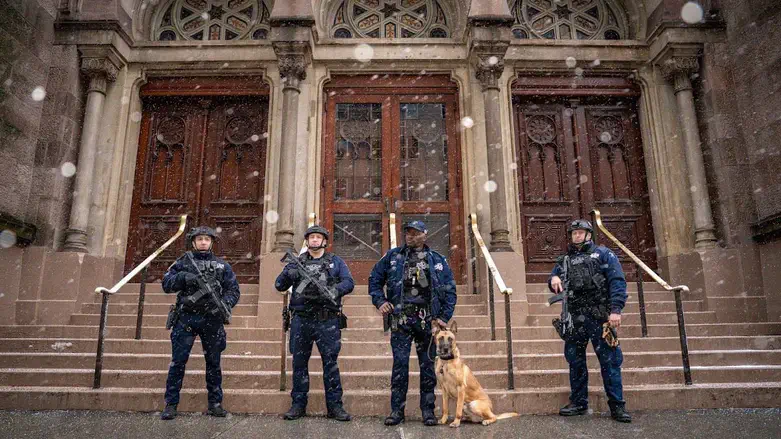
Amid this unsettling backdrop, the passage of City Council Speaker Julie Menin’s legislation establishing protective “buffer zones" around houses of worship stands as a rare and commendable assertion of moral resolve. Approved by a veto-proof majority, the bill is a direct response to the appalling spectacle witnessed last November outside Manhattan’s Park East Synagogue, where a mob of approximately 200 agitators besieged congregants attempting to attend an event hosted by Nefesh B’Nefesh.
That episode was not a protest in any legitimate democratic sense; it was intimidation, pure and simple. Individuals seeking to engage in religious and communal life were subjected to harassment, obstruction, and fear. The synagogue-one of the most sacred spaces in Jewish life-was transformed into a battleground by those intent on weaponizing public outrage for ideological ends.
The Menin bill, therefore, is not merely a procedural adjustment. It is a reaffirmation of a fundamental civic principle: that no individual, regardless of faith, should be impeded from entering a house of worship. That this measure faced opposition from figures closely aligned with Mayor Mamdani only deepens concerns about the prevailing ethos within his political orbit.
More alarming still was Mamdani’s own response to the Park East incident. Rather than unequivocally condemning the mob’s actions, he offered a justification so tenuous and so morally inverted that it demands careful examination.
Through a spokesperson, Mamdani asserted that while he supports the right of all New Yorkers to enter houses of worship without intimidation, such spaces “should not be used to promote activities in violation of international law." This statement, cloaked in the language of principle, is in fact a masterclass in obfuscation.
The event in question did not involve any illegal activity. The allegation that it facilitated the purchase of Muslim-owned land in Judea and Samaria -a claim both factually untrue and legally irrelevant-served merely as a pretext. And no legal framework exists that prohibits such transactions under international law.
More troubling, however, is the ideological lineage of such claims. The notion that Jews should be barred from purchasing land in certain areas is not a neutral legal argument; it echoes a discriminatory doctrine with deeply troubling historical antecedents. The prohibition on selling land to Jews in the Holy Land was propagated in the early twentieth century under the influence of figures such as Hajj Amin al-Husseini, the Grand Mufti of Jerusalem and a known collaborator of Adolf Hitler. That such ideas now find tacit endorsement within New York’s political discourse is nothing short of astonishing.
Mamdani’s defenders, including segments of the city’s progressive Jewish leadership, have sought refuge in a familiar strategy: plausible deniability. By parsing language, emphasizing nuance, and invoking selective interpretations, they attempt to recast what is plainly discriminatory rhetoric as legitimate political critique.
This strategy is not merely misguided; it is dangerously enabling. It allows antisemitic tropes to be repackaged as policy positions, thereby granting them a veneer of legitimacy. It also places the burden of interpretation on those targeted by such rhetoric, forcing them to prove harm in the face of carefully constructed ambiguity.
The consequences of this dynamic are already evident. Mamdani’s record includes not only controversial statements regarding Israel but also expressions of support for organizations such as the Holy Land Foundation, which has been implicated in financing terrorist activities. During his tenure in the State Assembly, he was associated with the dissemination of conspiracy theories that echo longstanding antisemitic narratives.
Yet these concerns are routinely dismissed or minimized, often by those who should know better. The result is a political environment in which antisemitism is not confronted but rationalized.
Perhaps the most insidious development, however, lies in the institutional sphere. Mamdani’s decision to appoint Phylisa Wisdom as head of the Office to Combat Antisemitism exemplifies a broader pattern of appointing individuals whose perspectives are at odds with the communities most affected by antisemitic violence.
Wisdom’s alignment with ideological positions that frequently critique Orthodox and Hasidic communities raises legitimate questions about her suitability for a role that demands impartiality and cultural sensitivity. These communities, after all, have borne a disproportionate share of antisemitic attacks in recent years. To place their concerns in the hands of a figure who is clearly unsympathetic to their experiences is, at best, a misjudgment; at worst, it is a deliberate marginalization.
Compounding these concerns is the establishment of the so-called “Global Oppression and Public Health Working Group" within the city’s Health Department. As highlighted by Senator Bill Cassidy, this initiative appears to blur the line between public health and political advocacy, promoting narratives that characterize Israel’s actions as genocidal while minimizing or omitting the atrocities committed by Hamas on October 7, 2023.
Such framing is not merely contentious; it is profoundly misleading. It reduces complex geopolitical realities to simplistic moral binaries, thereby distorting public understanding and inflaming tensions.
Senator Cassidy’s intervention marks a critical juncture in this unfolding crisis. As chair of the Senate Health Committee, he has both the authority and the responsibility to scrutinize how federal funds are utilized by municipal agencies. His warning that New York City could face the loss of federal funding if it continues to institutionalize antisemitic narratives is both significant and necessary.
This is not a matter of political retribution; it is a question of accountability. Federal resources are intended to serve the public good, not to subsidize ideological agendas that undermine social cohesion and perpetuate discrimination.
Mamdani now faces a stark choice.
His broader policy agenda, characterized by ambitious social programs and expansive public spending, is heavily dependent on federal support. If that support is jeopardized, the viability of his initiatives will be called into question.
In this sense, the conflict is not merely ideological but practical. The mayor must decide whether to prioritize his political convictions or the financial stability of the city he governs.
New York stands at a pivotal moment. The city’s identity as a haven for diverse communities is being tested by forces that seek to redefine tolerance in ways that exclude and marginalize. Antisemitism, once relegated to the fringes, is increasingly finding expression within mainstream political discourse.
This trend is neither inevitable nor irreversible. It can be countered through decisive action, principled leadership, and an unwavering commitment to truth. The passage of the buffer zone bill demonstrates that such action is possible. The involvement of federal authorities indicates that oversight mechanisms remain intact.
But these are only initial steps. What is required now is a sustained effort to confront antisemitism in all its forms, whether overt or disguised. This includes holding public officials accountable for their words and actions, ensuring that institutional policies reflect genuine inclusivity, and fostering a civic culture that rejects hatred unequivocally.
The rise of antisemitism under the current administration is not merely a political issue; it is a moral one. It challenges the very principles upon which New York City-and indeed the broader American project-are founded.
Mayor Mamdani’s tenure will ultimately be judged not by the ambitions of his policies but by the integrity of his leadership. At present, that leadership is compromised by a willingness to tolerate, and at times justify, rhetoric that undermines the dignity and security of Jewish New Yorkers.
The question posed at the outset-whether anyone will stop this trajectory-remains open. The answer will depend on the courage of those willing to speak out, the vigilance of institutions tasked with oversight, and the collective resolve of a city that has always aspired to be better than the forces that now threaten to divide it.
New York has faced crises before and emerged stronger. It can do so again-but only if it confronts this moment with the clarity, conviction, and courage it so urgently demands.
Fern Sidman, a former NY correspondent for Arutz Sheva, is the current editor-in-chief of The Jewish Voice, a New York based publication. Her writings can be accessed at: tjvnews.com