

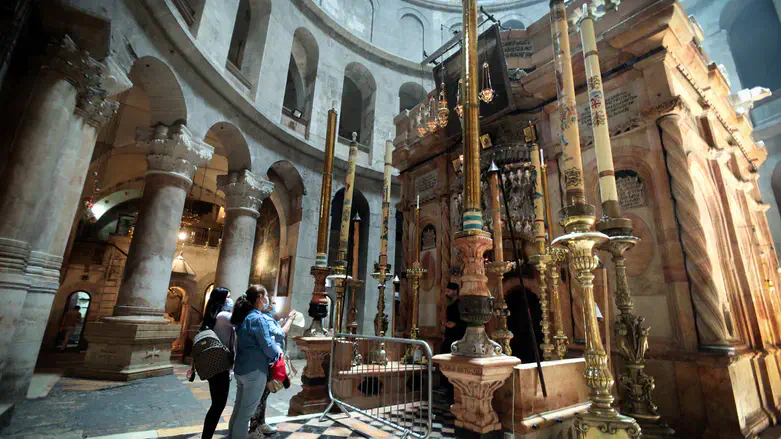
The Israel Police on Sunday night approved a prayer framework at the Church of the Holy Sepulchre, in coordination with a representative of the Latin Patriarch.
During a situational assessment by the Jerusalem District Commander, Deputy Commissioner Avshalom Peled, together with the Commander of the David Sub-District, Commander Dvir Tamim, and in coordination with a representative of the Latin Patriarch, a limited prayer framework was approved in order to enable freedom of worship for all Christian denominations at the Church of the Holy Sepulchre, said an Israel Police statement.
The police clarified that restrictions at holy sites without standard protected spaces, including the Church of the Holy Sepulchre, stem from Home Front Command directives and are intended to safeguard worshippers.
It noted that both the Western Wall Plaza and the Temple Mount complex are also closed to worshippers, due to concerns for public safety.
“Iranian regime missiles do not distinguish between religion or background, and the Iranian regime continues to launch missiles toward populated areas and holy sites," the Israel Police stated.
The new framework follows the incident on Sunday morning in which Israeli Police prevented the Latin Patriarch of Jerusalem, Cardinal Pierbattista Pizzaballa, from entering the Church of the Holy Sepulchre after he attempted to reach the site in violation of wartime restrictions imposed under Home Front Command guidelines.
According to a statement by the Latin Patriarchate of Jerusalem and the Custody of the Holy Land, Cardinal Pizzaballa, together with the Custos of the Holy Land, Fr. Francesco Ielpo, was stopped en route while proceeding privately and “without any characteristics of a procession or ceremonial act," despite existing wartime restrictions barring access to holy sites, and was compelled to turn back.
The Patriarchate noted that, as a result, “for the first time in centuries, the Heads of the Church were prevented from celebrating the Palm Sunday Mass at the Church of the Holy Sepulchre."
The statement described the incident as “a grave precedent," adding that it disregards “the sensibilities of billions of people around the world who, during this week, look to Jerusalem."
Church leaders stated that they have complied with all restrictions since the outset of the war, including canceling public gatherings and arranging for broadcasts of services to the faithful worldwide.
“Preventing the entry of the Cardinal and the Custos… constitutes a manifestly unreasonable and grossly disproportionate measure," the statement said, calling the decision “hasty and fundamentally flawed" and “an extreme departure from basic principles of reasonableness, freedom of worship, and respect for the Status Quo."
The Patriarchate and the Custody of the Holy Land expressed “profound sorrow" to Christian faithful in the Holy Land and worldwide over the inability to hold prayer on one of the most sacred days of the Christian calendar.
Israel’s Ambassador to Italy, Jonathan Peled, was summoned for a discussion at the Foreign Ministry in Rome following the incident. Additional foreign embassies have also sought clarification from the Foreign Ministry.
The Foreign Ministry stated that all safety and precautionary instructions in the Old City are a direct result of Iranian missile fire.
“As is known, the Iranian regime has fired on the Old City on multiple occasions, striking sites in the vicinity of the Church of the Holy Sepulchre, the Al-Aqsa Mosque, and the Western Wall," the statement said.