

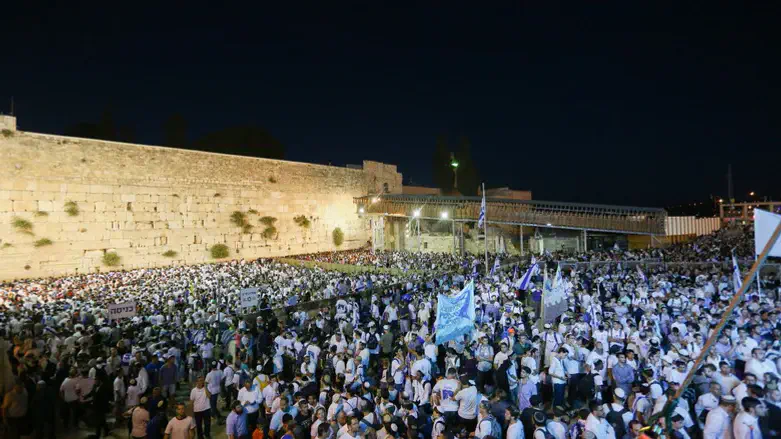
The day after the Iran War broke out, I shelved an op-ed I had started to write. It centered on the combustible issue of the Kotel status quo that had burst back in the news in late February. Although the Kotel is always of paramount importance, I did not think a piece on its sanctity would get the attention it deserves within days after the war.
The Kotel issue had reemerged around a week before the war began, after lying dormant for some time. In a ruling widely cheered by diaspora’s non-Orthodox Jews, the Israeli High Court of Justice ordered the government to advance the upgrade of the egalitarian prayer section at the Kotel, demanding that the multimillion-dollar construction be completed within ten months.
In response, Avi Maoz of the Noam Party introduced the “Western Wall Bill". The bill is an unambiguous amendment to the existing 1967 law concerning the Kotel, which places control of prayer arrangements under the authority of the Chief Rabbinate. Maoz’s legislation essentially criminalizes egalitarian prayer at the Kotel by classifying any failure to comply with rulings of the Chief Rabbinate as a “desecration", punishable by up to seven years in prison.
Maoz’s bill passed its initial presentation on February 25th by a 56-47 vote. While it needs to pass future readings, Maoz was joined by Hareidi and Orthodox politicians in calling the bill a “victory for tradition, Jewish law and Judaism."
Predictably, the Reform Movement put out a statement unequivocally condemning “this alarming proposal". The statement urged “our Reform and Conservative partners worldwide in calling on Israeli leaders and diplomats to halt this dangerous legislation."
Three days later, America and Israel jointly attacked Iran. The Kotel issue stalled again.
But protecting the holiness of the Kotel is not a subject that ever goes away. As the last standing vestige of the Beit Hamikdash, the kedusha of the Kotel is a symbol of the kedusha permeating all precepts of Jewish life. War or no war, the topic may temporarily recede in the background but its relevance remains ubiquitous.
Certainly, the Reform movement did not put the issue on the back burner. An action alert regarding “Defending Egalitarian Prayer at the Kotel" that appeared before the war still runs on their website’s homepage. It provides directives and resources to block the bill, including email links to Prime Minister Netanyahu.
Just like we understand that adherence to halakha is what undergirds Eretz Yisrael, the Reform understand it too. From the opposite point of view.
According to the Reform, “This proposal risks setting a broader precedent. If codified, it could embolden efforts to restrict recognition of non-Orthodox conversions, limit public funding for pluralistic institutions, and expand rabbinic court jurisdiction in ways that further erode religious freedom."
This is precisely why we must do whatever is in our power to protect the status quo of the Kotel, thus protecting the status quo of halakhic decisions that come under the purview of Israel’s Chief Rabbinate.
To that end, Am Echad and the Coalition for Jewish Values put out an ad in late February warning that, “This is not about prayer. It is about the future of the state. A small but radical minority among Diaspora Jews is attempting to overturn a 3,000-year tradition at the Western Wall by establishing a ‘Reform section’ at this holy site."
Two weeks into the war, Rabbi Pesach Lerner from Eretz HaKodesh, a movement representing Orthodox communities in the diaspora, assisted by Esther Jacobs, who facilitated the enormously consequential Am Echad Kotel petition campaign several years ago, sent a letter to Israel’s Ambassador to Washington Yechiel Leiter. Rabbi Lerner proposed meeting with Ambassador Leiter to “express our unwavering support for the current actions of the Israeli government in her quest to eliminate the threat of Iran, and her proxies; and to discuss the Kotel issue."
A zoom meeting took place on March 18 with Ambassador Leiter that included rabbis and lay leaders that ran the gamut from Ashkenaz, Sephardic, Chassidic, Chabad, Russian, Syrian, Bucharian and other communities.
Ambassador Leiter spoke of the war and the threat of delegitimization that Israel faces, and he called for unity among Jews to combat the scourge of antisemitism. However, he was unwilling to discuss the topic of the Kotel when, as one of the participants, I broached it.
I asked why Israel would acknowledge grievances by non-Orthodox diaspora denominations when they often partner with progressive groups like the New Israel Fund and J Street. These groups oppose the Iran War, promote the two-state solution and deny the IHRA definition of antisemitism, thereby endangering the State of Israel and Jews worldwide.
While Ambassador Leiter did state that he was the first ambassador to officially announce that J Street was outside of the tent, it was clear he did not want to touch the hot button Kotel issue. He said that he did not think it was time to make an issue of Kotel legislation in the midst of a war nor did he think there was an assault on the Kotel. The time for both sides to debate the issue, he said, is after the war.
The ambassador is doing a superb job representing the State of Israel during wartime and the pressures on him must be enormous. But perhaps fog of war obscured the fact that the Knesset itself went back to business two days before our zoom meeting.
On March 16, the Knesset convened a more expanded legislative framework. Bills were scheduled, including the Western Wall Bill, which thankfully advanced.
On cue, the non-Orthodox shried gevalt again. Anna Kislanski, CEO of the Israeli Movement for Progressive Judaism, slammed the advancement as an afront to non-Orthodox Jews “in the midst of a war". It was a refrain that other groups, like Women of the Wall, used too.
When is the time to tackle the issue? In four weeks? Eight weeks? When the war is over?
Spiritual battles don’t have a time line. Or a deadline. While the non-Orthodox continue to push against the Western Wall Bill during the war, the Orthodox need to be as vociferous in pushing for it.
Furthermore, there can be no place for debate here. There are no two legitimate sides to this issue, when one side is pro-halakha and the other side is anti-halakha.
It’s not surprising to hear the outrage of the non-Orthodox, considering how desperately their leadership tries to hold on to fading relevance amidst dwindling membership and an intermarriage rate of over 70%.
After October 7th, Israeli Jews have been moving towards tradition rather than away from it. During the debate for the Western Wall Bill, Israeli Finance Minister Betzalel Smotrich referenced the miniscule Reform presence in Israel, saying that there are only “three and a half Reform Jews in Israel, out of eight million Jews."
In the diaspora, there is the growing phenomena of the October 8th Jew - the unaffiliated Jew eager to learn about his heritage after having it thrust on him in the form of Jew-hatred.
Even the ADL, long associated with progressive groups that now shun Jews, seems to be doing tshuva of sorts upon being confronted with a devastating volume of antisemitic attacks. At their recent Never is Now Summit in NYC, there was an Orthodox presence in attendance and among speakers that is new and growing. Even their meals were strictly Cholov Yisrael.
The heads of the conservative and reform denominations have been busy publishing articles, raising awareness and urging their constituents to contact Netanyahu and “demand that members of his coalition reject this bill and respect Jewish pluralism."
Orthodox Jewry must respond in kind. We must also educate Orthodox diaspora Jews on the issue, partner with groups that promote the Kotel’s sanctity and contact Israeli politicians to support the Western Wall Bill.
This year, as we recite “bechol dor va’dor" at the Pesach seder, the words take on a singular immediacy. And we should be mindful that one kind of threat to the Jewish people sometimes, sadly, comes from within.
As this article goes to print, we do not know when the war will end. But we do know that protecting Kedushat Hakotel can only be a zechut for us as we beseech Hashem to vanquish the enemies of the Jews and the Jewish State.
Sara Lehmann is an award-winning New York based writer. For more of her writings please visit saralehmann.com.
A version of this article first appeared in Hamodia.