
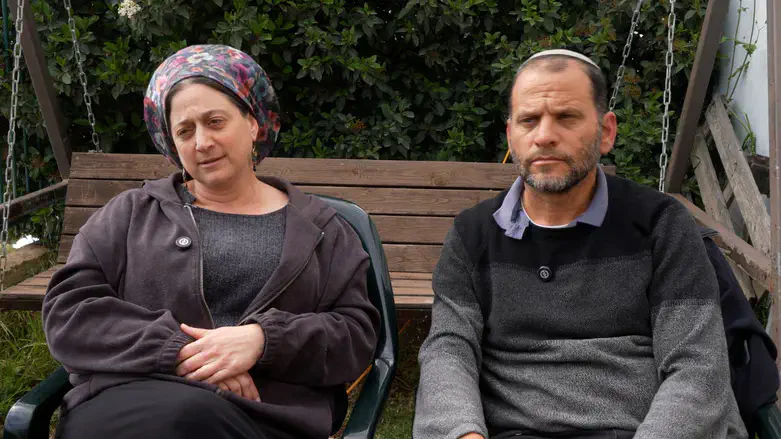
Yehoshua and Sima Sherman, the parents of Yehuda Shmuel HY"D, who was murdered last Sabbath in a ramming attack at just 18 years old, spoke with Arutz Sheva-Israel National News about his unique character, the pain and loss, and also about the unwritten legacy he left behind-the strengthening Jewish communities in Judea and Samaria.
“How do you summarize Yehuda Shmuel in a few words?" wonders Sima. “Sweet Yehuda Shmuel. He was a young man with an enormous heart. Sensitive to his surroundings, to friends, and also stubborn and determined." The father, Yehoshua, adds: “The guys knew that he is determined." When he decided to do something, he would keep going until it was totally completed."
Yehuda Shmuel’s connection to the land began at a very young age. Yehoshua recalls his 11-year-old son walking on Sabbaths to remote hills to reinforce them. “There was no path, it was raining-it was devotion from a young age."
From there, the path to working the farm was natural. Yehuda became an inseparable part of the farm landscapes in the Jordan Valley and Samaria. “Thanks to him, I discovered many farms I didn’t even know existed," says Yehoshua. “He would tell me every time: ‘Dad, the guys at the farm need to go home for Sabbath, I’ll go replace them.’"
For Sima, her son’s choice of a challenging and dangerous life in the field was not always easy to digest, but she chose faith over fear. “As a mother, it was complicated. God forbid, you’re alone going out to the fields. It required self-work on my part to release and allow him because I understood and believed in it. I told him to be careful and protect himself, but we believed the path was right. We’ve lived here for 25 years, through difficult times, and my choice is faith-that the Holy One, blessed be He, decides, and whatever He decides is precise."
Click here to take part in building the land in memory of Yehuda Shmuel Sherman, HY"D.
The picture that emerges from the parents’ stories is of a boy who lived in a world of values, far from the materialism of the screen generation, but who also knew how to enjoy life. “When he would come home from the farm once every two or three months, I would ask, ‘What should I prepare for you? How should I spoil you?’ He wasn’t interested. He lived elsewhere, his world was different. Not that he was some holy recluse-he was mischievous, had off-road vehicles, and they worked on them all day. But his heart was in the right place."
The moment of the brutal attack is etched in the family’s memory as a testimony to devotion and brotherly love. Yehuda Shmuel was on a mounted security patrol with his older brother Daniel and another friend when an Arab pickup truck rammed them with tremendous force, throwing the vehicle into an abyss. Yehoshua recalls the reports he received: “Daniel found himself about ten meters from the car. He saw Yehuda Shmuel in critical condition, tried to reach him despite his own injuries. When he got to him, he realized there wasn’t much he could do. When Arabs arrived and started throwing stones, Daniel went down to shield Yehuda Shmuel with his body. He shouted at them in Arabic: ‘He’s already dead. Leave him alone.’"
Daniel remained with his dying brother for about 40 minutes under a hail of stones, his weapon broken and unusable, until rescue forces arrived. He was attacked by the attackers and suffers from fractured vertebrae in his back and neck. “The recovery journey will take a lifetime," says Yehoshua quietly. “Being with your brother for 40 minutes while he breathes his last breaths is tough enough."
One of the most painful things for the family was the attempt by some media and system actors to distort the reality immediately after the attack. “The story they initially put out in the media was that they stole a pickup truck, went down to the village, and had an accident," says Yehoshua in pain. “From there, you can start spinning whatever narrative people want, and the whole story about Jewish violence. I don’t buy it. These are teenagers with a path."
Sima adds passionately: “These young people have light and clarity in their way. They connect the holy to the land. They sit and study Torah at the farms, attend lessons after nights without sleep, in all weather. This is a generation building the Temple, a generation of redemption. I said this even before he was murdered-these are kids with different strengths we need to learn from."
Yehuda Shmuel HY"D’s legacy is already beginning to take shape. Even during the shiva, the wounded Daniel asked his father to open maps and plan the next sites for building communities. “We are already planning three new sites to be named after Yehuda Shmuel," announces Yehoshua. “His spirit continues; it doesn’t stop. The land of Israel awaits us, crying to be redeemed. Our tears and Yehuda’s spirit will now sow two thousand communities among the people of Israel for continued action."
The phrase that may become Yehuda Shmuel’s motto and sticker is: “The land of Israel needs me." “We hadn't heard of that quote," admits Yehoshua. “The guys told us it was the question that always guided him: ‘Where does the land of Israel need me?’ Not where it’s comfortable for me, but where I am needed."
In conclusion, the parents ask to convey a message of comfort and courage to the entire people of Israel. “We are comforted in building the land and in Jerusalem," concludes Sima. “Yehuda Shmuel did not ascend to heaven to rest. He went to work hard before the seat of honor. The Holy One, blessed be He, needed there a brave warrior to help Him with all the forces above. The light that comes from this will be great light."