
Edited by B. Silberstein
The Rav, Rabbi Yosef Dov Soloveitchik, explained that a tradition tracing back to Moshe Rabbeinu (Moses our Teacher) assigns certain Torah portions to be read near various holidays. This week’s Parsha, Tzav, is read on the Shabbat preceding Pesach (Passover). What is the link between the two?
Halakhic Framework: Kashering in the Mikdash
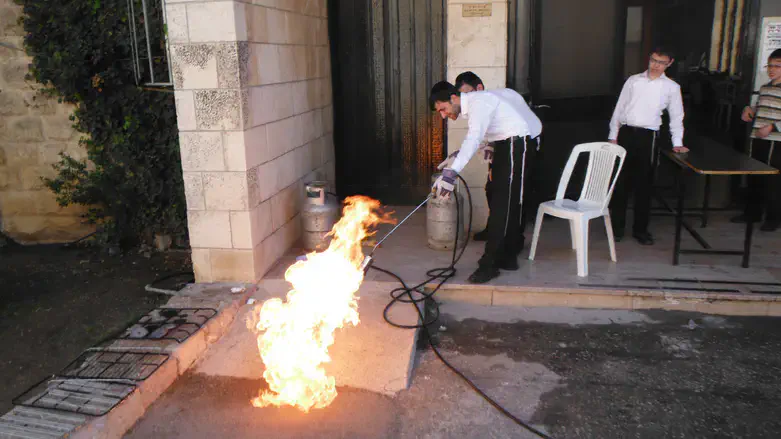
One of the connections is that our Parsha discusses the Kashering of vessels. This was not a peripheral matter, but an integral component of the Temple service. While only kosher meats were used, food could become impure for a variety of reasons. The vessel in which it was prepared would thereby assume a prohibited status and require purification.
This concept is directly relevant to Pesach. One of the most demanding aspects of preparation for the festival is the Kashering of utensils. Our Torah reading serves as the primary source for this procedure, establishing both its necessity and its method.
Why Absorption Matters
Why does it not suffice to merely scrub a vessel until it is completely clean? The Halakha (Torah Law) requires more. The vessel must be subjected to boiling water. The Torah teaches that metal vessels absorb the flavor of the foods cooked within them. Consequently, a pot in which non-kosher food has been cooked cannot be reused until it undergoes a process of purging.
This gives rise to a fundamental question. Why did the Torah legislate concern for absorbed substances that are no longer perceptible? Why are these traces Halachically significant? Would it not be sufficient to avoid all tangible prohibited matter, without regard for what has been internalized within the walls of the vessel?
We are not in a position to determine the ultimate rationale for this or any Mitzvah. However, the Halachic phenomenon itself invites analysis. The Torah is here defining a category of absorption that retains significance even when it is no longer externally discernible. This opens the possibility of deriving an analogous insight in the realm of human behavior.
From Vessels to the Human Soul
The subject of the Temple and its sacrifices is deeply intertwined with themes of sin and its rectification, purity and impurity, guilt and rehabilitation. Man is, by nature, susceptible to sin; complete avoidance of transgression is not a realistic expectation. The sacrificial system was therefore instituted as a means of securing atonement and restoring one’s relationship with Hashem.
However, a critical distinction must be drawn. There is a difference between an external act and an internalized condition. A person may commit a wrongful act and subsequently correct it. But there exists a more serious state in which the influence of the wrongdoing is absorbed into the personality itself.
This is the precise danger to which we are constantly exposed. Inevitably, the impure will find its way into our environment. We exist within a culture that exerts a constant influence over us, both positive and negative. The appeal of hedonism and the logic of relativism are not merely external pressures; they possess the capacity to be internalized. The prevailing notion that “if it feels good, it is good" can become embedded within one’s framework of thinking.
Accordingly, the essential task is not only behavioral correction, but internal scrutiny. One must examine whether these influences have penetrated beyond the surface and altered one’s inner orientation. This requires a more exacting form of self-awareness.
When such absorption has occurred, the situation is qualitatively different. It is no longer a matter of isolated actions, but of a compromised inner state. This is analogous to an addiction in which the individual’s capacity for control has been fundamentally weakened.
Pesach and the Possibility of Transformation
The Halakhic process of Kashering now takes on conceptual significance. There are circumstances in which ordinary corrective measures are insufficient, because the defect has become internalized. In such cases, a more intense process is required, one that penetrates to the very point of absorption and eradicates it at its source.
This idea is reflected in the historical experience of Bnei Yisrael in Egypt. They had descended to an extreme level of spiritual and philosophical corruption. The danger was not merely in their actions, but in the extent to which idolatrous thinking had taken root within them. Had this process continued, recovery would likely have become impossible.
The redemption therefore occurred at the critical moment. Through decisive action, specifically the sacrifice of the Egyptian deity, they were able to uproot the internalized falsehood and reestablish their identity as servants of Hashem.
Pesach thus affirms a fundamental principle. Even when corruption has penetrated deeply, it is still possible to effect a complete transformation. But this requires more than superficial change. It demands a process analogous to Kashering, an intense and penetrating purification that removes the absorbed distortion from within.
As we engage in the physical act of Kashering our utensils, we are confronted with this idea in concrete form. The task is not merely to eliminate what is visible, but to address what has been internalized. In so doing, we are called upon to apply the same standard to ourselves, to reject falsehood at its root and to reorient our thinking toward truth.
May we merit to do so.
Shabbat Shalom VeChag Sameach.