
Erfan Fard is a counterterrorism analyst and Middle East studies researcher based in Washington, with a particular focus on Iran, Islamic Terrorism, and ethnic conflicts in the region. His latest book is The Black Shabbat , published in the US. You can follow him at erfanfard.com and on X @EQFARD
The Islamic Republic rejected all preconditions for an agreement with the United States and refused to engage. Once again, Donald Trump extended an opportunity for diplomacy, yet the remaining structure of the regime appears unwilling to compromise. The situation continues to stagnate, with no meaningful shift in direction. Signs of Russia’s influence can still be seen operating behind the scenes. Meanwhile, the possibility of restarting U.S. military involvement inside Iran remains on the table, suggesting this story is far from over.
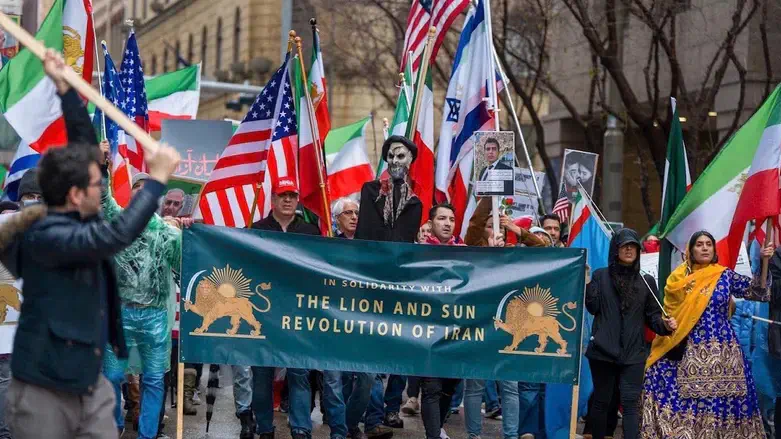
Many Iranians remain hopeful, eagerly anticipating the end of this oppressive and malevolent regime.
Khamenei may be dead, but the violent architecture he built-the network of enforcers, militias, and ideological loyalists-remains intact.
This year’s Nowruz, March 21, arrived not only as a celebration of renewal, but as a moment shadowed by grief. The absence of those who lost their lives in the struggle for Iran’s freedom weighs heavily on the nation’s conscience. Yet alongside this sorrow, there is a growing recognition of something else: the Islamic Republic is entering its final stage, and the pillars of its tyranny are beginning to fracture.
The regime of Shi’ite mullahs, defined by its barbarism and its reliance on Islamic terrorism, has dragged Iran into war and devastation. This is not the will of the Iranian people, who historically have sought stability, coexistence, and peace.
The Islamic caliphate that emerged in Tehran in 1979 was not the product of a mature political transition, but of a chaotic uprising that thrived in the absence of critical thought and institutional resistance. It was, in effect, a hollow spectacle-constructed by opportunists, ideological extremists, and actors detached from national responsibility.
Within a civilization spanning over 5,500 years, it is difficult to imagine a more destructive deviation. The rise of corrupt clerical power-figures devoid of competence yet driven by absolute authority-produced what can only be described as the most discredited and damaging chapter in Iran’s modern history.
Following the earlier weakening of Iran’s state structure after the removal of Reza Shah and foreign intervention, the groundwork for clerical dominance had already been laid. In 1979, with the symbolic presence of figures such as Yasser Arafat, the Islamic Republic was declared. What followed was not merely regime change, but the institutionalization of a system rooted in ideological absolutism and Islamic terrorism.
The ruling establishment constructed an entire narrative to justify its authority: “government of God," “Islamic justice," “religious governance." In practice, however, these slogans masked a system built on repression, deception, and violence.
The outcome is visible today: four decades of systematic suppression, قتل، mass violence, and the erosion of Iran’s social and political fabric.
The regime of Shi’ite mullahs operates not as a rational state actor, but as a destabilizing force-committed to expansion through proxy warfare, ideological indoctrination, and internal repression. It has consistently demonstrated disregard for Iran’s national interests, prioritizing survival and regional influence over stability and development.
Even now, much of the international community continues to underestimate the regime’s fundamental nature.
Its endurance is not based on legitimacy, but on perpetual conflict-with its own population, with the region, and with the broader international order.
Iran today reflects the consequences: a weakened state, a traumatized society, and a younger generation waiting for an exit from authoritarian rule.
Externally, the regime has embedded itself within broader geopolitical rivalries, functioning in alignment with Russian and Chinese strategic interests. Iran, in this framework, is treated less as a sovereign nation and more as a geopolitical instrument.
For historical context, the late twentieth century was defined by the collapse of communism and the end of apartheid, followed by a brief period of unipolar American dominance. The twenty-first century, however, has been shaped by the rise of Islamic terrorism, particularly after the attacks of September 11.
Now, 25 years later, we find ourselves in the unstable, anarchical, and insecure multipolar world, where a new potential turning point is emerging: the dismantling of one of the central nodes of Islamic terrorism in the Middle East.
The events of 1979 remain a critical inflection point. Strategic miscalculations by U.S. policymakers resulted in the loss of Iran as a key ally. The Late Shah, Mohammed Reza Pahlavi, departed the country without resorting to large-scale violence, but the vacuum that followed was filled by forces the West failed to assess properly.
The narrative surrounding 1953 continues to obscure rather than clarify this history, diverting attention from the internal dynamics that enabled the rise of clerical power.
Subsequent decades reinforced the pattern. While the elimination of Osama bin Laden marked a significant milestone, broader connections between state actors and terrorist networks remained insufficiently addressed. Policies such as the JCPOA provided the regime with resources without fundamentally altering its behavior.
A more assertive phase emerged later, particularly with the targeted killing of Qassem Soleimani-an operation that disrupted key elements of the regime’s external projection of power. Earlier, the designation of Iran as part of the “Axis of Evil" had correctly identified the threat, though it was not followed by decisive action.
Taken together, these developments suggest that the long arc of the war on terror is approaching a decisive moment.
Yet the outcome is not guaranteed.
As stated clearly:
This war is a prevent intervention and a hegemonic regime change against an Islamic terrorist regime or Shi’ite caliphate in Tehran which wanted to be a hegemonic power in Middle East and threatened the survival and existence of Israel.
Failure to follow through would allow for the regeneration of Islamic terrorist proxy forces-Hezbollah, Hamas, Hashd, the Houthis, and others-and would prolong regional instability.
Engagement strategies that ignore the ideological and operational nature of the regime risk repeating past mistakes.
At the same time, it is essential to distinguish between the Iranian state and the Iranian people.
Iran is not a banana Republic, it is a nation with a 5,500-year history of civilization.
Any post-regime scenario will present significant risks. The networks that sustain the current system are likely to persist underground, seeking to reassert themselves through violence and fragmentation.
This underscores the importance of a structured transition.
External actors-particularly intelligence institutions with historical familiarity with Iran-can play a role in supporting stability during this period, not as controllers, but as facilitators of security.
Within this context, The Crown Prince Reza Pahlavi emerges as a central figure for a transitional framework. The path toward democratic governance in Iran is inherently complex, shaped by internal divisions, entrenched interests, and external interference, particularly from Moscow.
The internal structure of the regime-rooted in ideological patronage networks with both Russophile and Anglophile dimensions-remains a significant obstacle.
The lessons of 1979 are clear: strategic hesitation carries long-term consequences.
As this moment unfolds, it will be judged not only by its immediate outcomes, but by whether the opportunity for lasting structural change was realized.
The ultimate objective remains straightforward: a stable, sovereign Iran, reintegrated into the international system, and capable of contributing to regional and global stability.
The reopening of diplomatic relations with Tehran would not merely symbolize normalization-it would represent the conclusion of a prolonged period of conflict and the beginning of a new strategic reality.
History will determine whether this moment marked resolution-or repetition.
Erfan Fard is a Middle East political analyst. His latest book, “Tehran’s Dictator," examines the theocratic era of Ali Khamenei, from 1989 to 2026.