
Edited by B. Silberstein
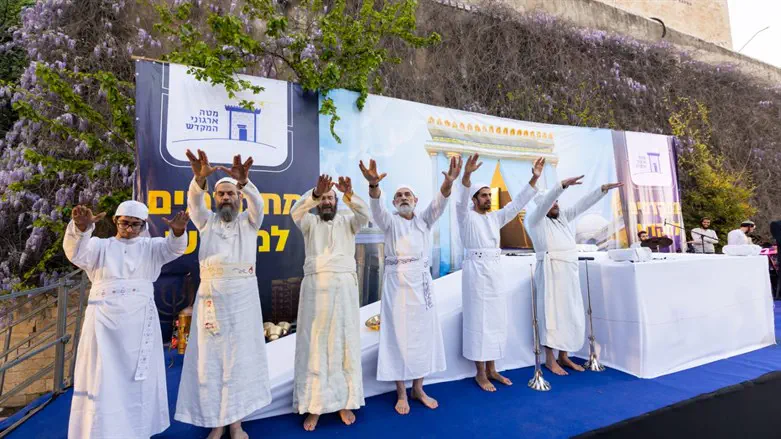
This week’s Parasha commences the third Book of the Torah, VaYikra. Its main theme is the sacrifices performed in the Beit HaMikdash (Holy Temple). This practice was discontinued when that edifice was destroyed and the Jews consigned to exile.
Are the Korbanot a Thing of the Past?
Is it gone for good?
The Rambam states that the Beit HaMikdash will be rebuilt in Messianic times by the King Mashiach himself. In fact, his success in this endeavor will constitute the ultimate authentication of his Messianic status. At that point, allthe Mitzvot (commandments) of the Torah will be restored, including the Korbanot (sacrifices).
In the meantime, the concepts and religious utility of the sacrifices are very much in effect. Judaism is adept at keeping seemingly obsolete institutions alive and relevant, primarily through Torah study. The Talmudic tractates detailing the sacrificial service are studied with the same vigor and intensity as those dealing with contemporary issues. More concretely, Chazal (our Rabbis) ordained that the prayers we recite act as substitutesfor the sacrifices.
From Sacrifice to Prayer
At first glance, the connection between the two disparate activities is not obvious. The Korban entails the offering of an animal, its ritual slaughter, sprinkling blood on the Altar, and consuming the flesh in fire.
What does this have in common with prayer? When one comes before the Creator and presents his petitions and requests, that is, essentially, an Avodah SheBaleiv (Service of the Heart)?
The two rituals seem diametrically opposed. In sacrifice, man “offers" something of his “own" to Hashem, while in prayer, ostensibly, he presents himself as someone who takes, for he is asking for something he would liketo receive (there are no guarantees). We should not be complacent and naively imagine that, simply by supplicating for something, we can be confident that we will get it.
The Rambam’s words are relevant here. He extols the virtue of praying with a Minyan (quorum of 10 men) and says:
“Communal prayer is alwaysaccepted, even when it includes sinners, for the Holy One, Blessed is He, does not reject the prayer of the many. Therefore, a person should associate himself with the Tzibbur [community]; he should not pray alone when he is able to pray with a Minyan." (Hilchot Tefilla 8:1)
Indeed, the very text of the Amidah prayer contains the request that Hashem should find favor with and grant our petitions.
The Root of Sin: The Illusion of Self-Sufficiency
In my opinion, the common thread between Korban and Tefillah is the consciousness that human existence is absolutely dependent on Hashem. This may sound like a simple proposition, but it carries great consequences.
This is because Cheit (sin) is rooted in a certain arrogance. We erroneously believe that our lives belongto us to live as we please. We do not feel that our existence requires an explanation, but rather that it is due to our innate significance in the scheme of things.
We also overestimate our ability to distinguish between right and wrong and thus invent our own code of morality. In our heart-of-hearts, we do not want to believe that we must “nullify [our] will before the Will of the Creator." (Pirkei Avot 2:4) If anything, many people feel the opposite should be true.
True Closeness to Hashem
The sacrifices express the genuine reality of the matter. We take something of significant value that we own and “proffer" it to Hashem. Of course, we are not actually “giving" Him anything.
The notion that we can give something to the Creator or do something forHim is absurd and blasphemous. Although in certain religious circles, it has become popular to express ideas such as, “by doing this and that, we give Nachat (pleasure) to Hashem," I regard this as misleading.
We owe our existence and everything in the universe we inhabit to G-d’s Will, which determined that He should create the world. He, in fact, has no need of us, but for reasons we are not able to discern, He created us.
Realizing that we exist as the handiwork of our Maker must be at the forefront of our consciousness. This awareness keeps us humble and guards us from sin, for we know that we are answerable to the Creator of the universe for our transgressions.
We are not perfect, and when we stray from this idea and violate Hashem’s commandments, we come to His House and reaffirm our belief that we enjoy life by virtue of His Will and must conformto it to find favor in Hissight.
The same “sacrifice" takes place when we pray. We renounce the idea that we are self-sufficient creatures who have the power to dispense all our needs. We humbly testify that He alone, is the Omnipotent Being in whom we trust to straighten our path and provide us with what we need to live a life that brings us closer to Him.
As Rav Yosef Dov Soloveitchik explained regarding the bowing in Modim:
“It appears that there is a requirement of bowingin the “thanksgiving" blessing of Tefilla (Modim) because bowing expresses nullification, in that man realizes that he has nothingand there is nothing comingto him and he is completely dependenton the mercy of the Holy One."
As the Sages have pointed out, the term Korban, generally translated as “sacrifice," is actually rooted in the Hebrew word (ק-ר-ב) meaning “to draw close." This is exactly our goal when we “stand before Hashem" in prayer, which explains why it was chosen to be the vehicle that assures the continuity of the sacrificial system.
May we merit to witness the restoration of Yerushalayim to its former glory.
Shabbat Shalom.