

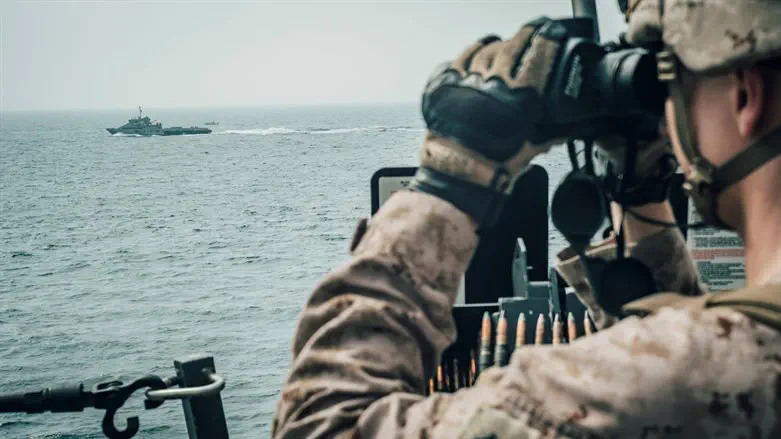
The Strait of Hormuz is not just a stretch of water on the map. It is the most critical chokepoint in the global energy system. Roughly one-fifth of the world’s oil supply passes through this narrow corridor. At its tightest, it functions less like an open sea and more like a controlled valve.
A useful way to understand it is medical. The Strait is like a coronary artery. If it narrows, or worse, becomes blocked, the global economy risks a heart attack.
Hormuz doesn’t need to close to trigger a global shock.
This is why recent calls by Donald Trump for European assistance in securing free passage through the Strait are not merely tactical requests. They reflect a recognition of a structural vulnerability at the heart of the global economy.
There is, however, a fundamental misunderstanding in much of the public discourse. Claims that Iran’s navy has been destroyed, or reduced to irrelevance, miss the nature of the threat entirely. Iran does not rely on a traditional navy. It relies on a distributed, resilient system of asymmetric capabilities, fast attack boats, mobile missile launchers, drones, and mines, many of them easily hidden, quickly deployed, and difficult to track.
Destroying large vessels does not eliminate these capabilities. It merely changes their form.
It doesn’t take a navy, just enough tools to create fear.
In practice, Iran does not need to impose a full blockade. It only needs to create uncertainty. A few mines, a seized tanker, a missile fired near a shipping lane, these are enough to drive up insurance costs, delay shipments, and reduce traffic. The effect is the same, less oil flows, prices rise, and the global economy reacts.
This is where escort missions come into play. Escorting ships are not symbolic. They are operational instruments of deterrence. They accompany tankers, monitor suspicious activity, deploy surveillance assets, and position themselves between potential threats and commercial vessels.
But what does it mean, in practical terms, to respond to threats?
It means operating in a continuous state of tension where the line between potential and actual danger is razor thin. A fast boat accelerating toward a tanker, a drone changing trajectory, a radar signal locking onto a ship, these may be seconds away from becoming lethal.
And this is where the mission becomes fundamentally dangerous.
Escorting forces are not only reacting to attacks, they are often forced to anticipate them. Modern rules of engagement allow action not just against confirmed attacks, but against imminent threats. That creates a slippery slope.
The risk is that potential threats become kinetic targets.
A commander who waits too long risks losing a ship. A commander who acts too early risks hitting the wrong target. In a narrow, crowded waterway, the margin for error is minimal.
This means that shooting is not theoretical, it is part of the mission. Casualties are not hypothetical, they are likely. A single engagement can escalate quickly, drawing in additional forces and widening the conflict.
This is precisely why European powers hesitate.
They are not simply being asked to help keep the peace. They are being asked to place their forces into a situation where one split-second decision could trigger war.
If everyone depends on Hormuz, why is no one willing to defend it?
The answer lies partly in politics. In democratic systems with frequent elections, leaders are rewarded for avoiding immediate crises, not for preventing future ones.
Short-term politics, long-term consequences.
The instinct is to defer risk, to manage optics, to avoid casualties today, even if that increases the likelihood of a larger crisis tomorrow.
But this argument, while politically convenient, ignores a far more dangerous reality.
Yes, there is a risk of escalation today. Yes, escort missions could lead to confrontation, casualties, and even broader conflict. But that risk, real as it is, is dwarfed by the risk of inaction.
Allowing Iran to continue its pattern of harassment, disruption, and gradual capability rebuilding carries a far greater long-term cost. Each day of hesitation gives Iran more time to adapt, to rearm, and to refine the very asymmetric tactics that make the Strait so vulnerable.
Deterrence delayed is deterrence weakened.
At some point, the balance shifts. What is manageable today becomes unmanageable tomorrow. What can be contained now may later require far greater force, at far greater cost.
The choice is not between risk and no risk. It is between controlled risk now, and uncontrollable risk later.
If the Strait is allowed to remain vulnerable, the consequences will not be limited to higher oil prices. The erosion of deterrence will embolden further aggression, not only in Hormuz, but in other critical regions.
From Washington’s perspective, the calculation is therefore clear. The objective is to ensure that the Strait remains open, that oil continues to flow, and that global prices remain stable. The request for European participation reflects a broader principle, shared benefit should imply shared responsibility.
At the same time, Trump’s rhetoric about NATO introduces another layer of pressure. A formal U.S. withdrawal from NATO is legally and politically complex, and likely constrained by Congress. But formal withdrawal is not necessary to produce real consequences.
A reduction in U.S. commitment, hesitation in crisis response, or selective disengagement could weaken NATO in practice.
You don’t have to leave NATO to make NATO weaker.
For countries on Europe’s eastern flank, that distinction may be irrelevant.
If European participation does not materialize, the United States still has options. It can form a coalition of willing partners, expand its naval presence, increase surveillance and minesweeping, and provide financial guarantees to restore shipping confidence. It can also act preemptively against emerging threats, because waiting for those threats to fully materialize may no longer be an option.
There is no clean solution.
The goal is not victory, it is containment. A successful outcome would mean that Iran concludes interference is too costly, that shipping resumes, and that markets stabilize without triggering a wider war.
What happens in Hormuz will not stay in Hormuz.
The Strait will remain what it is, a narrow artery carrying a disproportionate share of the world’s economic lifeblood. It does not need to be severed to cause damage.
It only needs to tighten.
The real question is whether leaders will accept the risks of acting today, or pay a far higher price tomorrow, when the problem has grown beyond control.
Dr. Avi Perry is a former professor at Northwestern University, a former Bell Labs researcher and manager, and later served as Vice President at NMS Communications. He represented the United States on the UN’s International Telecommunication Union (ITU) Standards Committee, where he authored significant portions of the G.168 standard. He is the author of the thriller novel 72 Virgins and a Cambridge University Press book on voice quality in wireless networks, and is a regular op-ed contributor to The Jerusalem Post and Israel National News.