
Negar Karamati is a journalist and former Persian language news editor, and an anchor who works in the legal field. She writes on Iran‘s political and social issues, including women's rights and Iran's religious minorities, particularly the Baha’i.
This is not a war against Iran.
It is a war against a regime that has taken an entire nation hostage and for millions of Iranians, it may be the only path left toward freedom.
What is unfolding today is not about a country under attack. It is about a system being confronted, a system built on ideological extremism, sustained through repression, and responsible for decades of suffering, corruption, and regional instability.
For years, the Islamic Republic has tried to convince the world that it represents Iran. It does not.
And Iranians know it.
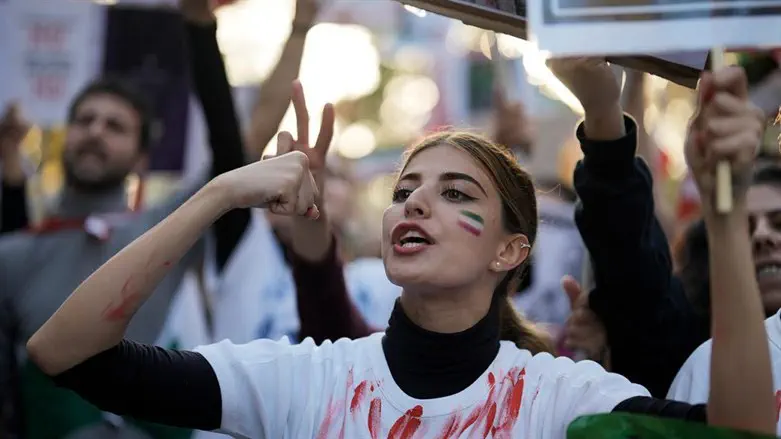
Contrary to common narratives, a significant number of Iranians see the weakening of this regime not as a tragedy but as a long-overdue turning point. Not because they desire war, but because they desire an end to a system that has denied them dignity, freedom, and the most basic elements of a normal life.
Today, many Iranians are not primarily concerned about the continuation of the war.
They are concerned about the survival of the regime.
Because for them, the greater danger is not conflict, it is the continuation of a system that has already taken everything from them.
At the same time, visible cracks are forming within the regime itself. The reported elimination of key figures such as Larijani has further destabilized an already fragile leadership structure, exposing internal fractures up to the highest levels of power.
Meanwhile, international outlets, including Fox News, have published reports pointing to alleged corruption and internal dysfunction within the leadership circle, issues that were once hidden from public view. Regardless of the specifics, one reality is becoming increasingly clear: the regime is losing control over its own narrative.
As the conflict continues, more previously concealed aspects of the regime’s deeply corrupt inner structure are coming to light. Intelligence activity and covert operations inside Iran suggest that this confrontation is unfolding not only externally, but from within.
And yet, at the center of it all stand the Iranian people. A nation wounded- but watching.
As the Persian New Year approaches, millions of Iranians are not preparing to celebrate but waiting. Waiting for a breaking point.
Waiting for the collapse of a system that has long defined itself through fear and control.
More than a century ago, the Persian poet Iraj Mirza warned that as long as clerical rule endures, conditions would only worsen. Today, for many Iranians, that warning feels less like literature-and more like lived reality.
One truth must be made absolutely clear to the world:
This is not a war against Iran. This is a war for Iran’s freedom.
The Iranian people are not the enemy. They are hostages.
In this context, the role of the United States and Israel deserves recognition. Leadership from President Donald Trump and Prime Minister Benjamin Netanyahu has directly challenged the Iranian regime as a central source of instability.
For many Iranians, this is not seen as aggression, it is seen as pressure against those who oppress them.
It is seen as a rare opportunity.
A chance for liberation.
A chance for self-determination.
A chance to live as free human beings.
Those who, from a distance, reduce this reality to simplistic slogans like “stop the war" without acknowledging decades of repression, fail to grasp the core of the issue.
This is not about war versus peace. This is about freedom versus captivity.
And today, more than ever, the Iranian people are standing at that defining line.