
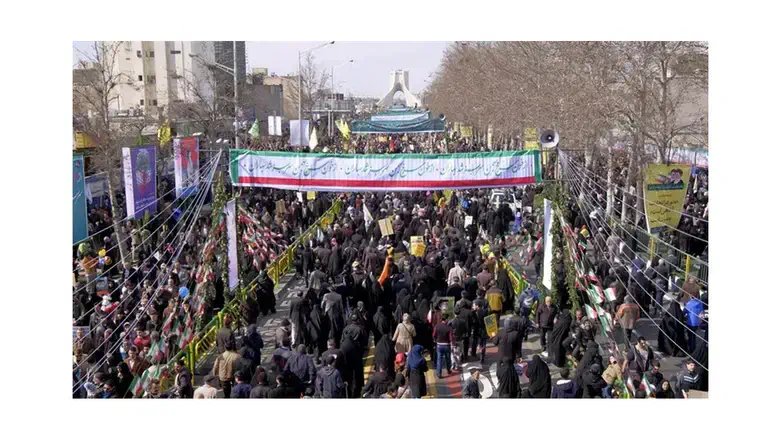
The terrorist theocratic Iranian Regime, with unabated nuclear ambitions, in a long-standing state of war of aggression against the US and Israel, is now facing extinction. Coordinated airstrikes by the U.S. (Operation Epic Fury) and Israel (Operation Roaring Lion), targeting the Regime and IRGC leadership, ballistic missile launchers, nuclear sites, military sites, air defenses and naval assets, have been devastatingly successful.
However, notwithstanding the elimination of Supreme Leader Ali Khamenei, the Regime rejected surrender and continues its aggression with missile/drone attacks against U.S. bases and sites in the region and civilian targets in Israel, as well as the Gulf Arab States.
The US victories in World War II (WWII) over Nazi Germany and Imperial Japan offer profound lessons on transforming militant dictatorships, led by cult-like virtually religious ideologues, into democratic, prosperous and law-abiding allies.
Both the Nazi and Imperial regimes, driven by aggressive ideologies and responsible for global atrocities, were utterly defeated and dismantled in 1945. In Germany, denazification purged Nazi elements and Marshall Plan aid sparked rebuilding and reinforced reformation, ultimately leading to integration into NATO and the EU. Japan underwent demilitarization under MacArthur, with the 1947 Constitution institutionalizing democracy, embracing pacifism and social reforms, like women's suffrage. The Korean War and U.S.-Japan Security Treaty solidified Japan's alliance role.
These successes were rooted in no small measure in economic incentives tying prosperity to reform, and Cold War geopolitics repositioning former foes as allies against communism.
The secret sauce common to both these successful results was a combination of broad internal buy-in and external commitment. These lessons are particularly relevant to Iran's ongoing crisis today.
President Trump has signaled the war's end is near, emphasizing regime change and urging Iranians to take over their government. The Iranian Regime has also become more isolated, as the initially reluctant neighboring Gulf States have effectively signed on to the U.S.’ war efforts. Iran’s strikes on the UAE, Saudi Arabia, Qatar, Bahrain and Kuwait and threats to oil infrastructure crossed red lines, prompting expressions of solidarity with the joint efforts of the US and Israel.
For Iran to mirror post WWII Germany’s and Japan's trajectories, a broad united opposition coalition must emerge to facilitate unconditional surrender, interim governance and democratic transition.
It is suggested that along side the military pressure there must also be an intensive effort made to unite and leverage exile networks and the many diverse ethnic groups in Iran to form a broad based coalition. Interim leadership, devoted to achieving a genuine democracy in Iran, over a transition period, is needed, with an ironclad commitment that the interim transition leaders will resign in favor of the democratically elected government. It is believed President Trump can help accomplish the broad coalition required to achieve this noble end, by promoting it and anchoring this commitment with an appropriate U.S. guarantee.
Preceding the current phase of the Iranian Regime’s ongoing wars of aggression were protests, sparked in part by economic woes that evolved into anti-regime calls, which highlighted Iran's societal fractures, held together by the Regime’s iron rule and intolerance of any dissent. Iranians in over 400 cities were involved and chants for freedom echoed nationwide. Ethnic minorities (including Kurds in Ilam and Kermanshah, Baloch in Sistan-Baluchestan, Azeris in Tabriz and Urmia, Ahwazi Arabs in Khuzestan, Lurs in the Zagros Mountains, Turkmen, Bahá'is and Christians), comprising approximately 40% of Iran's 92 million population, played pivotal roles.
These repressed groups could counter IRGC remnants in post-regime scenarios, akin to how Allied forces co-opted Wehrmacht elements for stability. In this regard, it is critical to harness the force of the Artesh (regular army), as a counterforce to the IRGC and the Basij militia. Defections are not easy to achieve; but unity of the sort described herein will help facilitate it.
The key is organizing a broad coalition of these diverse groups. This includes exiles like Reza Pahlavi, the Shah's son, and Maryam Rajavi, leader of the National Council of Resistance of Iran. Pahlavi positions himself as a transitional leader, emphasizing continuity, amnesty and a referendum on governance that does not require restoration of monarchy. Rajavi promotes a provisional government based on her Ten-Point Plan for a secular, democratic republic, emphasizing gender equality, non-nuclear policy and minority rights.
The Iran Freedom Congress, convened in London this past February, exemplifies the unity needed. Monarchists, republicans, leftists, and ethnic representatives adopted principles for pluralism. A number of Kurdish parties also formed a coalition in February. Enlisting them in this common cause and enabling coordinated efforts is one of the keys to success.
To promote the formation of this kind of a broad coalition and enhance its viability requires someone able and willing to wield the power needed to catalyze it. That person is President Trump. He has the power and credibility.
For example, Reza Pahlavi might be a good choice for an interim transition leader. However, concerns have been raised about deposing one form of tyrannical government of the Ayatollahs only to replace it with another, in the form of imposing a monarchial government. Positioning the U.S. as a guarantor that a Pahlavi's pre-tendered resignation would be honored by him to transfer leadership at the end of a transition period to whomever is duly and democratically elected might provide the needed comfort and security to enable him to be accepted in this role. As Pahlavi described himself, he is "bridge, not the destination," committing to step down after stabilizing the country and holding elections.
President Trump's endorsement of this kind of a broad coalition arrangement, followed up by calls by all the parties in the coalition and Iranians generally to work together to seize power, might be the catalyst needed to spur the revolt, cause army and governmental defections and effectuate regime change. The united coalition bolstered by U.S.-Israeli combined arms and a Gulf Arab States’ defensive alignment, is well positioned to achieve this result.
A U.S. style constitutional structure, with a real federalist system of government, might also be a useful organizing tool. It would provide for empowered local state-like government to handle regional affairs that could address the legitimate concerns of geographically concentrated minorities that were trampled on by the Ayatollah Regime. At the same time, it would provide for a strong central government, like here in the U.S., in charge of national issues, like defense, foreign affairs, protection against discrimination and enforcing equal protection under the law, interstate commerce, free-markets, central banking and currency, as well as other matters of national concern.
The concept is to preserve Iran as one nation, comprised of many diverse groups of people, while reforming and reconstituting it as a viable and democratic nation embracing the rights of all the people.
Integration of Iran into the Circle of Peace and Prosperity, with the US and Israel, as well as other members of the Abraham Accords, favors the emergence of a Persian economic miracle. Reinforced by genuine abandonment of any nuclear ambitions, ballistic missile programs and support for terrorist proxies would result in enormous savings that could better be applied to improving the lives of its people. Iran could then take its rightful place as an ally and friend of the US and Israel.