
I was invited to speak at the Anti-Defamation League (ADL)’s “Never Is Now" conference on a panel about businesses targeted in the escalating struggle confronting Jews today, a conflict increasingly shaped by the red-green alliance.
Just a week before the conference, I received a welcoming message from the organizers:
“We are delighted that you will be joining us at Never Is Now and look forward to seeing you at the Jacob Javits Center in New York. Your panel is scheduled for Tuesday, March 17 at 11:30 a.m."
They even offered to register my guests.
Shortly afterward, however, a second email arrived:
“Because of a change in the direction of the panel, we will be cancelling your registration."
No explanation was offered. The invitation simply disappeared. The moment carried an ironic resonance. I cannot say I was surprised. In my book I recount how Rabbi Meir Kahane himself was once blocked from speaking at a Jewish conference in Brussels. His voice, which challenged the complacency of communal leadership, was considered too disruptive for polite discussion.
The episode also carries an uncomfortable historical echo. Rabbi Meir Kahane spent much of his life confronting not only external enemies but also resistance from within the Jewish establishment. In the 1960s and 1970s, as his activism grew more visible, government agencies monitored his activities and informants circulated within activist circles. At the same time, major Jewish institutions such as the Federation and the ADL frequently positioned themselves against him, viewing his methods and message as too confrontational. His words, once thought extreme, seem eerily prescient now.
The result was a strange inversion that has appeared more than once in Jewish history. The Jew in the arena, confronting threats directly, often finds himself opposed not only by his adversaries but also by the institutions that claim to represent the Jewish community.
Admittedly, it was never comfortable for organizations built around diplomacy and consensus to embrace someone who insisted that Jewish survival sometimes requires confrontation rather than accommodation.
History does not repeat itself exactly, but patterns have a way of echoing. The voices that disturb institutional comfort are often the first to be shown the door.
One cannot escape the irony. In the free societies of the West, the danger has been different. No one forbids the Torah. No one bans Hebrew. Yet something essential has weakened. Comfort, accommodation, and the desire for approval have quietly eroded the confidence that once sustained Jewish identity.
Rabbi Meir Kahane’s struggle, for example, was never only with the enemies of the Jewish people. He also faced fierce opposition from within the organized Jewish establishment. Throughout the late 1960s and 1970s, major institutions such as the ADL and elements of the Federation world publicly condemned his movement and worked actively to distance the broader Jewish community from the Jewish Defense League. They argued that his confrontational methods endangered the community and undermined relationships with government authorities.
However, this conflict revealed a deeper problem. Institutions built around diplomacy, fundraising, and political access were naturally uncomfortable with a message rooted in Jewish pride, self-defense, and confrontation with antisemitism. The result was a painful paradox: the Jew standing in the arena defending Jewish dignity often found himself opposed not only by those who hated the Jews, but also by the very institutions that claimed to speak in the name of the Jewish people.
Because in the end Jewish survival has never depended on institutions.
Jewish history has always been written by the Jews who refused to wait for permission to exist.
A Jew who knows who he is does not beg for acceptance, does not apologize for his existence, and does not abandon another Jew in the breach.
The future of the Jewish people will not be secured by conferences, panels, or carefully worded statements. It will depend on whether Diaspora Jews rediscover the courage to live openly as Jews, to stand for one another, and to reclaim the dignity that has carried our people through every age of history.
Because in the end, Jewish survival has never depended on institutions.
It has always depended on Jews. For seventy years under Soviet communism, Judaism was outlawed, Hebrew was suppressed, and Jewish religious life was driven underground. Yet despite that relentless pressure, Soviet Jews remained hungry for their G-d, their Torah, and their connection to Zion. When the gates finally opened, hundreds of thousands rushed toward Jewish life and toward Israel.
Compare that with seventy years under the stewardship of America’s most powerful Jewish institutions. With vast budgets, influence, and freedom unprecedented in Jewish history, one might have expected a renaissance of Jewish identity.
Instead, we have witnessed staggering attrition. Intermarriage rates soar, Jewish literacy collapses, and entire generations grow distant from the traditions and destiny of their people. In some cases, young Jews now openly support political movements hostile to Israel, demonstrate against the only Jewish state, and even vote for figures who align themselves with those antisemitic movements.
The tragedy is not merely assimilation. It is something deeper: a loss of confidence in Jewish identity itself.
Where Soviet oppression could not erase Jewish consciousness, institutional complacency in the West has too often weakened it. Instead of cultivating pride, courage, and commitment, many institutions have emphasized accommodation and approval. In doing so they have too often fueled Jewish erasure rather than Jewish preservation.
Because of this background, I believed my voice would add something meaningful to a panel about businesses targeted by anti-Israel boycotts. The Jews most visibly and consistently targeted by antisemitism are often the very Jews who live openly and identifiably as Jews in public life.
There are Jews who live comfortably within institutions, and there are Jews who live on the front lines of Jewish life.
The difference between the two is not theoretical. One learns it quickly when a yarmulke makes you a target, when your business becomes a symbol for agitators, or when threats begin arriving in the middle of the night.
For decades the Jewish establishment has increasingly confused representation with reality. Conferences are organized, panels are assembled, and statements are issued. Yet the Jews who most visibly carry Jewish identity in public life often find themselves standing alone when the hostility arrives at their doorstep.
That divide became clear to me again recently when I received that email informing me that my invitation to participate in the ADL’s “Never Is Now" conference panel had been cancelled due to a “change in direction."
I cannot say I was surprised.
It seems to me that the ADL is not going in a new direction at all. It is continuing along the same path it has followed for years, hosting panels where people speak in platitudes, raising funds at cocktail receptions, and sustaining institutions whose considerable budgets might have been put to far better use strengthening Jewish identity and educating the next generation.
I have been a critic of the ADL. That is true. But I also signed the waiver they sent, agreeing that I would not defame the organization during the event. I intended to honor that commitment. Like any human being, an institution has the opportunity to confront its mistakes, show contrition, and move forward in a way that is conducive to its well-being.
Sadly, both the ADL and the Federation have much to answer for regarding the current state of Jewish affairs. The Jewish world stands at a precarious moment. History has shown how quickly societies can move from 1932 to 1936 when warning signs are ignored.
Perhaps that is why voices like mine are unwelcome.
The question I had been asked to address at the conference was the following:
“Your family and hotel became ground zero for what you described as ‘personal and business terrorism,’ framed publicly as ‘pro-Palestinian Arab activism.’ Can you walk us through what happened, and specifically address how that framing affected your ability to get help from law enforcement and the broader community? What would you want this community to understand about what it means to be left alone when you are being targeted?"
I wrote about these events extensively as they were unfolding, documenting them on my Substack, in Israel National News, and later in my book Between the Altar and the Sanctuary.
Today nearly every form of Jew hatred is repackaged as “activism." The rhetoric is often tinged with blood libels and narratives designed to malign the Jewish people and ignite hostility against what radicals now describe as “infidel Jews."
Our personal pogrom arrived at our doorstep in July 2024.
It began with a barrage of phone calls and a flood of emails containing graphic Holocaust threats. Our staff was threatened, our address was doxxed, and messages promised violent and disfiguring deaths.
Photo: Mamdani was a founding member of SJP at Bowdoin College
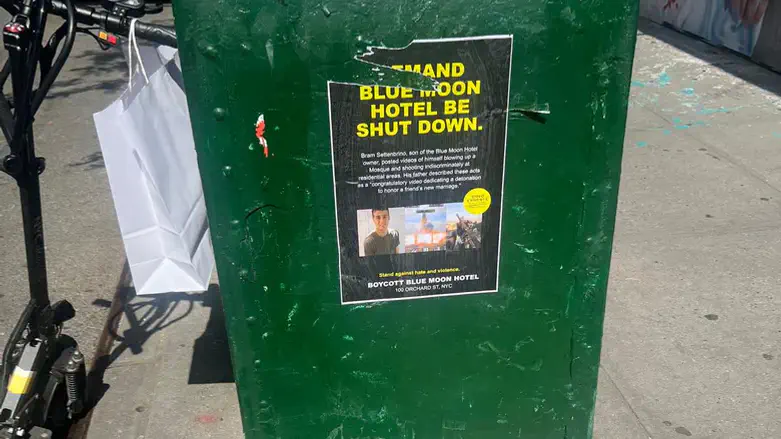
Soon after, individuals appeared outside the hotel distributing flyers with my IDF soldier son’s face on them, accusing him of being a “destroyer of mosques" and labeling me an Islamophobe. I removed the flyers and brought them inside. Within minutes, however, a coordinated flash mob began assembling.
The effort was organized by Students for Justice in Palestine at FIT, a group operating within a broader ecosystem of Islamist aligned activism that includes organizations such as CAIR and networks historically associated with the Muslim Brotherhood.
As the crowd grew, my staff and I stood outside the hotel to protect our guests.
Police eventually arrived but did little to disperse the crowd. At one point a man attempted to force his way into the hotel. A staff member struck him to prevent entry, and that staff member was immediately arrested.
That night in my own home the atmosphere felt eerily reminiscent of Kristallnacht.
In the weeks that followed posters appeared throughout the neighborhood calling for a boycott and shutdown of the Blue Moon Hotel. The threats escalated.
Photo: Exterior windows at the Historic Blue Moon Hotel
Our exterior was vandalized with paint, and our 1898 planter was torn down and smashed to pieces. Messages arrived showing guns and knives accompanied by promises of brutal violence. For more than three months, my family, employees, and I lived in a state of relentless fear caused by Donovan Hall. His campaign of harassment, intimidation, and antisemitic hate invaded every corner of our lives: our home, our business, and even our sense of safety as parents.
Hall contacted us more than a thousand times. He called our business, our home, and my personal cell phone, often dozens of times a day, including in the middle of the night. He would say he was outside our door or “on the way," threatening to kill us, mutilate us, and rape members of our staff. During these calls he repeated our home address aloud, a chilling reminder that he knew exactly where we lived.
Photo: Chilling text messages sent by Donavan Hall
We constantly feared for our children’s safety. The thought that someone who hated us enough to threaten our lives and the lives of our children might appear at any moment was unbearable. The fear our children felt, and the anxiety it caused them, made this period extraordinarily difficult to endure as a family. Every sound outside, every unfamiliar car, every late-night phone call filled us with dread.
Hall’s violent antisemitic threats were brutal and vile. He invoked images of gas chambers and crematoriums, resurrecting the language of Jewish annihilation. He expressed fantasies of inflicting pain on us and our children. He sent text messages showing guns, knives, and a machete, promising to use them.
At our workplace the impact was devastating. Our employees were terrified. One young woman quit after receiving one of his calls. An intern placement agency withdrew its students, fearing for their safety. The constant ringing of the phones, tied up by his repeated calls, brought our business to a standstill and filled the air with panic. Many times we watched the door in fear or called the police because he claimed he was on his way, diverting police resources that were needed elsewhere.
Six months ago Donovan Hall was sentenced to four years in prison for these crimes.
Jay Clayton, the United States Attorney for the Southern District of New York, and Stefanie Roddy, the Special Agent in Charge of the Newark Field Office of the Federal Bureau of Investigation, announced that Donovan Hall was sentenced on October 30, 2025 to 49 months in prison for making interstate threats and stalking Jewish victims in New York City. The sentence was imposed by U.S. District Judge Jennifer H. Rearden.
Despite this, police protection during the ordeal was minimal and temporary, but it existed. Even more disturbing was the near total silence from Jewish politicians and institutions who publicly claim to stand with Israel, despite our turning to them
Photo: Posters Plastered around NYC to shut down the Historic Blue Moon Hotel .
ADL Prompt for My Panel Discussion
“Randy, your family and hotel became ground zero for what you described as ‘personal and business terrorism,’ framed publicly as ‘pro-Palestinian Arab activism.’ Can you walk us through what happened and specifically address how that framing affected your ability to get help from law enforcement and the broader community? And what would you want this community to understand about what it means to be left alone when you’re being targeted?"
What does it mean to be left alone?
Many Jews today will fight passionately for causes that have nothing to do with their own people, yet hesitate when the threat is directed at Jews themselves. Some even fund politicians whose ideologies undermine the very values necessary for Jewish survival.
Many simply do not understand what it means to live as a visibly identifiable Jew.
I learned that lesson when I was nine years old. Growing up in Brooklyn, it was Jew hatred itself that drew me toward my mother’s faith. I quickly learned that wearing a yarmulke could make you a target and that one must always be ready for whatever comes.
Much of the cultural infrastructure of Jewish life has vanished. New York once had 1,500 Jewish delis and hundreds of appetizing stores. Yiddish echoed in the streets. Much of that world has disappeared.
What remains is the deeper truth: we are the People of the Book.
The cure is Hadar - Jewish dignity and pride. Meir Kahana taught that “a Jew who does not stand in the breach for another Jew is no Jew at all."
That instinct has guided me since childhood.
We must rediscover common ground among ourselves and stand together. In my writing I examine the roots of the radicalism we are witnessing today and the failure of our community to properly educate the next generation about Jewish identity and Zionism.
Zionism is not merely a political word. It is part of the spiritual destiny and story of the Jewish people.
Even many Christians understand that truth. That is why tens of thousands of churches around the world carry the name “Zion."
My hope is that we strengthen our identity, stand together, deepen our alliances with those who truly support the Jewish people, including our Christian allies, and help make the world a safer and better place.
If the shepherds are afraid of the wolves, the sheep are already lost.
Randy Yisroel Settenbrino is a writer, artist, and public intellectual whose work bridges theology, philosophy, and psychology. He is a passionate advocate for Israel and Jewish-Christian solidarity, and the founder of the Historic Blue Moon Hotel, recognized by National Geographic as one of the 150 most unique projects in the Western Hemisphere.
Watch for his newest release on Amazon Between the Altar and the Sanctuary: The Life, Faith, and Fire of Rabbi Meir Kahane
Color Edition Hardcover: https://a.co/d/0aZPsQYs
Color Edition Paperback: https://a.co/d/08W8SeO5
Black and White Edition: https://www.amazon.com/dp/9798276297354