
The Second Iran War, being waged by the United States and Israel against Iran, creates a tactical opportunity for the Syrian regime. At this stage, Syria is not directly involved in the hostilities and is affected mainly by falling debris from missiles, UAVs, and munitions on its territory as a result of interceptions and military activity in the region.
Amid the wartime environment, Damascus may seek to take advantage of the shift in regional and international attention in order to advance security and political objectives across different arenas within the country and along its borders.
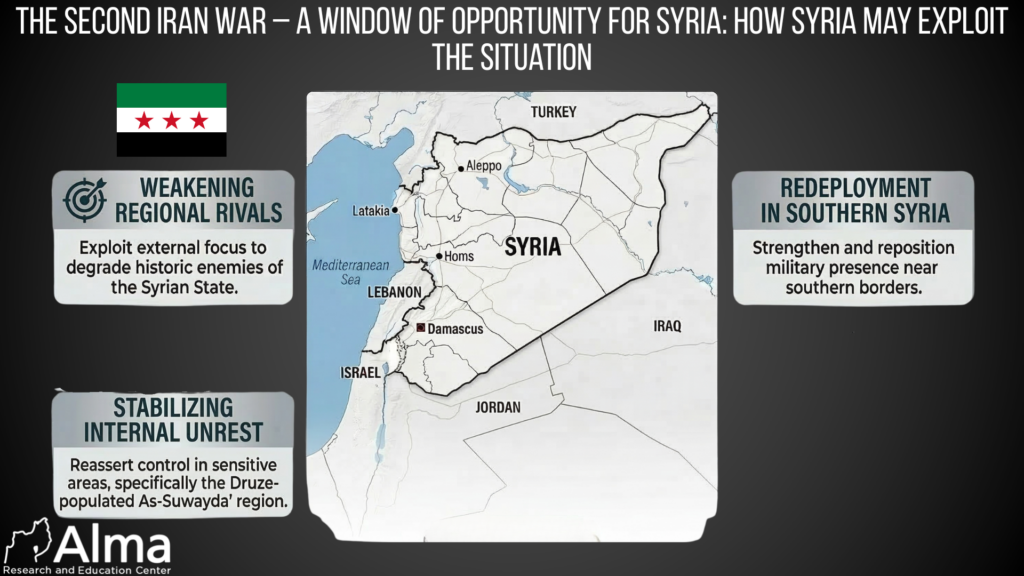
Harming the Historical Enemies of the Regime
For the Syrian regime, which is composed largely of former rebel elements, the regional confrontation may present an opportunity in its struggle against Hezbollah and Iran. During the Syrian civil war, Hezbollah and Iran were the principal actors supporting the Assad regime in its fight against rebel groups. As a result, significant segments of Syria’s Sunni camp continue to harbor deep hostility and a desire for revenge toward the Shiite axis.
The ongoing fighting, by the United States and Israel against Iran, and by Israel against Hezbollah, undermines and weakens both past and present adversaries of the Sunni-led Syrian regime. In this context, several unverified reports suggest that the Syrian regime may seek to exploit the situation and could be considering action against Hezbollah in Lebanon as a form of retaliation.
Following the rebels’ rise to power in Syria, Iran and its proxies-including Hezbollah and other Shiite militias-were largely compelled to withdraw from the country after years of deep military entrenchment. Nevertheless, Iran and Hezbollah continue to seek ways to maintain a foothold, operational channels, and influence within Syria, while also attempting to undermine the stability of the new regime.
In this context, a weakening of the Shiite axis amid the broader regional confrontation could be viewed in Damascus as an opportunity to further diminish their influence and consolidate the authority of the new government.
From the standpoint of Syria’s leadership, any potential blow to Hezbollah and other pro-Iranian actors would therefore be seen not only as strengthening national security and regime stability, but also as a chance to settle scores with forces widely regarded as responsible for the violent campaign against the rebels during the civil war.
Opportunity for Redeployment in Southern Syria
In light of the situation, Syria has reinforced and deployed forces along the borders with Iraq and Lebanon, and also in southern Syria, beyond the buffer zone with Israel.
The deployment along the Iraqi border is intended to prevent the entry of pro-Iranian militia forces seeking to carry out attacks against Israel or even to infiltrate Syrian territory, although according to some reports the reinforcement is due to the resurgence of ISIS (which recently carried out several attacks in the Al-Bukamal area).
The deployment along the Lebanese border comes amid the escalating tensions between Israel and Hezbollah and is aimed at reinforcing state control, preventing militia infiltration and the transfer of weapons, and limiting the spillover of hostilities into Syrian territory. In recent days, Syrian sources have claimed that Hezbollah fire crossed into Syria, a development that, from Damascus’s perspective, underscores the need to strengthen the security presence along the border. Reports indicate that thousands of fighters have been deployed there, including infantry, armored units, and elite forces, moves that Syrian officials describe as a “defensive measure."
The deployment in southern Syria, along the Israeli border, according to Damascus, is part of precautionary steps taken by internal security forces rather than the regular army and is intended to thwart potential activity of terrorist infrastructures against Israel.
Regional developments allow Damascus to attempt to strengthen its presence once again in southern Syria, near the buffer zone, particularly in the provinces of Daraa and al-Quneitra adjacent to the border with Israel.
The Syrian army is exploiting the regional escalation - which includes missile and UAV interceptions over southern Syria and Israel’s engagement on additional fronts - in order to move forces and expand its deployment in the area.
Officially, Damascus presents the move as precautionary steps by security forces aimed at strengthening checkpoints and preventing armed groups or “undisciplined" actors from exploiting the regional tensions. This wording enables the regime to present the activity as an internal security move rather than an offensive military deployment near the Israeli border.
It is possible that the reinforcement of internal security forces also serves as a cover for the movement of regular Syrian army personnel and combat equipment into strategic locations, particularly the hill areas in the eastern Syrian Golan Heights. Sites mentioned include Tel Ahmar al-Sharqi (Eastern Tel Ahmar), Tel Tranja, and Tulul al-Hamar, along with additional locations in western rural Daraa and Quneitra province.
These hills are regarded as significant topographical vantage points, providing wide observation and potential fire control over the Golan region and northern Israel.
Through such measures, Syria may gradually expand its military presence near the line of separation of forces without formally announcing a policy shift or initiating a direct confrontation.
Main deployment areas of Syrian security forces along the Syria-Israel border:
- Western rural Daraa - Yarmouk Basin (حوض اليرموك): between the villages
جملة (Jumla), صيصون (Saisoun). This is an area close to the border with the Golan Heights. - Quneitra Province: various points near the demilitarized zone (DMZ) of the 1974 Disengagement Agreement. Additional villages in which the presence of Syrian security personnel was reported include:
كودنة (Kudna), صيدا الجولان (Sayda al-Golan), تل أحمر (Tel Ahmar). - Western rural Damascus: secondary reports of strengthened checkpoints and security presence.
Regional developments may allow Syria to exploit the regional escalation in order to change the security situation and the strategic balance in southern Syria and in areas adjacent to Israel.
Addressing the Druze Issue in Southern Syria
The regional escalation may also present the new regime in Damascus with an opportunity to address the challenge posed by the Druze issue in southern Syria, particularly in al-Suwayda province. Since the fall of the Assad regime, the Druze region has been marked by a relatively high degree of local autonomy, the activity of local militias, and periodic protests against the central government. This situation has complicated Damascus’s efforts to establish full control over the area, especially as some local communities fear a decline in their status or the influence of external actors.
Tensions among the Druze intensified following the events of July 2025, when violent clashes broke out in Suwayda between Druze armed groups and Sunni Bedouins who support the new regime. Army and internal security forces of the regime - including elements with jihadist affiliations - acted against the Druze. The violence reportedly resulted in hundreds of deaths and included massacres, war crimes, and abuses against Druze civilians, further deepening the mistrust between the Druze community and the central government.
Tensions surrounding the Druze issue also gained a regional dimension, as Israel expressed involvement in the matter. The Suwayda province, which constitutes the demographic and political center of the Druze in Syria and lies about 80 km from the Israeli border, became a focal point of concern in Israel in light of its historical commitment to the Druze community. Following the events of July 2025 and pressure from the leadership of the Druze community in Israel, Israel carried out targeted airstrikes intended to protect the Druze population and deter regime actors.
Within this complex reality, the leadership in Damascus may view the regional escalation as an opportunity to gradually increase its influence in the south and attempt to re-establish control in the area - but such a move also carries the risk of further escalation, both with the local Druze community and in the regional arena, vis-à-vis Israel, which according to reports conveyed a warning message to the Syrian regime not to exploit the situation to its advantage against the Druze in Suwayda.
From the Syrian regime’s perspective, dealing with the Druze issue is part of a broader effort to stabilize southern Syria and reassert state authority in a region that is highly sensitive both politically and security-wise. Restoring sovereignty over the entire country is a central objective of the new regime. It is unlikely to compromise on this goal, as demonstrated by its consolidation of control over the Alawite region in northwestern Syria and the Kurdish areas in northeastern Syria.
With backing from Turkey and even the United States, the Syrian regime dismantled Kurdish autonomy and curtailed aspirations for Alawite autonomy. In the regime’s view, attention has now turned to the Druze in Suwayda, and it is determined to resolve what it perceives as the “problem" there as well. Nevertheless, even though Israel is currently fighting on two fronts (Iran and Lebanon-Hezbollah), the Syrian regime will likely encounter considerable difficulty in achieving its objectives regarding the Druze. Israel, as a matter of strategic policy, fully supports the Druze.
And another viewpoint on the situation, from Alma reader Stephen Hughes:
Is Ahmed Al-Sharaa, or Abu Mohammad Al-Jolani, Turkey’s Erdogan’s unrecognized military arm, employing a strategy of patience? From Syria to Lebanon and Gaza.
Erdogan / Al-Jolani perceive Israel’s destruction of Hezbollah removing the only real roadblock stopping their takeover of Lebanon. Jolani’s Forces, Hay’at Tahrir al Sham (HTS) stress that “al Sham" in the group’s name refers to Greater Syria, a territory encompassing modern Syria, Lebanon, Jordan, Israel/Palestine, and parts northern Saudi Arabia/ Egypt’s Sinai.
HTS is a covert armed wing of Erdogan’s Turkey. It is true Erdogan supports both Iran and Hezbollah, but only to the extent they serve his grand strategy of Mavi Vata. Actually, Erdogan wants Israel to destroy Iran and Hezbollah, and hopes for Israel to be in ruins, the IDF forces bled out.
Erdogan has already planted one of his most unnoticed power pieces in Gaza: three mosques, one named after Abdullah Azzam, Father of Global Jihad.
In February 2026, Turkey’s government-run Diyanet (Turkish Directorate of Religious Affairs) inaugurated three new mosques in the Gaza Strip, including one named after Abdullah Azzam, a figure described as the “father of global jihad. This is a cornerstone of Diyanet’s five-year strategic action plan.
Abdullah Azzam (1941-1989) was a Palestinian jihadist ideologue, Muslim Brotherhood affiliate, Osama bin Laden mentor, and co-founder of Maktab al-Khidamat (a precursor to al-Qaeda).
The Diyanet Foundation is a critical element of Erdogan’s geopolitical strategy of Mavi Vata. Diyanet masquerades obscures its covert Mavi Vata operations as the Directorate of Religious Affairs. Diyanet’s global reach is in over 140 countries, employs around 145,000 people and oversees 90,000+ mosques in Turkey plus thousands abroad. One its largest in the US
The Turkish Directorate of Religious Affairs operates directly under the President of Turkey Erdogan, to understand just how powerful the Diyanet really is just compare its budget to Turkey’s top two agencies MIT National Intelligence Organization, $39 .5 billion, Ministry of National Defense (MoND) $19.08 billion, Turkish Directorate of Religious Affairs “$131.1 billion" .
Turkey’s Jolani Forces have massed several thousand troops, rockets, and heavy weapons along multiple sectors of the Lebanese border since late February 2026, in what Damascus calls a defensive deployment, but Hezbollah and its media ecosystem read as an offensive military buildup.
Hezbollah-aligned Al Akhbar and an Israeli counter-terror analysis describe the posture as “aggressive," highlighting rocket launchers and artillery with ranges that penetrate deeply into Lebanese territory, plus redeployment of Chechen, Uzbek, Uyghur and other foreign fighters from the northeast to the border.
• The Syrian army’s 52nd and 84th divisions moved additional formations into western Homs countryside and areas south of Tartus.
• Elite units, tanks, troop carriers, and field artillery redeployed from fronts against Kurdish/SDF forces in the east to the Lebanese border, concentrating especially opposite Hezbollah strongholds in the Bekaa and along the Anti Lebanon ridge.
Reuters and regional outlets report “thousands" of Syrian soldiers plus missile/rocket units deployed along the Lebanese frontier, with Border Guard and reconnaissance battalions forming the backbone of the line.
The Second Iran War, known as Operation Fury, is currently commanding everyone’s attention, yet a parallel war is unfolding, originating in Turkey and reaching into Lebanon and Gaza.