
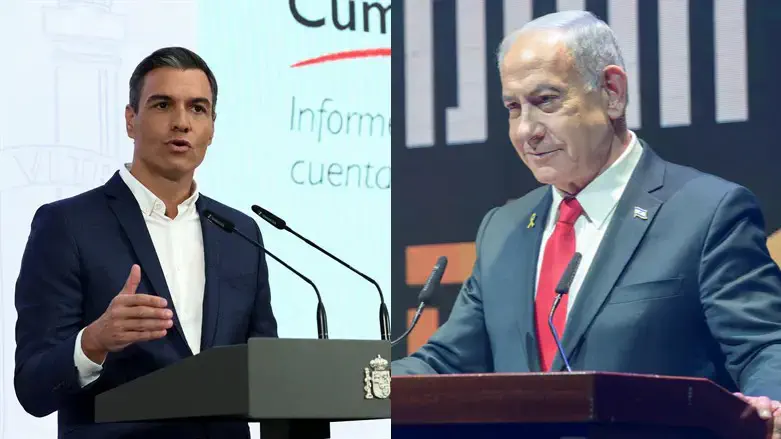
In moments of profound geopolitical confrontation, alliances reveal their true character. Nations that once stood shoulder to shoulder in defense of shared values either reaffirm their commitments or expose fissures that had long been concealed beneath diplomatic pleasantries. The present rupture between Washington and Madrid represents precisely such a moment. The increasingly antagonistic posture adopted by Spain under Prime Minister Pedro Sánchez has raised urgent questions about whether the United States should continue to treat Spain as a trusted ally within the Western democratic community.
President Trump’s warning that the United States may sever trade relations with Spain should not be dismissed as mere rhetorical flourish. It reflects a sober recognition that Madrid’s policies have moved far beyond routine diplomatic disagreement and now verge upon outright obstruction of Western strategic objectives. If Spain continues to pursue a course defined by hostility toward American interests, indifference toward NATO obligations, and a disturbing pattern of antagonism toward Israel, the United States would be justified-indeed compelled-to reevaluate the very foundation of its relationship with the Sánchez government.
The dispute began with Spain’s refusal to permit American forces to utilize jointly operated bases on Spanish soil for operations connected to the U.S.-Israeli campaign against Iran. These bases, which have long served as critical nodes in NATO’s Mediterranean defense architecture, were established precisely to facilitate collective security. They were not designed to function as symbolic installations that Spain could selectively deny access to when ideological disagreements arise.
By barring American aircraft from these facilities, Madrid has not merely expressed dissent regarding a particular military campaign. It has effectively undermined the principle of alliance solidarity that forms the bedrock of NATO. When one member state obstructs the operational readiness of another during an ongoing security crisis, the consequences extend far beyond a bilateral disagreement. Such actions erode the credibility of the entire alliance.
For decades, the United States has borne a disproportionate share of the financial and military burden required to maintain NATO’s deterrent capabilities. Successive American administrations-have expressed frustration with European partners who benefit from the alliance’s security guarantees while failing to meet their defense spending commitments. Spain has long been among the most conspicuous offenders in this regard.
President Trump’s criticism that Madrid refuses to “pay their fair share" is not merely a political talking point. It reflects a structural imbalance within NATO that has persisted for years. The alliance’s recently proposed defense spending benchmark of five percent of gross domestic product represents an attempt to address this disparity. Yet Spain’s reluctance to increase its defense expenditures while simultaneously obstructing American military operations raises a troubling question: What precisely does Madrid believe its responsibilities within NATO entail?
If Spain wishes to enjoy the protection afforded by the alliance, it must also accept the obligations that accompany membership. Security is not a one-way transaction.
Yet the Sánchez government’s antagonism extends beyond the realm of defense policy. Spain’s increasingly hostile posture toward Israel has introduced a deeply troubling dimension to the diplomatic rift.
The permanent withdrawal of Spain’s ambassador from Israel marks one of the most severe diplomatic downgrades between two Western nations in recent memory. While governments are free to express policy disagreements with allies, the symbolic significance of such a step cannot be ignored. It signals that Madrid is no longer content merely to criticize Israeli actions; it seeks to isolate the Jewish state diplomatically at a moment when Israel faces existential threats from Iran and its regional proxies.
Even more disturbing is the rhetoric that has accompanied Spain’s policy shift. Prime Minister Sánchez’s suggestion that Spain might need nuclear weapons in order to deter Israel’s military operations was widely interpreted as an alarming and irresponsible remark. Israeli officials rightly condemned the comment as dangerously provocative, noting that it evokes the specter of genocidal threats against the world’s only Jewish state.
Historical context renders such rhetoric particularly troubling. Spain’s relationship with the Jewish people carries a heavy historical burden. The expulsion of Jews from Spain in 1492, the persecutions of the Spanish Inquisition, and the broader tragedies that later befell European Jewry remain indelible chapters in the continent’s history. When contemporary Spanish leaders adopt rhetoric that is clearly hostile toward Israel, it inevitably resonates against that historical backdrop.
This is not merely a matter of diplomatic etiquette. It touches upon the moral credibility of Spain’s foreign policy.
A government that claims to champion human rights while simultaneously targeting Israel for isolation invites legitimate scrutiny. Israel is a democratic nation confronting terrorist organizations that openly proclaim their desire to eradicate it from the map. Iran’s leadership has repeatedly called for Israel’s destruction, while its proxies-Hezbollah, Hamas, and others-have carried out heinous attacks against Israeli civilians.
In this context, Spain’s decision to side rhetorically with critics of Israel rather than with the democratic state under siege sends a troubling message. It suggests that ideological hostility toward Israel has eclipsed a sober assessment of the region’s security realities.
The consequences of this posture extend beyond the Middle East. Spain’s refusal to cooperate with American operations against Iran directly undermines the broader Western effort to counter a regime that sponsors terrorism, destabilizes neighboring states, and pursues nuclear capabilities in defiance of international norms.
Iran is not merely a regional adversary. It represents a systemic challenge to the international order.
By obstructing the logistical infrastructure required for operations against Tehran, Madrid effectively weakens the collective response to one of the most pressing security threats facing the Western world.
Some observers argue that severing diplomatic and economic ties with Spain would constitute an excessively drastic measure. After all, the United States and Spain share deep cultural, economic, and historical connections. Bilateral trade between the two countries exceeds $50 billion annually, and American companies maintain substantial investments within the Spanish economy.
Yet alliances are not sustained solely by commercial transactions or cultural exchange. They are sustained by shared strategic priorities and mutual trust.
When a government persistently undermines those foundations, the continuation of normal relations becomes increasingly untenable.
Severing diplomatic, economic, and cultural ties with Spain would undoubtedly carry short-term costs. American businesses operating in Spain could face disruptions, while Spanish firms with investments in the United States would experience similar challenges. Cultural exchanges and academic partnerships would inevitably suffer as well.
However, the long-term implications of tolerating Spain’s current trajectory could prove far more damaging.
If the United States allows a NATO ally to obstruct its military operations, vilify Israel, and openly challenge the strategic consensus of the Western alliance without consequence, it risks signaling weakness to adversaries and confusion to other partners.
Foreign policy credibility is built upon consistency. Allies must know that cooperation is expected, not optional. Adversaries must understand that attempts to fracture Western unity will not succeed.
Spain’s leadership under Pedro Sánchez has chosen a path defined by ideological hostility toward American policy, antagonism toward Israel, and an alarming willingness to undermine NATO’s operational capabilities. These actions demand a response commensurate with their severity.
President Trump’s warning that trade relations could be severed should therefore be understood not as a reckless threat but as a legitimate instrument of diplomatic pressure. If Spain persists in its current course, Washington should not hesitate to take the next step.
The United States must make clear that alliance membership entails responsibilities as well as privileges. A government that refuses to uphold those responsibilities cannot expect to enjoy the benefits of partnership indefinitely.
History teaches that alliances survive only when their members share not merely common interests but common values. When those values diverge, difficult decisions become unavoidable.
Spain now stands at such a crossroads. If the Sánchez government continues to pursue a policy defined by anti-Americanism, hostility toward Israel, and obstruction of NATO’s mission, it will have chosen its path.
And the United States must be prepared to respond accordingly.
Fern Sidman, a former NY correspondent for Arutz Sheva, is the current editor-in-chief of The Jewish Voice, a New York based publication. Her writings can be accessed at: tjvnews.com