

We could be on the brink of a profound historic change in the Middle East that will set it on the path to peace, prosperity, goodwill, harmony, tolerance, and mutual respect for all countries. Or not.
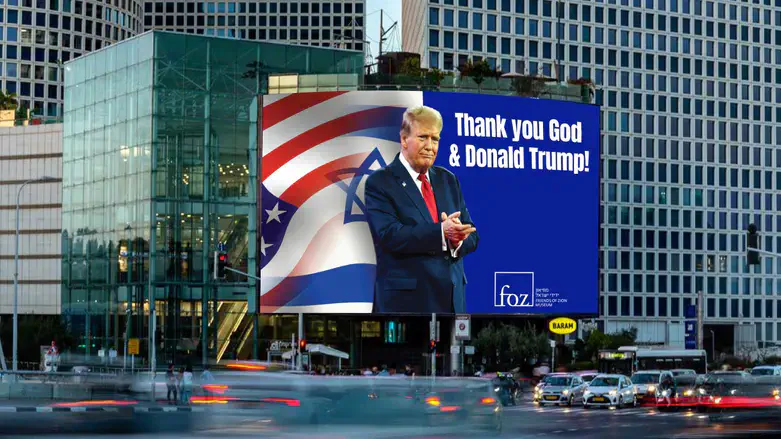
The unprecedented cooperation between the United States and Israel - a melding of the militaries, to a great extent - reflects several positive developments. It is an achievement for both President Trump and PM Netanyahu, two leaders routinely vilified by large segments of their population and the world, who both perceived the looming dangers to their countries and rather than just shrilly warn against them and make idle threats, acted in a bold and audacious way. We can even forgive Trump’s claiming credit for killing the Ayatollah, notwithstanding there weren’t US planes over Iran at the time of that initial attack. Such is the way of the showman.
It also should not be overlooked that these two leaders unflinchingly defined evil as evil and went to war against it. This is not to be taken for granted in a world where evildoers wage psychological and propaganda warfare in order to blur the distinction between good and evil, if not to declare such notions completely obsolete. The obliteration of the distinction between objective good and objective evil plagues modern Western and secular society and is one of the catalysts for the unrest on college campuses and the moral muddle that afflicts so many young people.
This collaboration ultimately reflects the commitments of both nations and their citizenry to a world that is ordered on moral grounds as well as to a repudiation of the Jew hatred that is gaining strength in the United States and animates so many people in the West.
Nevertheless, fighting side by side should not obscure the fact that each nation went to war for different though equally valid reasons. As such, it is likely that the United States will want to end the war sooner than will Israel.
Israel embarked on this campaign as a classic war of self-defense. The threat from Iran was not “imminent," but rather constant. Israel has been in a continuous state of war with Iran since the early 1980’s with the creation of Hezbollah. Iran, through its various proxies in the region and their tentacles across the world, has been plotting Israel’s demise since then, murdering Jews and Israelis wherever we may be found. A state does not have immunity because it masks its malevolent actions behind the subordinates it funds, trains, and dispatches. The unremitting menace of Iran had to be confronted; it took decades of terror but finally the battle was joined.
The United States went to battle against Iran not because it perceived an imminent threat, even though Iran has engaged in terror against the US since 1979 - kidnappings, murders, assassination plots against American leaders and politicians, etc. The US war with Iran is a classic preventative war, a war meant to be fought on terms favorable to the attacker to ward off a genuine and tangible future menace. Forty-seven years of chanting “Death to America" eventually, from Iran’s perspective, reached the wrong audience (i.e., President Trump), who took those threats and Iran’s nuclear and ballistic weapons program seriously. Iran has paid and continues to pay a heavy price for that verbal indiscretion and its malign designs against civilization. Its new leader may also be supreme, which does not necessarily mean durable.
Both grounds for initiating an aggressive attack - a present threat with actual hostilities or a preventative war - are inherently moral and legitimate but engender two different objectives. The US is interested in destroying or at least impeding the Iranian program for the foreseeable future, thus removing an even longer-term threat from America’s horizon. That is one reason regime change in Iran is desired by the US but is not indispensable to its mission.
For Israel, regime change - a shift to an Iranian government that may not be enthusiastic Zionists but at least does not consist of obsessive Jew haters and fanatical mass murderers - is a primary goal of the war. It pays to recall that Iran’s deposed Shah was friendly to Israel relative to the region, but not overly warm. Relations on the surface were cordial but the Shah rarely deviated from the Arab consensus at the time. He sold oil to Israel but also had ties with the PLO, condemned the Israeli “occupation," and called repeatedly for full withdrawal. Like Turkey, another non-Arab but Muslim state that had ties with Israel but not necessarily warm ones, Iran under the Shah had relations with Israel that were benign only in comparison to those of the psychopaths that overthrew him.
The Shah’s son and putative heir is certainly friendlier to Israel but we should not overestimate his standing or popularity in Iran. Again, the few who remember his father’s autocracy favorably do so only when compared to the horrors and monsters that followed him.
This bespeaks the current dilemma facing Israel and the United States. The second reason why regime change is not indispensable to the US military mission is because regime change cannot be effectuated by a foreign army, certainly not from aerial bombings alone, and not from an army of thousands trying to impose its will on a nation of 91,000,000 people - not all of whom are amenable to change.
The conventional wisdom in the West is that Iranians overwhelmingly reject the rule of the Ayatollahs and their monomaniacal, virulent interpretation of Islam. The vast majority of Iranians, we are told, yearn to be free of the rule of the mullahs would like nothing better than a secular Iran within a Muslim framework, such as existed under the Shah’s rule, the better to pursue a good material life. Polls, apparently, show that rule by the mullahs is supported by perhaps 10% of the population, which is not much, even if in raw numbers it is larger than the population of Israel.
And what if the polls are wrong? What if it is not 10% of the population but 20% or 30% - in other words, tens of millions of fanatics, and that percentage - granted, a minority - is still the only portion of the population that is armed? Under that scenario, regime change becomes less and less likely.
Assuming that 30,000 protesting Iranians were murdered by the regime in the last few months, and myriads more arrested, and many not arrested, that means that barely .001% of the population took to the streets. That is a sobering figure. Policy should not be based on projection - how would we feel if we lived under such a tyranny? - but on reality. A true mass movement of Iranians to overthrow the regime and restore some sort of normalcy has not yet materialized, perhaps because it presently can’t without being mowed down, or perhaps because it does not exist. We can wish for its existence but we cannot wish it into existence.
The allure of radical Islam should not be underestimated as it has taken root in much of the world and threatens much of the rest. Iran and Turkey have fallen under its sway but each Arab country - even moderate ones - finds it must try to suppress the radicals who live among them, and they do so with varying degrees of success. Europe is overrun with radical Muslims, including large sections of Britain, France, Belgium, Germany, and elsewhere. And radical Islam is a growing menace in the United States as well, even when the face of it has a pleasant smile. Note that the extremists - several of whom sit in the US Congress - are mostly able to preclude any responsible discussion of its dangers by accusing all skeptics and challengers of Islamophobia.
The entire world view of the radical Muslim is permeated with the imperative to propagate Islam even at the cost of one’s own life. It thus becomes difficult to see how this regime - and whoever survives to lead it - can surrender. Even the Nazis surrendered when their ideology collapsed and Germany was overrun. Do the Iranians have a Gorbachev who oversaw the demise of the Soviet Union rather than annihilate his own people? The opposite seems to be the case. Mass murder of their own civilians - not to mention of the infidels across the globe - is the price they joyfully pay to spread their understanding of their faith.
In this, the Iranian leadership is more akin to Imperial Japan, which would not have surrendered to end World War II absent the US atomic bombs that destroyed two major cities with the threat (hollow, as it was) of more to come. Japan would have fought to the last man, a volatile combination of religion and nationalism.
For Israel, regime change is an obvious desideratum, because the survival of this regime in any form will only make it more extreme, if such a thing is possible. For the US, regime change will require a greater commitment of troops and resources than even the Trump administration is willing to provide. What then lies ahead?
As Yogi Berra said, it is difficult to make predictions, especially about the future. The most optimistic but realistic scenario envisions someone from the military - not the Revolutionary Guards - seizing power and quashing the radical mullah movement. This doesn’t transform Iran into a Western democracy but it might enable its decent citizens to remodel their country into an exporter of oil and spices and not terror. The fear that any new radical leader will be decapitated should be a deterrent to normal human beings but might not be applicable in the context of radical Islam. Nonetheless, the present is thus an opportune time for such a military leader to assert authority, especially as the Iranian military will otherwise be totally devastated.
Until that happens, Israel should destroy as much of the Iranian infrastructure as possible, including the oil installations, despite American objections. A poor, weak, and bankrupt Iran poses a limited threat in the short term, and would also starve its proxies of the funding and support they require to wage their relentless war against Israel.
We should continue calling every day for the professional military - those not beholden to radical Islam - to step forward and save Iran from devastation.
We should also realize that even the complete defeat of Iran - including regime change and the opening of a Chabad House in Tehran - does not mean an end to Israel’s enemies. New foes are already on the horizon - Turkey, Qatar - just as the possibility of new alliances with other Arab nations exists as well. Then again, a defanged Iran could also mean that those Arab nations that drew close to us because they feared Iran, will have less incentive to ally with Israel. Who knows?
The book of Shoftim (Judges) states several times after our enemies were temporarily defeated “and the land was quiet," for forty years, even for eighty years. If only! In every generation we can weaken Amalek but full victory awaits the coming of Messiah. That is encouraging - along with a more sensible leadership that, one hopes, has purged itself from failed conceptziyot, a military whose feats with G-d’s help astound the world, and a resilient and brave civilian population that cannot be cowed and intimidated by wicked enemies but grows ever stronger and more faithful with each new challenge.
Rabbi Steven Pruzansky, Esq. serves as the Senior Research Associate for the Jerusalem Center for Applied Policy (JCAP,ngo) and the Israel Region Vice-President of the Coalition for Jewish Values and is the author of six books including “Road to Redemption," all about Pesach (Kodesh Press).