
As Israel is currently facing an Iranian regime obsessed with pursuing its demise, so, too, the ‘Yishuv’-the 500,000 strong Jewish population of the land of Israel faced the threat of Nazi genocide during the Second World War.
In early 1942, the German army launched a campaign to seize the Middle East, at the time primarily under British control. They sought its vital oil fields, and control of the Suez Canal in Egypt for the transport of supplies. The land of Israel, then usually referred to as Palestine (since Roman times with no connection to those Arabs who call themsselves Palestinians today), was also a target. If the German Afrika Korps under the command of Field Marshal Erwin Rommel succeeded in reaching its borders, the Jewish community there would be in grave danger.
Rommel, who was perceived to be invincible for his military successes, led the Axis attack.
After taking the seaside city of Tobruk, Libya, Rommel’s forces made their way eastward into Egypt. The British 8th army strategically retreated to El Alamein, sixty miles out of Alexandria, Egypt.
The British commander, Field Marshal Sir Claude Auchinleck, chose to retreat to El-Alamein, as it was situated next to a large depression. It was good ground to face an approaching enemy. Rommel, expecting victory, confidently stated, “Once through, (El-Alamein) our road to the Nile is clear."
From El-Alamein, the road to nearby Palestine would also be wide open.
In Alexandria, facing a very possible German attack, there was panic. Trucks were hastily exiting British personnel from the city. Fleeing refugees filled the trains. British officials were busy frantically destroying their records.
The situation was dire.
In the land of Israel the local Arabs expected a Nazi victory and subsequent invasion, and were emboldened. Swastikas appeared on the streets, copies of Mein Kampf were found in Arab bookstores, passersby greeted each other in the street with ‘Heil Hitler.’ Jews feared to be outside at night.
The Jewish Telegraphic Agency reported that on July 26, 1942, German radio promised Palestinian Arabs that upon the Nazi invasion, they would be given the Jews' possessions in Palestine. Arabs were marking Jewish homes they planned to claim for their own after the anticipated arrival of German forces. Rabbi Haskel Besser, who witnessed the scene, writes in his book, The Rabbi of 84th Street, about "streets filled with Arabs who were actually fighting among themselves over who was going to get which house."
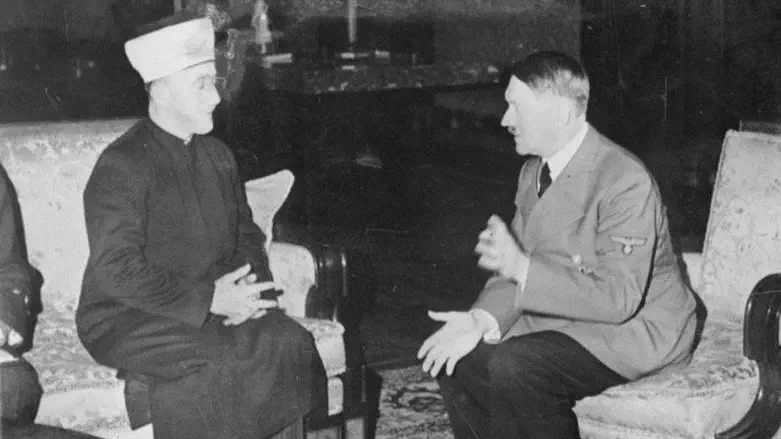
The British-appointed “Mufti" of Jerusalem, Amin Al-Husseini, a notorious Jew-hater who had close connections with Nazi leaders, had met with Hitler and on a few occasions with one of the chief organizers of the Holocaust, Adolf Eichmann, was ready to form an Arab unit to assist SS units in slaughtering the Jews.
Jews prepared to meet the threats. Extra precautions were taken. Shelters were set up everywhere and additional first aid stations were established. Buses were equipped to be easily converted into ambulances. The Haganah was planning defenses and a possible evacuation of the Yishuv. But to where? After the possible British retreat upon the German advance, Hagana leaders considered Mount Carmel, near Haifa. From Haifa, civilians could be transported out from the city’s port.
This time would eventually become known as the ‘two hundred days of dread’ during which Palestinian Jewry faced the horrific prospect of a Nazi invasion.
Many Jews turned to prayer.
The book, Miracle at El-Alamein by Rabbi Zev Paretzky describes the intensity of the prayers in the Land of Israel during this time in synagogues, shtiebelach, and at the graves of known tzaddikim. Public fasts were also declared.
Rav Eliezer Finklel who arrived in Eretz Yisrael in 1941 from Mir, Poland and founded the Mir Yeshiva in Jerusalem, stated that, “It is true that there are no weapons but there is a way to escape from the troubles of Hitler: Torah and prayer."
The Ponovitcher Rav, Yosef Shlomo Kahaneman, who at this time re-established the Lithuanian Ponevezh Yeshiva in Bnei Brak which had been destroyed by the Nazis, cited a sentence from the prophet Ovadia, 1:17, stating that there will be sanctuary for the Jews in the land of Israel, "and on Mount Zion will be refuge." Other sages also referred to this sentence when appraising the situation. One was Rav Tzvi Pesach Frank, halakhic authority and Chief Rabbi of Jerusalem, who when asked about the situation cited the same verse.
The Zhviler Rebbe of Jerusalem, stated that “the enemy will not be able to enter."
Rabbi Yitzchak HaLevi Herzog, the Chief Ashkenazi Rabbi of the Palestine Mandate was urged by British Conservative politician and ambassador in Washington, Lord Halifax, at a meeting in Washington DC not to return to Palestine due to the dangers. Rabbi Herzog replied that “the prophets did not foretell a third destruction of the Temple and I firmly believe the enemy will not reach the gates of our land."
The German attack on El Alamein on June 30, 1942 failed. Allied forces held strong and stopped the Nazi advance.
At the second battle of El-Alamein, the British offensive from October 23 to November 4 broke through German lines, ending the German threat. Leading the allied assault at that time was British Lieutenant-General Bernard Montgomery.
The British victory at El-Alamein, the first major land victory against the Germans in the war, denied the Germans access to vital oil supplies and transport routes, thereby signifying a turning point in the war. British Prime Minister Winston Churchill, who called El-Alamein, the “End of the Beginning" also stated: “Before El-Alamein, we never had a victory, after El-Alamein, we never had a defeat."
It is paradoxical that whiile the British policy restricting immigration of Jews into Palestine during the war was a catastrophe of untold proportions, denying European Jewry refuge during the Holocaust, the Jews relied on the British victory at El -Alamein to save those of Palestine.
Little has changed since the Arab pogroms in Palestine during earlier waves of Zionists in the early 1920s. The Yishuv and the eventual State of Israel have faced numerous existential threats from surrounding enemies, averted miraculously against great odds.
During the horrors of the Shoah, the Yishuv was spared the peril of Nazi invasion. Between the holidays of Purim and Passover this year, festivals which mark survival and redemption, may the Jewish people merit complete redemption.