
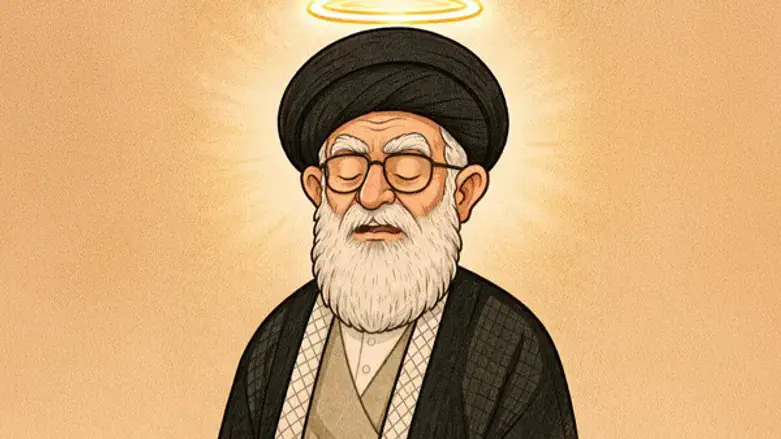
Who could forget the Washington Post's foolish unforced error in 2019 when its obituary for Abu Bakr al-Baghdadi, the self-proclaimed Caliph of ISIS, called him an "austere religious scholar"?
Apparently, the editors at the Washington Post forgot, because they printed an obituary for the Islamic Republic of Iran's Supreme Leader Ali Khamenei that makes its praise for al-Baghdadi look restrained.
It portrays Khamenei as a modest man, quoting him as saying "I consider myself a common religious student without any outstanding feature or special advantage," and provides details on his reading habits.
It even claims that Khamenei "declared [nuclear weapons] to be forbidden by Islam" and quotes him as saying he "issued a fatwa, based on Islamic teachings, forbidding the production of nuclear weapons."
"With his bushy white beard and easy smile, Ayatollah Khamenei cut a more avuncular figure in public than his perpetually scowling but much more revered mentor," author of the obituary William Branigin gushes.
The New York Times
The New York Times obituary writers, Alan Cowell and Farnaz Fassihi, must have been reading from the same set of notes when they wrote that Khamenei "affected an avuncular and magnanimous aloofness, running the country from a perch above the jousting of daily politics."
They portray Khamenei as an effective leader who "lacked his predecessor's charisma and mystique" but "cannily exploited political instabilities in the Middle East to extend Iran's reach."
Like Branigin, Cowell and Fassihi claim that "nuclear arms ... were banned by the ayatollah in a 2003 religious edict."
The Wall Street Journal
Obituaries are handled by the news division at the Wall Street Journal. It's hard to imagine the Editor of the Editorial Page, Paul A. Gigot, approving Sune Engel Rasmussen's Khamenei obituary, which opens with a sentence identifying him as "Supreme Leader Ayatollah Ali Khamenei, the austere cleric who ruled Iran for more than three decades and reshaped the balance of power across the Middle East."
And while Rasmussen doesn't call Khamenei "avuncular," he describes him as "A pragmatist as well as an ideologue" who "endorsed diplomacy when convenient" and held a "popelike position in the Shiite Muslim world: elected by a council of elders to convey the word of God."
He even goes so far as to credit Khamenei with making "progress in some important areas" including offering "some of the best healthcare and education in the region" and "boost[ing] female literacy rates."
Like his peers at the Washington Post and the New York Times, Rasmussen also appears to accept uncritically Khamenei's insistence that "the program was peaceful" and mentions that he "issued a religious pronouncement asserting that Iran wouldn't acquire nuclear arms."
What could compel journalists to praise an avowed enemy of the U.S., ignore his lies, downplay his nuclear program, and overlook his slaughter of thousands of Iranians and his genocidal campaign to destroy Israel?
Khamenei the Diplomat
The Khamenei-as-diplomat portrayal in the obituaries of the three most important American newspapers revolves around Barack Obama's Joint Comprehensive Plan of Action (JCPOA), the so-called "Iran nuclear deal" that rewarded Iran handsomely for doing very little and set the stage for a legal Iranian nuclear bomb.
All three obituaries misrepresent the JCPOA through both omission and commission.
First, the errors of commission.
The Washington Post states that the JCPOA "restricted Iran's nuclear program in exchange for the easing of crippling economic sanctions." The New York Times claims that it "restricted Iran's right to enrich uranium in exchange for the lifting of international sanctions." And the Wall Street Journal claims that it "granted Iran relief from sanctions in return for restrictions on its uranium enrichment program."
The error here is that Iran's "restrictions" were largely self-imposed and self-policed. Unlike Ronald Reagan's "trust but verify" approach to negotiations, Obama naively agreed to Iranian "self-inspections" of sensitive military sites.
In terms of omission, none of the three obituaries acknowledges the fact that had the U.S. not pulled out of the JCPOA and reinstated the "maximum pressure" sanctions, Iran's nuclear program would be mostly legal by now due to the JCPOA's sunset clauses.
Trump the Villain
Each obituary frames the U.S. pullout of the JCPOA as evidence of Trump's belligerence.
The New York Times is the most direct of the three with the claim that Khamenei's "mistrust was validated three years later, however, when Mr. Trump withdrew from the agreement, restoring sanctions and piling on new ones."
The Wall Street Journal puts the sense of validation in Khamanei's mouth: "After President Trump in 2018 withdrew from the historic nuclear pact that Iran struck with global powers in 2015, Khamenei said he was vindicated."
But the Washington Post actually provides cover for Khamenei's rush for nuclear breakout capacity and crossing the 90% enrichment threshold, with the claim that after Trump voided Obama's agreement, "In retaliation, Iran began disregarding some provisions of the nuclear deal."
In fact, Khamenei had been cheating on the JCPOA from the very start. None of the three obituaries reminds its readers of that fact.
The obituaries also subtly attempt to downplay Khamenei's desire for nuclear weapons, believing, it seems, his lie that the Islamic Republic is only interested in nuclear energy.
None asks why Iran denied IAEA inspectors access to the nuclear enrichment facilities it built deep underground or why a peaceful nuclear energy program would need underground facilities. None mentions that nuclear energy requires uranium enrichment of about 5% whereas Iran has admitted to having 460 kg of uranium at 60% enrichment.
Khamenei's Death
In their zeal to tell a story, Khamenei's elegists overlook the climax of their tale, studiously avoiding details, graphic or otherwise, about his death.
In nearly identical language, each concludes its opening paragraph by announcing that Khamenei "has died during U.S. and Israeli strikes against his country. He was 86" (Wall Street Journal); "died on Saturday during U.S. and Israeli military strikes on his country. He was 86" (New York Times); and "was killed Saturday as Israel and the United States launched a joint attack on Iran. He was 86" (Washington Post).
This staid, low-key announcement is very different from the way that Osama bin Laden's death was reported in 2011.
The Washington Post obituary for bin Laden starts out telling readers about a "surgical strike on his luxury hideout in Pakistan" and later adds that "Bin Laden was shot in the head after he and his guards resisted the U.S. attackers."
On May 2, 2011, the New York Times ran 90 articles analyzing bin Laden's death from every conceivable angle, including dramatic pieces like "Behind the Hunt for Bin Laden" and "The End of the Jihadist Dream." There was even one titled "Hamas Condemns the Killing of Bin Laden."
It's not hard to imagine how the details of Khamenei's demise would be told differently had a Democrat been president.
I suspect we would be reading dramatic pieces on how the overconfident dictator never saw it coming. Someone would likely observe that there would be no more fatwas or "Death to America" chants coming from the pile of rubble that had been Khamenei's hideaway since the 12-Day War. And there would certainly be praise for the (Democrat) president who ordered the lethal strike.
Conclusion
Khamenei's obituaries come as no surprise to anyone who follows media bias and understands how journalists increasingly side with America's enemies in general and our Islamist enemies in particular.
While claims that journalists are the enemies of the American people are hyperbolic, the Khamenei obituaries show that many of them are not the enemies of our enemies. The Washington Post, New York Times, and Wall Street Journal have demonstrated that they are not interested in portraying the world's number one supporter of terrorism, a man who has killed thousands of his own countrymen and women and threatened to wipe America off the map, as the villain that he was, preferring instead to humanize him, truth be damned.
Chief IPT Political Correspondent A.J. Caschetta is a principal lecturer at the Rochester Institute of Technology and a fellow at Campus Watch, a project of the Middle East Forum where he is also a Milstein fellow.