
The many parallels and contrasts between October 7, 2023 and February 28, 2026 were remarkable. One contrast that especially stood out for me personally was the armed reservist who ordered everyone in our Shabbat Simchat Torah minyan to go home on October 7. While on February 28 not only did the Torah reader, the ba’al korei, finish Parshat Zachor with the siren blaring, he repeated it four times, each time in a different nusach (style) before we all rushed into the mamad (safe room) for the hatforah.
It is no coincidence that Purim is preceded by Parshat Zachor. The parallels are manifest. We are commanded to remember Amalek’s genocidal designs immediately preceding the reading of Megillat Esther’s account of Amalek’s descendant, Haman, and his plan to wipe us out, only to be saved by the God-inspired Persian intrigues of Mordechai and Esther.
The parallel with the current Persian iteration of Haman’s genocidal plan and our response on Shabbat Zachor was also no coincidence. The sense of purpose we felt in my Tzafon Talpiot minyan as Zachor was being read was palpable. Still unbeknownst to us was the fact that Khamenei and his evil cohort were already sipping tea with Hassan Nasrallah and Yihya Sinwar Y"S - all of whom deliberately targeted innocent civilians. As we started to learn about the events of the day, remembering Amalek’s attack from the rear against the infirm and elderly at Refidim, only served to remind us of the upcoming Pesach Seder’s warning that in each generation they rise up against us to destroy us.
The theme of remembrance is one that permeates Jewish tradition, whether on Purim, Pesach Seder, Shabbat Zachor and for that matter on every Shabbat, as per the commandment to “remember the Shabbat day, to keep it holy." Our People’s collective and shared memory has been our single most unifying factor from time immemorial.
A few days prior to Shabbat Zachor, the International Committee for Har Hazeitim (The Mount of Olives) - ICHH, and government leadership came together to celebrate and dedicate a Visitor Education Center currently under construction on Har Hazeitim.
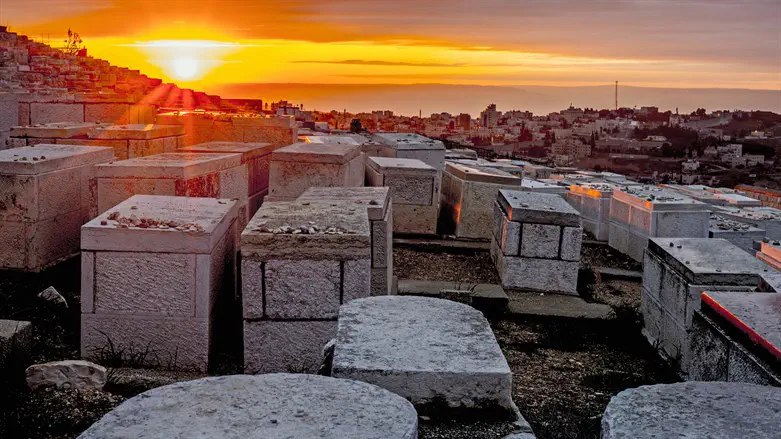
The 3000 year old Har Hazeitim cemetery is unquestionably the greatest repository of the Jewish People’s collective memory. Jews dreamed of being buried there for thousands of years. King David, fleeing his rebel son Absalom, is mentioned in the Tanach as ascending Har Hazeitim. This and more has to be made meaningful for Jewish youth today and in the future.
The Center, once completed, will serve as an educational and unifying tool that will expose student, tourist, soldier and scholar alike to the pantheon of Jewish leaders and gedolim (Sages) buried among 150,000 kedoshim (holy souls) from all walks of Jewish life.
For the past 15+ years, I have been privileged to work alongside the likes of international co-chairs Abe and Menachem Lubinsky and so many others who understood that the real agenda of the vandals, grave desecrators and stone throwers, et al., on Har Hazeitim was to intimidate visitors, thereby distancing us from our past and consequently depriving us of our future. As a result of the government’s and ICHH’s diligence and persistence, we have managed to reverse that pre-2010 intolerable reality.
Time and time again during our two day dedication ceremonies, Chief Rabbis, ambassadors, mayors, ministers and members of Knesset stressed the importance of remembering our shared history on Har Hazeitim in order to fulfill Am Yisrael’s shared destiny.
During the past decade and a half I have often been struck by the beauty and grace of my ICHH colleagues - Jews obviously from different backgrounds, locations and religious orientations - who have come together around the importance of preserving and promoting Har Hazeitim as the international cemetery of the Jewish People. Our original Knesset shdula (caucus), the largest by far in Knesset history, consisted of 67 MKs from the most Haredi to Meretz and everything in between, all if whom understood the importance of unifying around this holy mission.
Perhaps that has been the most profound take away from our efforts to restore and remember Har Hazeitim - the importance of cohering around common ground regardless of differences, as did the twelve tribes, all unified to defeat a genocidal Amalek when the Jewish People did not yet have the three millennia storied history of Har Hazeitim.
Likewise, Prime Minister Menachem Begin z"l who is buried directly behind the Visitor Center, understood the grave existential threat Saddam Hussein and his Osirak nuclear reactor posed to the people of Israel when he ordered its destruction in June 1981. Were our current leaders, many of whom visited Begin’s grave on his yahrzeit a couple of weeks ago, inspired by his example when they ordered last week’s attack on the genocidal Khamenei and his terrorist acolytes? Perhaps.
Clearly, we do not need to be attacked to find common cause. ICHH members, national and Jerusalem government officials, donors and activists have all come together to make the Visitor Center dream a reality.
This past Shabbat Parshat Parah we read about the Parah Adumah (red heifer), slaughtered, burnt and whose ashes were sprinkled on the Cohen Gadol (High Priest) on Har Hazeitim before entering the Kodesh Kedoshim (Holy of Holies) on Yom HaKippurim to pray for the welfare of Am Yisrael. The Parah Adumah is arguably THE quintessential chok (inexplicable Heavenly decree). Far easier to comprehend, though, is the role the Visitor Education Center will play as we celebrate our People’s glorious past and future - God-willing, without existential threats - on a revived Har Hazeitim.
Jeff Daube is the former Israel director of the Zionist Organization of America and the current Israel chair of the International Committee for Har Hazeitim (harhazeisim.org).