
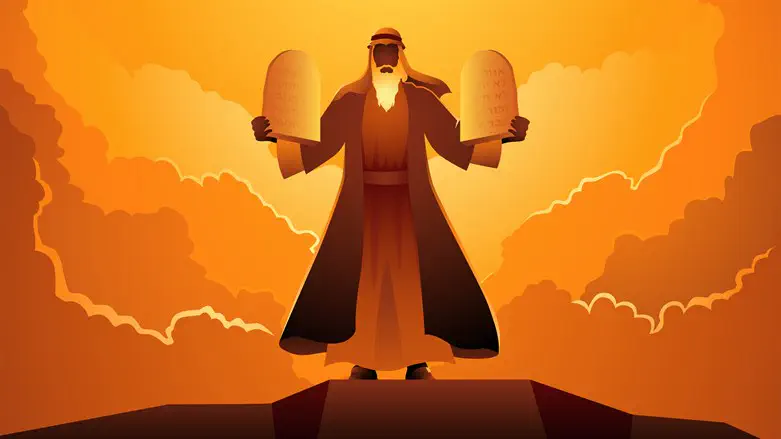
The Torah relates that: (31:18)’When’ Hashem ‘finished speaking to him on Mount Sinai, He gave Moses the two Tablets of Testimony, stone tablets inscribed by the finger of G-d’.
Rashi brings the Midrash Tanchuma::’When He had finished: בכלתו: here spelled defectively (without the first vav), as if to be read ככלתו: like his bride, the Torah was delivered to him’ to Moses, ‘as a gift, as a bride is given to a bridegroom, because otherwise he could not have learnt it all in such a short time.’
The Siftei Chachamin expounds, on this Rashi:’Hashem therefore delivered it to him, as a bride, meaning: that it should be bought by him.’
The Be’er beSadeh elucidates: It is not the habit of Rashi to comment on defective spelling - however, here, he did so because of the use of the comparative כ: like - when it should have said בכלתו : ‘when He finished speaking to him - led Rashi to expound that the Torah was delivered to Moses ln the manner of the bride who is ‘acquired’ by the groom, without payment and without a price.’
Our Sages (Nedarim 38.) comment:’’And He gave to Moses’: Rabbi Yochanan said:’Initially Moses learnt the Torah, but forgot it, until it was given to him by way of a present, as it says:’And He gave to Moses..’.
Rav Baruch Halevi Epstein comments on this gemara:’There is no doubt that it was not due to natural forgetfulness, that Moses forgot the Torah that he had learnt, as he is known for his exceptional talents; it therefore appears to me that the fogetfulnes was intentionally from Hashem, that he forget what he had learnt - however, the intention of this is not clear, and the Maharsha had difficulty in explaining it.
‘However, I did find an explanation for this in the Yerushalmi (Horayot 3:8) , where this very saying is also brought in the name of Rabbi Yochanan: all the forty days that Moses was on the mountain he learnt Torah and forgot it, until it was given to him as a present - why all this ? To put the fools on the right track, that one who learns and then forgets because of his defective memory, should not say to himself: ’Why should I toil for nought, since I forget what I learn.’
‘The answer to him is that even Moses forgot what he learnt, yet nevertheless, learnt until it was given to him as a present, and was not forgotten.
‘So too, every person should learn, until he, too, receives it as a gift, and no longer forgets.
‘Further, we are taught in Mas’ Avoda Zara (19.): One should always learn, even though he forgets what he has learnt - clearly based on our Yerushalmi.’
Abarbanel notes: ‘There are commentators who thought that this parsha should have been written after Parashat :’And these are the ordinances’, as, in their view, it was said there:(24:12-18)’And Hashem said to Moses: ascend to Me on the mountain, and be there, and I will give to you the Tablets of stone.. and Moses came into the cloud..’and Moses was there on the mountain, for forty days..’ - and this is followed closely by our passuk:’And He gave..’, and then the event of the golden calf, after which Hashem commanded Moses to carve Tablets like the first ones, and Moses ascended the mountain, and his face shone, and he then received the command to build the Sanctuary.
‘This is not my view - which is that the parshiot are written in their chronological order.
‘After the parsha of ‘And these are the ordinances’, Hashem commanded Moses to ascend the mountain to receive the Torah , the Mitzvot and the Tablets, and - in the same meeting - commanded him to make the Sanctuary, the priestly garments and the animal offerings.
‘After this was completed - as is written in the parshiot - then ‘And He gave Moses, after He finished to talk to him’, meaning: once He had finiished talking with him as to the making of the Sanctuary and matters incidental to it, He then gave him the two Tablets of stone - and, as Moses was then prepared to descend, Bnei Israel made the calf, and Moses descended and shattered the Tablets, and judged the transgressors.
‘Moses then ascended, to pray for the people, and Hashem commanded him to prepare two stone Tablets, like the first ones, and he ascended and Hashem was appeased by him, and showed him His glory and the rays that shone on his face; when he descended, he gathered the people and commanded them to make the Sanctuary - so all the parshiot come in their chronological order, as the events occurred, without there being any difficulty.
‘The words:’And He gave to Moses..’, refers to Hashem who is mentioned above, and called them ‘Tablets of testimony’, as they were testimony to the Torah which was given at Sinai, to Israel, who heard the ten commandments as they were inscribed on the tablets - and as they were stone in the form of of thin tablets, they were therefore called ‘tablets’, as they were in the nature of tablets on which people inscribe writing.
‘As I have previously said, Hashem wanted to write the main principles of the Torah, on these stones, so that they should always remain whole, testifying to the eternal nature of the Torah - the tablets were thin so that they were not too heavy to be carried.’
Malbim expounds :’The gift of the Torah occurred at the end of forty days, at the beginning of which period Moses learnt and forgot what he had learnt, until - at the end of the forty days - the Torah was given to him, as a gift.
‘Our Sages add - from the Torah using the word ככלתו - that at the beginning, Hashem spoke to Moses, but at the end, Hashem said to him: ’Come, and we will say, I and you’. This, because his forty days stay on the mountain, cast from him his physical side, until he was - like the angels - a spiritual being, separated from the physical - for which, forty days were required, being the same period for the creation of a baby.
‘Until this period had elapsed, Moses had not yet cast off his physical side, and his comprehension was limited - like an intellect connected to physical matter, which meant that it was not free of forgetfulness - like writing on a piece of paper, which was erased several times, in the course of time.
‘This was the situation, until the forty days period was completed, when the physical cloud was lifted from him, and he attained comprehension like the angels, who have instant understanding - and, from that time, he learnt and did not forget.
‘This is what Hashem said to Moses: ‘Come, snd let us say, Me and you’, as the intellect stripped of the physical side, does not require to hear or to learn, as it, from itself, understands, as we saw at Matan Torah, when it said - of the angels - ‘Doing His bidding’, and then:’Hearing His voice’, as they understood everything from themselves.
‘This is why Hashem said to Moses :’Come, and let us say, Me and you’ - as you will understand everything before I say it to you ‘ - as if the two of them were saying it at the same time.’
The Alshich Hakadosh opens his commentary, by exclaiming :’Every heart will shudder, at the thought that Hashem permitted that calamity to befall His people - the golden calf - as, but for Hashem’s mercy, His people would have been destroyed, and the world returned to nothingness..
‘As to why Hashem did not ensure that Moses returned, and thereby spared the people from their transgression, the Torah preceded, by giving us a goodly reason, saying:’And He gave Moses ככלתו, to speak with him’, as to which several queries arise: Could it be that until the expiry of forty days, Hashem did not cease to speak with Moses; saying.
‘To answer all this, our Sages in Midrash Tanchuma, relate that Hashem spoke to Moses, and taught him Torah, and further - that at the end of this forty days, He gave it to him, as a gift - why didn’t Hashem do so during the forty days, and, if it was because Moses could not acquire it before then, why did Hashem teach him in these days, when He knew that he would forget what he had learnt - more so, when, in the natural order, the forgetfulness would gradually decrease, till it was overcome - and, this being so, why is it called ‘a gift’?
‘Hashem wanted all to know that any difficulty in learning, was not due to Him, but rather because our physicality is what causes this.
‘He wanted to give Bnei Israel merit, by the hands of the choicest of Mankind - Moses Rabbeinu - in two matters, as one: to teach him the whole of the oral Torah, in all of its details - present and future; second, to give him hand-to-hand the Tablets, they being the whole of the written Torah, as through them man cleaves to his Creator, so that his physicality would not prevent him receiving them from ‘the hand of Hashem’.
‘This raises a great query, as, we don’t find that even the angels are able to receive hand-to-hand, from Hashem.
‘For this, it was necessary that Moses dwelled for forty days on the mountain - like the period for the birth of a child - for his physicality to be transformed, to spirituality.
‘When this period elapsed, and the spirituality was attained, only then was it possible for Moses to learn and to receive the oral Torah - and not forget, AND also, to receive the Tablets hand-to-hand - the transformation by hearing the voice of Hashem.
‘At the end of the necessary speaking by Hashem - which was the expiration of the forty days - only then, was the preparation complete, and all that Moses had learnt in the forty days, he then forgot - which should have meant that more time was required, but, as this would likely lead to the people justifying their transgression - as being due to the delay - Hashem, at the end of the forty days, gave the Torah to Moses ‘as a gift’, and also gave him the two Tablets hand-to-hand.
‘This is why Hashem did not do so before the expiration of the forty days, when He gave it to him by His speech, as hand-to-hand, being by way of Moses cleaving to his Creator.’
Rav Moses Sternbuch adds, on ‘the Luchot being given as a gift, like a bride to a groom, that ‘it alludes to those who learn Torah, that they need to seek to acquire Torah, like a groom who ‘acquires’ his bride - not by casual learning, as in other areas - and, as with husband and wife, to cleave until they are ‘as one flesh’, his wife being as his own body.
‘So too, should he cleave to the Torah, in his love of it, it always being foremost on his mind, and all his thoughts in the engagement in Torah, and his yearning for it, just as for his bride.
A parting gem, from Rav Avigdor Nebenzahl:’Hashem knew - as all is revealed to Him, that Moses would - despite his daily toil - forget the Torah that he learnt each of the forty days, before it was given to him by Hashem, as a gift.
‘Why, then, did Hashem let His most faithful servant toil for nought, for forty days and nights?
‘The answer:true that by human toil alone it is not possible to acquire the Torah, as to do so, requires a gift from Above.
‘However, without the preceding toil, the gift from Above will not be given.
‘This applied to everyone of us - from time to time, there arises the thought in the heart of man: If, in any event, we are going to fo forget what we learnt, why bother toiling and learning? - the answer: do so, because if you toil and strive - you WILL receive it in the end, as a gift.
‘The mussar we learn from this episode, is that the toil and striving are the sole means of receiving the gift from Above.’
לרפואת נועם עליזה בת זהבה רבקה ונחום אלימלך רפאל בן זהבה רבקה, בתוך שאר חולי עמנו