
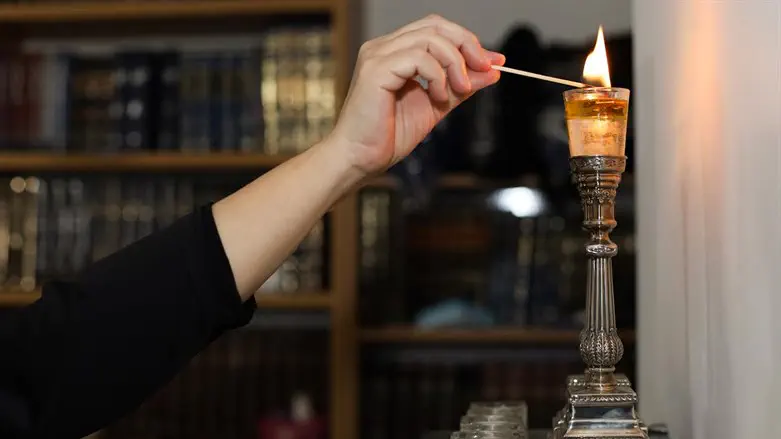
Each Friday I try to end the week by saying Shabbat Shalom to people who have made a difference over the past week, those who have stood up, spoken clearly, or helped move things forward when it mattered.Sometimes that difference comes from building something meaningful. Sometimes from telling uncomfortable truths. Sometimes from bringing people together when others would rather divide.
Every week the names will change, but the idea remains the same: to recognise those who move things forward, often quietly, often against the odds and often without the recognition they deserve.
The list may include individuals standing up to intimidation, leaders showing clarity when others hesitate or writers, thinkers and bridge-builders reminding us who we are.
This week, the thread that connects them is simple.
They refused to be intimidated.
So this week, I want to say Shabbat Shalom to the following people and institutions.
Shabbat Shalom to Raffi Berg.
This Friday, BBC Middle East editor Raffi Berg will have the first hearing in his libel case against Guardian columnist Owen Jones.
The case follows an article Jones published on Drop Site News last December titled “The BBC’s Civil War Over Gaza." In that piece, Berg was accused of being central to what Jones described as a culture of “systematic Israeli propaganda" within the corporation.
What followed was depressingly predictable. In the weeks after the article appeared, dozens of social media accounts began targeting Berg with abuse and threats, many of them explicitly referencing his Jewish identity.
He was called a “pig," “Zionist scum," “Nazi," “Child killer." Others accused him of being a child abuser and issued graphic death threats. This is the ecosystem reckless accusations create.
Until now, almost nobody has been willing to challenge it, but Raffi Berg has.
By bringing a libel case he is forcing one of the loudest voices in the anti-Israel commentariat to defend his claims in court.
That really matters, not because journalists should be immune from criticism, far from it, journalism depends on scrutiny. But when accusations cross the line into defamation and incitement, those targeted should not simply be expected to absorb the consequences.
The mob relies on intimidation, standing up to it breaks the spell.
Shabbat Shalom to the man who chose to stand up rather than be shouted down and to everyone brave enough to defend truth when intimidation is the weapon being used against them.
Photo: Owen Jones speaking at a Pro-Palestine rally in London 2024
Shabbat Shalom to Canada and Australia.
Over the past two and a half years antisemitism has surged across much of the Western world. Canada and Australia have been among the countries where that surge has been most visible and where government responses have too often been slow, hesitant, or absent.
In Australia the Bondi massacre, in which Jews were specifically targeted, did not emerge in a vacuum. It followed months of escalating hostility in which Jewish communities repeatedly warned that the atmosphere in the country was becoming more dangerous by the week.
In Canada the situation has been equally alarming. Synagogues in Toronto have faced arson attacks, gunfire and repeated intimidation, while Jewish schools and community buildings have required unprecedented security simply to operate.
This is what happens when antisemitism is allowed to metastasise unchecked.
It is a tragedy that it has taken dead Jews, intimidated Jews, frightened Jews for political leaders to begin recognising the scale of the problem. A tragedy that Jewish communities had to sound the alarm again and again before anyone truly listened.
It is equally tragic that in today’s climate it is considered remarkable for Western governments to say something that once would have been entirely uncontroversial: that they stand shoulder to shoulder with the United States and Israel in confronting the world’s leading sponsor of terrorism.
But this week that is precisely what happened.
Both Canadian Prime Minister Mark Carney and Australian Prime Minister Anthony Albanese were unequivocal in supporting the United States and Israel in their actions against the Iranian regime.
Iran is not simply another geopolitical rival, it is the single greatest state sponsor of terrorism in the world today. From Hezbollah to Hamas, from militias in Iraq to the Houthis in Yemen, its fingerprints are everywhere.
If the goal is peace, genuine peace, then confronting the regime that bankrolls perpetual war is unavoidable.
It should not be extraordinary to say so, but in the current climate, it is and so when leaders do speak clearly, it matters.
Shabbat Shalom to the countries willing to draw a line in the sand and to the leaders prepared to confront the forces that profit from chaos and terror.
Photo: Canada's Prime Minister Mark Carney, center, gestures to Daniel Mulino, Australian Assistant Treasurer as he is introduced at the start of a signing ceremony in Sydney, Feb 2026
Shabbat Shalom to Howard Jacobson.
Howard Jacobson is often described as one of the great Jewish writers of our time. Personally, I think the first half of that description is unnecessary. He is simply one of the great writers of our time.
If you haven’t read Kalooki Nights, The Finkler Question, or The Act of Love, you are poorer for it.
But his latest novel, Howl, may prove to be the most important thing he has written. The book is not about the October 7th massacre itself. Instead, Jacobson sets out to understand something many Jews have found even harder to comprehend, the reaction that followed.
Across parts of the educated West, the murder of Jews was not simply rationalised, it was celebrated.
The novel takes its title from Allen Ginsberg’s famous poem, whose opening line serves as the epigraph:
“I saw the best minds of my generation destroyed by madness."
The double meaning is devastating. On one level it captures the moral collapse of otherwise intelligent people whose hatred of the Jewish state strips away their sense of right and wrong. On another it reflects the disorientation felt by Jews across the world as we watched that collapse unfold.
But Jacobson’s Shabbat Shalom this week is not simply for writing a powerful book, it is for writing it now.
Here is a writer with far more to lose than to gain by telling this story. Yes, Jacobson has long written about Jewish life and Jewish identity, but rarely has there been a moment when speaking about those things carried such professional, personal and social risk.
Across large parts of the creative industries Jewish voices are being marginalised, shouted down, or quietly cancelled. To publish a novel confronting the moral failure of the West in the aftermath of October 7th is not merely an act of literary ambition. It is an act of intellectual courage.
Howl may be exactly the kind of novel we expect from a writer of Jacobson’s stature, but that should not diminish the bravery required to write it, nor the gratitude we should feel for the testament to this moment that he has now immortalised.
Great writers capture the emotional truth of their time, Jacobson has done exactly that.
Shabbat Shalom to the writer who refused to soften the truth and to those who continue to give voice to a Jewish story that others would prefer remained untold.
Photo: Novelist Howard Jacobson with his new book, Howl, Feb 2026
Shabbat Shalom to Rabbi Dovid Lewis and Imam Nasser Kurdy.
In an age increasingly defined by shouting, one of the bravest things anyone can do is simply sit down and talk. Rabbi Dovid Lewis and Imam Nasser Kurdy host the podcast “The Rabbi and the Imam." Its premise is simple: two men from different faiths speaking honestly to one another about some of the most difficult issues facing Jews and Muslims today.
Sometimes they agree, often they don’t, but they always listen.
What makes their work particularly powerful is that both men understand, personally, the cost of hatred. Imam Nasser Kurdy survived a brutal attack in 2017 when he was stabbed in the neck outside his mosque in Altrincham. Rabbi Dovid Lewis comes from Manchester’s Heaton Park community, a community that has experienced its own devastating violence. Last year Jews were murdered while worshipping on Yom Kippur, and his own cousin, Rabbi Eli Schlanger, was among those murdered on Bondi Beach in December.
These are not abstract debates for either of them, both men know exactly what hatred looks like and yet, rather than retreating into silence or fear, they have chosen the harder path.
They continue to speak, they continue to listen, they continue to insist that dialogue is not weakness.
At a time when many voices demand we retreat into our own corners, they are demonstrating something our communities desperately need to remember. A better future is only possible if we are brave enough to talk to one another, even when the world is trying to frighten us into silence.
At the end of April they will appear together on stage in London. If you can attend, go. Better still, take your children and grandchildren with you.
Shabbat Shalom to the men who refuse to be intimidated into silence and to those who still believe that dialogue, courage and humanity can build a future stronger than hatred.
Photo: Rabbi Dovid Lewis and Imam Nasser Kurdy
Every week there are people who move the world forward. Not always with grand gestures, sometimes simply by standing firm when others would prefer they stayed quiet.
This week’s Shabbat Shalom recognises just a few of those people, but they will not be the last.
So if someone made a difference this week, by telling the truth, building something meaningful, defending others, or refusing to be intimidated, add their name.
Because courage has a way of spreading and when we recognise it, celebrate it, and shine a light on it, we make it easier for others to find the strength to do the same.
At a time when intimidation and silence are too often rewarded, that matters more than ever.
If you’ve seen someone make a difference this week, in your community, in your workplace, or simply by standing up when it mattered, tell me. Because there are far more people worthy of a Shabbat Shalom than can fit into a single column.
Shabbat Shalom. And may we never stop recognising those who make a difference.
Leo Pearlman is a London based producer and a loud and proud Zionist. His most recent film about the Oct 7 Nova Music Festival massacre, ‘We Will Dance Again’ has won the 2025 Emmy of the 46th Annual News & Documentary Awards for most ‘Outstanding Current Affairs Documentary’.