
The demand for the average westerner to "think like a Shiite" might sound to many like a provocation, an excessive or even absurd request. Except for those combatants who "had the privilege" of knowing Hezbollah terrorists up close in Lebanon, or researchers who have dived into the depths of their psyche, most of us struggle to crack the genetic code of our Shia enemies. The bitter truth is that if we struggle to understand even the logic of moderate Sunni Muslims, it is no wonder that Western commentators fall time and again into the trap of "the conception" (preconceived notions) regarding Iran.
The West, with its institutions and pundits, insists on applying rational western - liberal tools to an Eastern reality driven by religious impulses and an apocalyptic vision. They seek "absolute surrender agreements" and sustainable peace, while in the Muslim Middle East in general, and the Shia world in particular, this concept simply does not exist. For the Ayatollah regime, any agreement is at most a "Hudna"-a temporary truce designed to allow for recovery, rearmament, and capacity building toward breaking the agreement at a more convenient time.
Anyone who expects that signing a piece of paper, without dismantling the regime's foundations and destroying its forces, will lead to the voluntary dissolution of the Ayatollah regime, nuclear disarmament, and the permanent abandonment of long-range missiles, is not living in the Shia-religious reality. Such an agreement would be a "lamentation for generations"; it will not prevent the next war, but only slightly delay it, ensuring it will be manifold more complex, dangerous, and cruel.
To understand this, one need only mention a phrase every U.S Marine and Israeli combatant who served in Lebanon knows: "Shia suicide bomber". While the West views this as an act of madness or despair, in the Shia worldview, it is a supreme and uncompromising sacrifice. This is not a random death, but the fulfilment of a noble goal that guarantees reward in the afterlife. This mindset, which sanctifies death as a political and strategic tool, is the window to understanding the path that led Iran, Hezbollah, and the Houthis into the current war against Israel and the U.S.
Attempting to understand the Shia mindset requires deep familiarity with the historical split and the bitter rivalry with the Sunnis since the days of Imam Hussein. Without understanding the perception of death and redemption in this religion, we will continue to interpret the Ayatollahs' steps as a delusional "death wish" or as seemingly irrational moves. Yet for them, it is a strategy driven by an ordered religious ideology. If U.S, Israel and the free world do not learn to speak this language, we may find ourselves signed on agreements written in ink, but destined to be broken in blood.
One Does Not Scare the Angel of Death with Death
The perception of death in Shia Islam weaves religious principles with a profound historical narrative of suffering, sacrifice, and a yearning for redemption. While death is viewed as a necessary transition to the afterlife, in Shia it is saturated with the significance of pursuing justice and connecting to the afflictions of Prophet Muhammad’s family. At the heart of this concept lies the ideal of "Shahada" (martyrdom), which distinguishes between natural death and the sacrificial death of the "Shahid." This model was shaped by the figure of Muhammad’s grandson and the third of the twelve Imams, Hussein ibn Ali, known as the "Father of Martyrs," who was killed in 680 AD at the Battle of Karbala. This was a formative battle in which Hussein and 72 of his family members and companions were slaughtered by the army of Yazid the first, of the Umayyad dynasty. The battle, which included siege and starvation, ended on the tenth day (the day of "Ashura") with Hussein’s decapitation and his head being sent to Yazid in Damascus. This battle led to the bloodiest religious and political split in Islamic history-between Sunnis and Shiites-the echoes of which are still felt today.
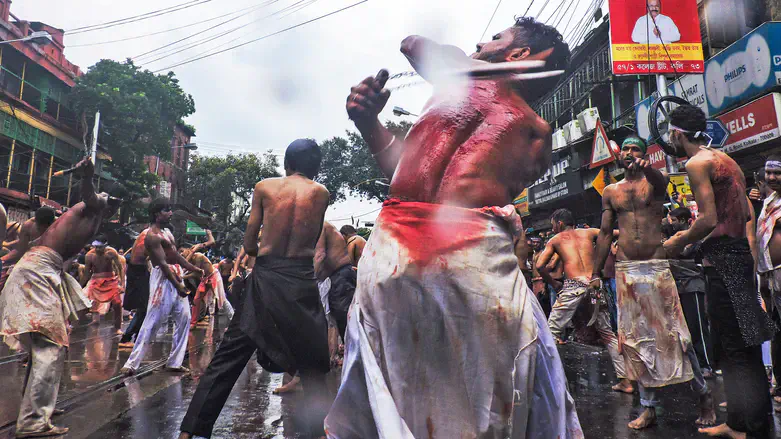
For the Shia believer, the Battle of Karbala is not merely a historical event but a consciousness-shaping heroic symbol. On one hand, it embodies a "victim mentality" accompanied by feelings of grief and guilt over the abandonment of Hussein, expressed in Ashura rituals that include self-flagellation as a means of drawing closer to God through suffering. On the other hand, death for the sake of justice is perceived as a spiritual victory and a steadfast, uncompromising stance against tyranny. Shiites believe there is a tight link between individual death and collective redemption: suffering in this world will be compensated in the next, where Imams Ali and Hussein will serve as intercessors for the believers, especially for those who earned the status of martyrs.
In contrast to the Western perception which sanctifies life, the Shia faith views death as a stage toward absolute justice and the blood-vengeance of the oppressed upon the return of the "Hidden Imam," Muhammad al-Mahdi, the 12th and final Imam in the lineage of the Prophet’s successors. While in the past, the expectation for the Mahdi was passive-a quiet waiting-since the 1979 Islamic Revolution in Iran, a dramatic shift has occurred: believers are now required to actively "prepare the ground" for his arrival through religious rule and struggle. This worldview, instilled in Iran for nearly half a century, raises the question: can a Western military attack, however prolonged, undermine such deep and rooted psychological foundations?
Concluding Thoughts
The legacy of Hussein ibn Ali, the "Father of Martyrs," who fought to the end against the tyranny of the Umayyad dynasty despite being vastly outnumbered, remains a source of inspiration for the Ayatollah regime to this day. In their view, the modern struggle against "Western tyranny"-represented by the Trump administration and its strategic alliance with Israel (the "Zionists")-is a contemporary reincarnation of the Battle of Karbala, with president Donald Trump cast as the "modern-day Yazid." The religious-cultural proximity between the Christian West and the Jewish state is perceived as a united front of the "Great Satan" and the "Little Satan," supported by moderate Sunni nations, aiming to impose nuclear disarmament and military containment on Iran under the guise of human rights concerns.
Contrary to Western perception, the conduct of the Ayatollah regime is considered entirely rational when viewed through a Shia-religious lens. For them, this is not "suicide" in the face of superior Western power-an act forbidden by Islamic law as it stems from personal despair-but rather "Shahada": a conscious sacrifice for a supreme religious cause. Therefore, as long as this radical ideology guides Iran’s leadership, it appears that only regime change in favor of a much more moderate government could lead to the long-awaited dramatic shift in the Middle East and end a half-century of terror and regional destabilization.
The West must not be mistaken: any agreement offered to the Iranians will be interpreted by them as a mere "Hudna" (truce). The Ayatollahs will not abandon their nuclear vision or their terrorist proxies out of concern for human rights or economic welfare. From their perspective, they are at the height of a "modern-day Battle of Karbala" against the Great and Little Satans-a struggle in which spiritual victory is guaranteed, even at the cost of temporary material suffering. This is the essence of a holy war - “Jihad".