
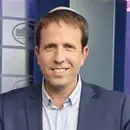
Public diplomacy expert Ran Bar-Yoshafat, speaking to Arutz Sheva-Israel National News, says Israel should not delay action against Iran while waiting for the US and must instead prioritize its own national security interests, while also dramatically strengthening its public diplomacy efforts to counter hostile narratives in the global information arena.
Speaking in a studio interview, Bar-Yoshafat said that while only US President Donald Trump ultimately knows whether and when the United States would act, Israel should not base its security decisions on American timelines or internal political considerations.
“Only one person really has the answer for this, and that is President Trump," Bar-Yoshafat said. “But I’m going to give you a different perspective. I think Trump likes winners. The reason why Trump joined the previous attack was because Israel started it and was doing very well. I don’t see why we need to wait for the Americans. This is first and foremost Israel’s interest."
Bar-Yoshafat suggested that Trump may prefer Israel to take the initiative, noting reports that some of Trump’s advisers believe the president does not want to be seen as initiating another military conflict, particularly amid domestic concerns among American voters.
“I have a feeling that Trump, being a person who really likes the winning side, might join in if Israel acts," Bar-Yoshafat said. “But Israel should not wait."
At the same time, Bar-Yoshafat expressed the view that Israel has operational capabilities beyond relying solely on large-scale American military assets, and said there were alternative ways Israel could address Iranian nuclear infrastructure if necessary.
“I was kind of upset that the Americans jumped on the bandwagon and joined the attack," he said. “Israel did pretty well, and there are other ways to destroy nuclear facilities. It doesn’t have to be with B-52 bombers. There are other operations that could be carried out."
Despite his strong support for the US-Israel alliance, Bar-Yoshafat emphasized that each country must act primarily in its own interest.
“I’m a big fan of America. Trump has been, in my opinion, the best president Israel has ever had, and I appreciate him," he said. “But Americans should not bleed over Israeli wars. That’s not good for Israel and not good for Americans. Americans should be America first, and Israel should be Israel first."
Bar-Yoshafat also addressed the broader global implications of Iran’s nuclear ambitions, warning that a nuclear Iran would pose a direct threat not only to Israel but to Western countries worldwide.
“The nuclear issue is really not just an Israeli issue, it’s a world issue," he said. “Once Iran has nuclear capabilities, they can threaten not only Israel, but Europe and even the United States."
He also pointed to Iran’s network of regional proxies, including armed groups in Yemen, Iraq, and Syria, as part of a broader strategy aimed at expanding Iranian influence and confronting Western powers.
“Israel is called the ‘little Satan’ and America is called the ‘big Satan,’" Bar-Yoshafat said. “If people think Iran would stop after threatening Israel, they are mistaken. Israel is just one part of a larger confrontation."
Bar-Yoshafat acknowledged the complexity of the situation, noting that Israeli and American interests often overlap but do not always require identical military roles.
“Regardless of what the Americans do, it is Israel’s responsibility to protect its own citizens," he said. “We cannot wait until Iran has nuclear weapons or fully developed ballistic capabilities that could devastate Israel’s infrastructure."
At the same time, he said it remains in America’s interest to prevent Iran from acquiring nuclear weapons, both for national security and to maintain global credibility.
“If America makes promises and does not follow through, it could damage its reputation globally," he said. “It could be worse than Afghanistan in terms of credibility."
Bar-Yoshafat also addressed growing debate within the US, particularly among isolationist voices on both the political right and left, about whether supporting Israel serves American interests.
He rejected claims that Israel is a liability, arguing instead that Israel provides strategic value to the United States through intelligence sharing, technological innovation, and regional stability.
“I’m going to quote an American general who said Israel is the biggest aircraft carrier America has that cannot be sunk," he said. “The values we share and the cooperation between our countries are extremely strong."
Turning to public diplomacy, Bar-Yoshafat said Israel faces a major challenge in communicating its narrative effectively to global audiences. He expressed discomfort with the Hebrew term “hasbara," which translates to “explanation," arguing that Israel should focus less on defending itself rhetorically and more on proactively telling its story.
“I don’t like the word ‘hasbara,’ because it already assumes you did something wrong and now you must explain," he said. “We need to improve Israel’s image by telling the truth and sharing what is actually happening."
He criticized what he described as an imbalance in the global media landscape, where anti-Israel voices operate continuously while Israel lacks a comparable, independent platform capable of reaching large international audiences.
“The other side is playing on an open field," Bar-Yoshafat said. “There is no strong voice constantly presenting Israel’s perspective and providing factual information."
He said Israel should invest significantly more in providing information, tools, and media access to individuals on the ground, including soldiers, journalists, and independent content creators who can communicate directly with international audiences.
“In today’s world, public diplomacy is not just conducted by governments," he said. “It is conducted by individuals, organizations, and media platforms."
Bar-Yoshafat also argued that official government spokespeople often face credibility challenges simply because they represent state institutions, making independent voices especially important in shaping public opinion.
“If a government official speaks, people may immediately be suspicious," he said. “But independent voices can sometimes be more persuasive."
He noted that figures such as Charlie Kirk have made a significant impact in amplifying Israel’s perspective abroad. “Charlie Kirk understood the importance of communicating Israel’s story to audiences in America and beyond," Bar-Yoshafat said. “Through his outreach, including letters to leaders like Prime Minister Netanyahu, he helped strengthen Israel’s image and ensure that Israel’s perspective is heard in influential circles that might otherwise overlook it."
Bar-Yoshafat also highlighted the recent wave of terror attacks in Judea and Samaria, emphasizing the urgency of sharing this reality with global audiences. “Last month alone, there were over 300 attempted terror attacks targeting Israeli civilians in Judea and Samaria, but nobody in America heard about these attacks," he said. “The world must understand the scope of these attacks and the threats faced by ordinary Israelis on a daily basis. Public diplomacy should convey these facts clearly to counter misinformation and highlight Israel’s security challenges."
Bar-Yoshafat further criticized international media outlets, including Al Jazeera, for spreading biased coverage against Israel. “Al Jazeera and similar networks present a distorted narrative that often ignores the security threats Israel faces," he said. “This only reinforces misinformation globally, making it even more essential for Israel to have a media outlet to constantly spread information about what is happening in Israel, to proactively share accurate information and present the reality on the ground."
He added that another problem is that Israel always wants it as a “win-win" situation, they’ll say we’re committing an ethnic cleansing, we’ve invented the flash drive, and the cherry tomatoes. I don’t think that’s the way to work; we are not saying that the other side is committing ethnic cleansing. We don’t want to bash the other side, but unfortunately, that is the war of images. He concluded by emphasizing that modern warfare extends beyond military operations to include information, perception, and global public opinion.
“In today’s world, the tank and infantry will only go as far as social media allows," Bar-Yoshafat said. “Israel is not doing enough to spread this information, and we don’t have a media outlet that basically focuses on sharing our narrative, our story. This mission of telling Israel’s story, sharing information, and presenting the truth is absolutely critical."